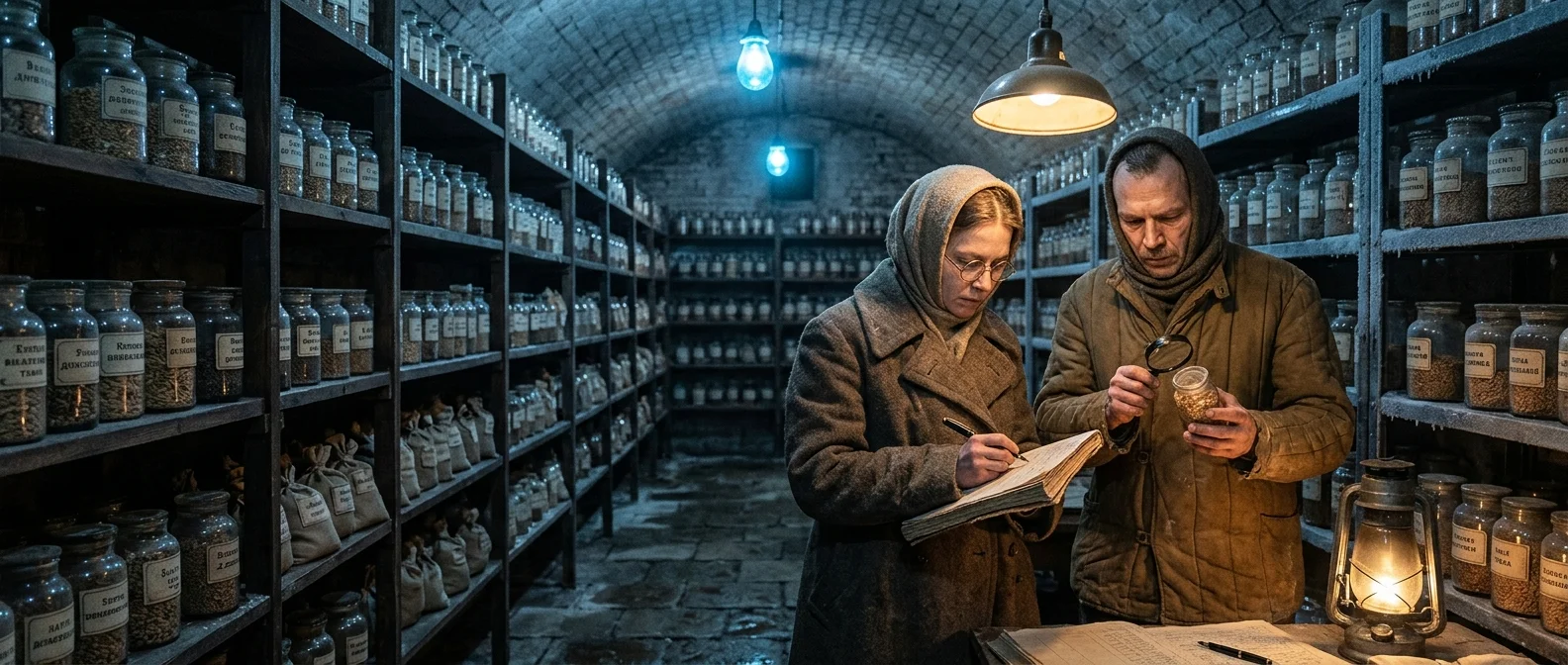
Picture this: you're starving. You haven't eaten in days. Around you sit tons of rice, wheat, potatoes, lentils — enough food to keep you alive for months. You have the keys. You could eat anytime. But you don't. You die of hunger instead. This happened to 12 scientists during the Siege of Leningrad. They chose death over destroying what they believed could save humanity's future. That seed bank still exists today — and it might be the only thing standing between us and agricultural collapse.
📖 Read more: Beetles Navigate Using the Milky Way: Mind-Blowing Discovery
📖 Read more: 52 Hertz Whale: The World's Loneliest Whale Calls
Nikolai Vavilov: The Visionary Behind the Collection
Born in Moscow in 1887, Nikolai Vavilov dedicated his life to one obsession: genetic diversity would determine whether humanity ate or starved. He traveled to 64 countries across five continents, collecting over 250,000 samples of seeds, plants, and fruits — the world's largest collection of plant genetic material at the time. His breakthrough discovery identified specific geographic zones where crop genetic diversity concentrated — the "Vavilov centers of origin" — a concept that remains fundamental to agricultural botany today. These centers include Mesopotamia, the Andes, Ethiopia, and Southeast Asia. Vavilov wasn't just collecting seeds. He was collecting insurance policies. He understood that the real treasure wasn't hidden in cutting-edge laboratories but in the fields of farmers who'd been growing the same plants for thousands of years. He crossed hostile terrain, Afghan mountains, and North African deserts, often risking his life for a handful of seeds that looked worthless to everyone else.
The Ultimate Test: Starvation in a Room Full of Food
September 1941: the Wehrmacht encircled Leningrad. The siege lasted 872 days — nearly 900,000 civilians died, mostly from starvation. Inside the city sat the Institute of Plant Industry (VIR), founded by Vavilov, housing the world's largest seed collection. The irony was unbearable: staff members were surrounded by sacks of grain, potatoes, rice — enough food for weeks. They didn't touch a single seed. Botanist Dmitri Ivanov died at his desk, surrounded by bags of rice. Alexander Stchukin died guarding potatoes and peanuts. At least 12 scientists starved to death inside the institute. The most heartbreaking detail? Each one had keys to the seed storage rooms. They could have opened any door and eaten at any moment. Not one did — not once, not ever. They believed these seeds represented something bigger than their own lives.
📖 Read more: Tardigrades: The Immortal Microscopic Bears

Why Seeds Are Worth More Than Gold
A seed isn't just food — it's information. Every local variety of wheat, rice, or potato carries unique genetic combinations: drought resistance, fungal immunity, adaptation to salty soils. Modern agriculture relies on a handful of high-yield varieties — just three plants (rice, wheat, corn) provide over 50% of global calories. This monoculture is extremely vulnerable. The Irish Potato Famine (1845-1852) proves the point: one disease (Phytophthora infestans) destroyed entire harvests because all plants were genetically identical. The genetic diversity that Vavilov's scientists protected was exactly this: insurance against future disasters.
📖 Read more: DNA Test Reveals You're Not Your Mother
Svalbard: The Modern Noah's Ark
In 2008, inspired partly by Vavilov's legacy, the Svalbard Global Seed Vault opened in Norway's Arctic. Located 120 meters inside a mountain in the Arctic Circle, maintained at -18°C, it's designed to survive earthquakes, bombing, even complete electrical grid failure — the permafrost keeps seeds frozen naturally. It houses over 1.3 million seed samples from nearly every country. In 2015, Syria became the first nation to request seeds back — the genetic bank at ICARDA in Aleppo had been destroyed in the civil war.
The Crisis of Genetic Erosion
According to the FAO, the world has lost approximately 75% of agricultural genetic diversity during the 20th century. Varieties cultivated for centuries were replaced by uniform hybrid varieties of the Green Revolution. India, which once grew over 30,000 rice varieties, now relies on fewer than 50. This "genetic erosion" means that if a new disease or climate change hits dominant varieties, there's no backup plan — unless someone saved the seeds. This was Vavilov's prophecy: one day, these "old" seeds would become the last line of defense.

📖 Read more: Artificial Photosynthesis 2026: Fuel from Sun and Water
📖 Read more: 70-Ton Dinosaur: The Patagotitan Giant That Ruled Earth
How One Seed Saves a Country
In 1970, a rust epidemic (Puccinia graminis) threatened US wheat production. The solution came from an ancient local wheat variety from Turkey — stored in a seed bank. Resistance genes were transferred to commercial varieties through crossbreeding. Today, similar genes are used to create flood-resistant rice varieties (Sub1A) and heat-tolerant wheat. Without seed banks, these genes would have been lost along with the local varieties that hosted them — buried under monocultures of commercial hybrids. Another example: the Cavendish banana, the variety consumed by almost the entire planet, is threatened by the fungal disease TR4 (Fusarium oxysporum). Hope lies in wild banana varieties stored in genetic banks — varieties no one would have considered useful just a few years ago. Agriculture has operated for centuries on one principle: diversity means resilience. And resilience starts with a small, seemingly insignificant seed in a freezer.
The Threat Isn't Over
Seed banks aren't safe from the outside world. In 2015, ICARDA facilities in Aleppo — one of the most important genetic banks for dry zones — were destroyed in the Syrian civil war. Fortunately, backups existed in Svalbard. But not everyone takes this precaution. Many local seed banks in Africa, Asia, and Latin America are underfunded or operate without proper cooling systems. Freezers break, generators run out of fuel, political instability leaves facilities without staff. An FAO study estimates that only 45% of genetic banks worldwide meet minimum conservation standards. Every lost bank takes with it centuries of evolutionary history — genes that exist nowhere else. Vavilov predicted this: "We must collect now, because tomorrow will be too late." He was more right than ever.
📖 Read more: Ocean = Pharmacy: 10 Animals Give Drugs to Humans
The Legacy: From Leningrad to the Future
The sacrifice of Vavilov's scientists paid off. The VIR collection continues operating in St. Petersburg, with over 320,000 samples — one of the world's largest and oldest genetic banks. These seeds are used in research programs developing climate-change-resistant varieties. Vavilov was posthumously rehabilitated in 1955 and is now considered a national hero. His legacy lives in the seeds: every drought-resistant gene, every harvest that survives disease, every variety pulled from storage to save a crop. The VIR story reminds us that real security isn't found in armies or technology — it's in what we choose to preserve for future generations. Today, over 1,700 genetic banks operate in 100 countries — a safety network built on the sacrifice of those scientists in frozen Leningrad, when logic said "eat" and they answered "preserve."
"We will pass through fire, but we will not abandon our post."
— VIR workers during the Siege of LeningradSources:
- Loskutov, I.G. — "Vavilov and his Institute: A History of the World Collection of Plant Genetic Resources in Russia," International Plant Genetic Resources Institute, 1999
- Fowler, C. & Mooney, P. — "Shattering: Food, Politics, and the Loss of Genetic Diversity," University of Arizona Press, 1990