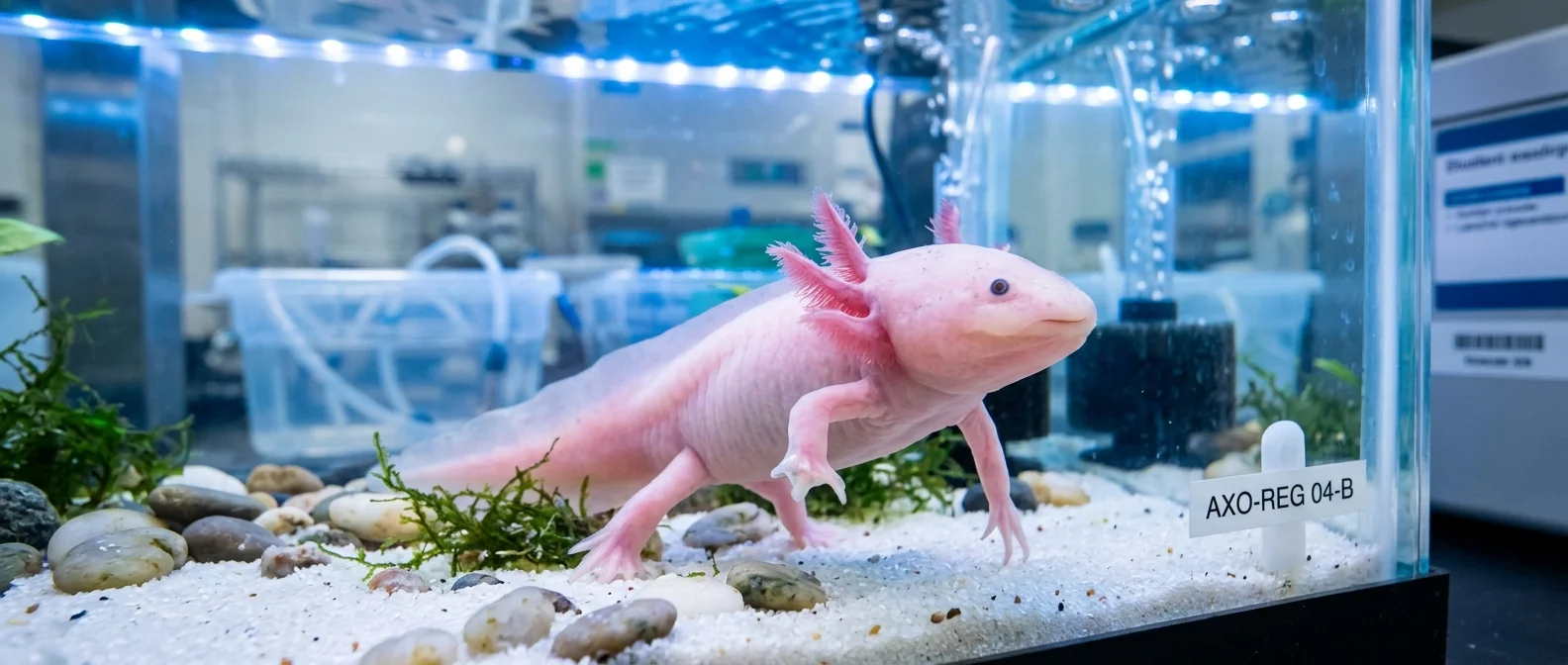
Chop off an axolotl's leg. Within weeks, it grows back — bones, muscles, nerves, blood vessels, even fingers. Perfect. Functional. Like nothing happened. This palm-sized amphibian pulls off something human medicine has dreamed about for centuries. Now scientists are closing in on the mechanism.
📖 Read more: The Immortal Jellyfish Turritopsis: Lives Forever?
📖 Read more: Spiders Mimic Ants: The Perfect Disguise
What Is an Axolotl
The axolotl (Ambystoma mexicanum) is an amphibian endemic to Lake Xochimilco in Mexico. Unlike most amphibians, it never metamorphoses — it stays in a neotenic state its entire life, keeping its external gills and living permanently underwater. It reaches 10-12 inches long and lives 10-15 years in captivity. The Aztecs considered it the embodiment of Xolotl, god of death and transformation — ironic, since this creature literally refuses to transform. In the wild, it's on the brink of extinction: fewer than 1,000 individuals remain in their natural habitat, though millions live in labs worldwide. The axolotl is among the most studied animals in regenerative biology — more than any other vertebrate. Its ability to regrow almost any body part has made it a star in regenerative medicine labs across three continents.
Regeneration: What Exactly Grows Back
The axolotl doesn't just regrow skin or tail — it regrows almost everything. Limbs, tail, heart sections, spinal cord segments, eyes (including the retina), jaw, even brain tissue. Remove a chunk of brain, and within weeks new neural cells appear to replace the lost tissue. In a University of Minnesota experiment, researchers removed an entire front limb from an axolotl — within 65 days, a complete leg with 4 functional digits had developed. The tissue doesn't form scars (fibrosis) like mammals do — this is crucial. Fibrosis is why humans don't regenerate — scar tissue seals wounds but prevents blastema formation. The axolotl never forms scars — and that's the key.

The Blastema: The Secret Structure
Regeneration begins with blastema formation — a mass of undifferentiated cells at the injury site. Within hours of amputation, cells around the wound "dedifferentiate": muscle cells, chondrocytes, and connective tissue cells revert to a primitive state, like becoming stem cells again. These cells multiply rapidly and form the blastema — a kind of "embryonic bud" containing all instructions for building a complete limb. A Nature publication (Gerber et al., 2018) revealed that blastema cells remember their original identity — muscle cells give rise to muscle, chondrocytes produce cartilage. They don't become "anything." Like craftsmen who forget what they're building for a moment, but once they return to work, they remember perfectly. This discovery overturned the older hypothesis that blastema cells are pluripotent — they're actually multipotent with memory, making the process safer than we thought.
Why Humans Can't Do This
Mammals — us — have evolutionarily chosen a different strategy: fibrosis. When you get cut, the body rushes to close the wound with scar tissue — collagen without structure, without function, just sealing. Regeneration would take time, but evolution preferred speed: better a scar now than a perfect limb in two months (if that time meant death from bleeding or infection). However, human embryos DO have regenerative ability — during the first weeks of pregnancy, skin wounds heal without scars. Children under 7 can regenerate fingertips if amputation occurs above the nail base. The genes exist. They're "switched off." And the question haunting researchers is: can we turn them back on?
📖 Read more: Frogs Saved from Fungus in Mini-Saunas at 86°F
📖 Read more: AI Predicts Drug Effects from Chemical Structure Alone
The Giant Genome
In 2018, an international team decoded the axolotl genome — and it was massive. At 32 billion bases, it's 10 times larger than the human genome. The study, published in Nature (Nowoshilow et al., 2018), revealed that a gene called Pax3 — essential for muscle development in other vertebrates — is completely missing. Instead, the axolotl uses Pax7 for both muscle development and regeneration. This "role redistribution" in genes is unique. Genome decoding opened the possibility for researchers to identify which genes activate during regeneration — and whether they can be artificially activated in human cells. This discovery transformed the axolotl from curious animal to front-line biomedical tool.

Regenerative Medicine: Where We Stand
Axolotl research has already inspired clinical applications. Harvard researchers used blastema proteins to accelerate wound regeneration in mice — reducing scar formation by 50%. At Tufts University, Michael Levin's team "regenerated" part of a frog limb (Xenopus laevis) using a silicone bioreactor filled with 5 drugs (progesterone, vitamin D, serotonin, etc.) — the study was published in Science Advances (2022). The regenerated limb had bones, nerves, and tissue, though it wasn't perfect. CRISPR technology now allows targeted activation of regenerative genes in mammalian cells — one step closer to human blastema. The path from basic research to clinical application stretches years ahead, but the barrier no longer looks insurmountable. The scale differs completely: a human leg contains dozens of bones, thousands of nerves, hundreds of miles of blood vessels. But 20 years ago, even scar-free skin regeneration seemed impossible — and now it's happening in lab animals.
Regeneration Without Cancer: The Paradox
Blastema cells multiply explosively — exactly like cancer cells. But axolotls almost never develop cancer. How? Blastema cells maintain strict epigenetic control — they "know" when to stop. A publication in eLife (2019) showed that brake genes like p53 function at increased intensity during regeneration, preventing uncontrolled multiplication. This ability — rapid multiplication without malignancy — could unlock both regeneration and cancer control. If we understand how it controls multiplication, we'll have keys for both tissue regeneration and cancer treatment in humans. If a 10-inch amphibian can solve the problem of uncontrolled multiplication, maybe we can too — if we figure out how. Cancer research is watching these findings with great interest, because they open an entirely new field of therapeutic strategies.
When Will Humans Regenerate?
The honest answer: we don't know yet. Regenerating an entire human limb requires coordinating millions of cells, vessels, nerves, and bones in precise architecture. But the steps are getting bigger. Frog toe regeneration was unthinkable 10 years ago. Activating blastema genes in mice is already at experimental stage. The axolotl, this weird amphibian that refuses to grow up and refuses to die easily, holds within its DNA answers that could change the fate of millions of humans. Under the microscope, blastema cells defy everything researchers know about mammalian healing. Regenerative medicine is no longer science fiction — it's a path opening slowly, step by step, lab by lab.
"The axolotl doesn't teach us how to overcome nature — it shows us that nature already knows how."
— Elly Tanaka, regeneration researcher, Research Institute of Molecular Pathology ViennaSources:
- Gerber, T. et al. — "Single-cell analysis uncovers convergence of cell identities during axolotl limb regeneration", Science, 2018
- Nowoshilow, S. et al. — "The axolotl genome and the evolution of key tissue formation regulators", Nature, 2018