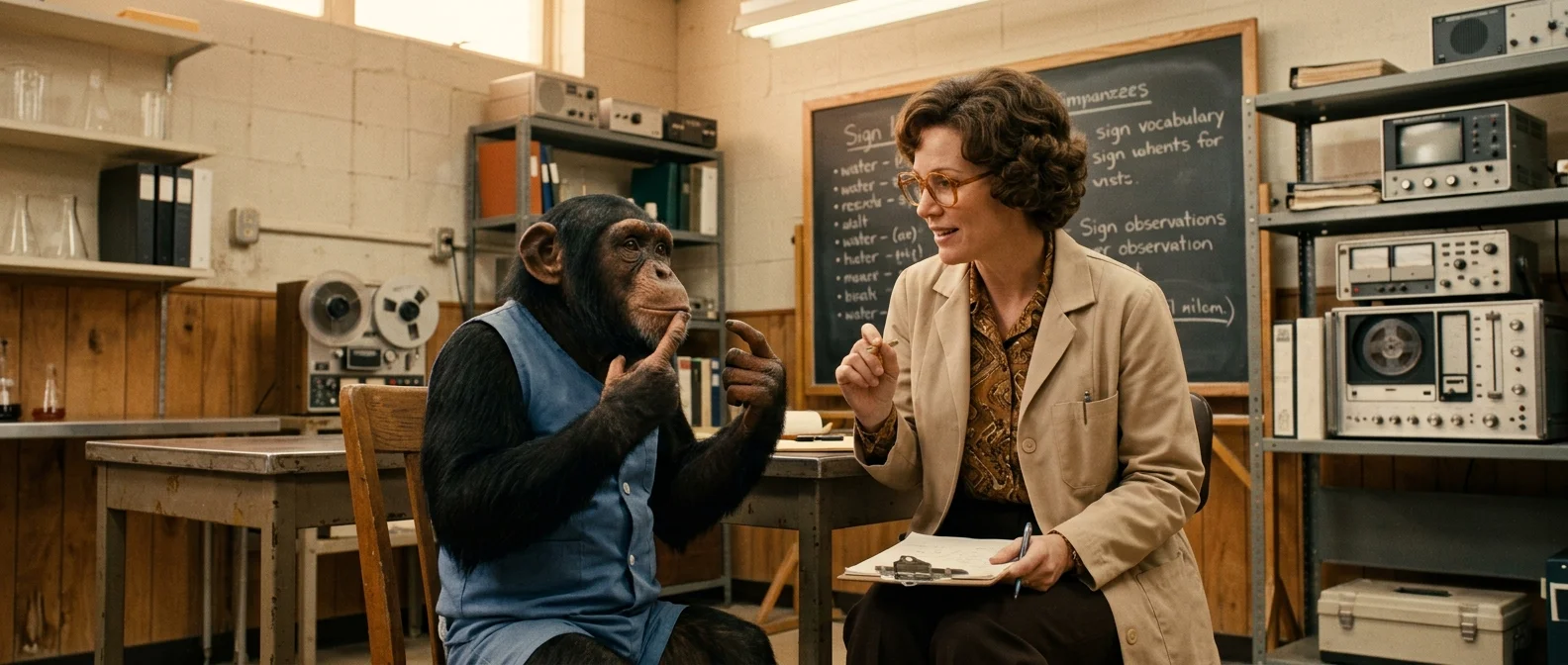
In the mid-1960s, a young chimpanzee named Washoe raises her hand and forms a sign. This isn't a random gesture — it means “more” in American Sign Language. For the first time in history, an animal uses human language to express a thought. This moment triggers a chain of experiments, controversies, and tragic stories that continue to fascinate us today.
📖 Read more: Mummified Dinosaur: 67-Million-Year-Old Skin Preserved
🐒 The Beginning: Why Sign Language Instead of Speech?
Before Washoe, the dominant academic view was crystal clear: language belongs exclusively to humans. Noam Chomsky, perhaps the most famous linguist of the 20th century, argued that linguistic ability is innate and uniquely human — like biological software that only Homo sapiens possesses.
Previous attempts to teach chimpanzees to speak vocally had failed miserably. The reason? The anatomy of primate larynx doesn't allow them to produce the sounds of human speech. Allen and Beatrix Gardner, a psychology couple at the University of Nevada, identified the problem: it wasn't about intelligence, but mechanics. What if they used hands instead of voice?
🤟 Washoe: The First Chimp Who “Spoke”
In 1966, the Gardners adopted a young female chimpanzee (Pan troglodytes) and began teaching her American Sign Language (ASL). Washoe didn't grow up in a cage — she lived as a family member, in a trailer behind the university, surrounded by humans who exclusively used sign language in her presence.
The results exceeded every expectation. Washoe managed to learn approximately 350 signs — “food,” “drink,” “more,” “book,” “dirty,” even abstract concepts. The most impressive part? Spontaneous combinations. Seeing a swan on a lake, Washoe raised her hands and signed “water bird” — without anyone teaching her that.
💡 Washoe by the Numbers
Born around 1965, died in October 2007. In 42 years of life, she taught signs to her adopted son, Loulis — without human intervention. She was the first documented case of cultural transmission of language in a non-human primate.
After the Nevada experiments, Washoe was transferred to Central Washington University, where Roger Fouts and his wife Deborah created the Chimpanzee and Human Communication Institute. There she spent the rest of her life, alongside a small group of chimpanzees who signed among themselves — even when no one was watching.

🧪 Nim Chimpsky: The Experiment That Backfired
The name wasn't accidental. The young chimpanzee was named “Nim Chimpsky” as a sarcastic play on Noam Chomsky's name. Herbert Terrace, a psychologist at Columbia University, started Project Nim in 1973 with exactly the opposite goal: to prove that sign language in chimpanzees was real language.
Nim spent his early years in a Manhattan home, raised like a human infant. He learned approximately 125 signs. But Terrace, analyzing hours of video, reached a conclusion that shocked even himself: Nim wasn't really talking. He was simply mimicking his trainers, seeking rewards. His “sentences” had no order or logic — they were random combinations of signs.
Terrace's 1979 publication didn't just question Nim — it questioned the entire field. Maybe Washoe, Koko, all these “talking apes” were simply mimicking? The question remained open for decades.
🦍 Koko and Kanzi: Two Exceptional Protagonists
Koko was a female lowland gorilla (Gorilla gorilla gorilla) who grew up under the guidance of psychologist Francine Patterson. According to researchers, Koko learned to use approximately 1,000 modified signs and could respond to over 2,000 English words. However, experts warned: "there's a big difference between learning some modified signs and truly mastering sign language" — Koko was never fluent, and critics noted that she sometimes signed incoherently while her trainers interpreted what they wanted to “see.”
Kanzi, on the other hand, stood out in a completely different way. This bonobo (Pan paniscus), who lived from 1980 to 2025, didn't learn sign language — he used a lexigram board, a system of visual symbols. According to evolutionary anthropology professor Simon Townsend, Kanzi possessed the most advanced linguistic skills ever observed in a primate. In a 1993 study, Kanzi understood brand-new English sentences — like “put on the monster mask and scare Linda” — and executed the requested action 75% of the time, surpassing a 2.5-year-old child.
Washoe
First chimpanzee with ASL. Taught signs to her adopted son without human intervention.
Nim Chimpsky
The experiment that questioned everything. His researcher concluded he was mimicking rather than speaking.
Koko
Gorilla with ~1,000 signs. Asked for a kitten as a pet — and mourned when it died.
Kanzi
Bonobo who understood English. Outperformed a 2.5-year-old child in speech comprehension.
📖 Read more: Nanotyrannus: Real Mini T-Rex or Juvenile Impostor?
💔 What Became of Them: Lives After the Labs
The fate of these primates reveals a darker side. Washoe, one of the lucky ones, lived relatively dignifiedly at Central Washington University until her death in 2007. She was the exception.
Nim had a much worse fate. After Terrace published his negative conclusions, Nim was abandoned. He was transferred first to a primate center, then to a medical research laboratory. A chimpanzee who had grown up in a Manhattan home found himself in a cage, without any familiar faces. He was eventually rescued and transferred to a sanctuary in Texas, where he died in 2000 at age 26.
Koko died in her sleep in June 2018, at age 46, at the Gorilla Foundation in California. Kanzi, the last significant chapter of this story, died in March 2025 at age 44, after spending his final years at the Ape Initiative in Iowa.

🧠 Language or Mimicry? The Great Debate
Fifty years after the first experiments, the debate remains unsettled. One side argues that chimpanzees used symbols meaningfully — Washoe created new combinations, Kanzi executed complex commands, Koko expressed emotions.
The other side — with Terrace in the forefront — counters that none of this constitutes real language. Critics point out that Koko sometimes signed incoherently and "her trainers tend to rely on their own interpretations to give meaning to the signs," according to LiveScience. Syntax — the ability to combine symbols into rule-governed structures — remained controversial even for Kanzi. While studies showed he arranged symbols at better-than-random rates, critics questioned his grammatical abilities.
⚖️ The Debate in Two Camps
Pro-linguistic ability: Spontaneous sign combinations, understanding new sentences, transmission of signs to next generation, expression of emotions through symbols.
Against: Absence of syntax, trainer mimicry, Clever Hans phenomenon (responding to unconscious body cues), over-interpretation by researchers.
Evolutionary anthropology professor Simon Townsend, from the University of Zurich, suggests a middle ground: "Humans are special in many things, and certainly language is uniquely human. But we're increasingly discovering really important similarities between animal and human communication systems."
🔬 Modern Discoveries: Kanzi Imagines
One of the most surprising recent discoveries concerns Kanzi — published in Science in February 2026. Researchers Christopher Krupenye, from Johns Hopkins University, and Amalia Bastos, from the University of St Andrews, experimentally proved that Kanzi could track imaginary objects — an ability thought to be exclusively human.
In the experiment, a researcher pretended to pour juice into two cups. Kanzi correctly identified the location of the imaginary juice in 68% of trials. And he wasn't confused — when offered a cup with real juice next to an “imaginarily full” one, he chose the real one 77.8% of the time.
"We were stunned by this finding," Krupenye said. "What we're seeing is that something that seems fundamentally human, that appears early in human development, is shared with our closest relatives."
🌍 Ethical Questions and Legacy
Beyond science, these experiments carry heavy ethical weight. Nim grew up believing he belonged to a human family — then was abandoned in a laboratory. Washoe lived in an environment that was neither wild nor truly human. These animals found themselves trapped between two worlds.
Today, researcher Laura Simone Lewis from the University of California, Santa Barbara, calls the recent findings “a huge development for our field,” because they "provide direct evidence supporting anecdotal reports that great apes can use their imagination for all sorts of activities, including pretend play."
The truth is more nuanced than any simplification. The chimpanzees didn't “speak” the way we speak. They didn't tell stories, make plans for the future, or discuss philosophy. But they did something — something that can't be explained as simple mimicry or coincidence. And that “something” forces us to reconsider what the word “language” ultimately means.