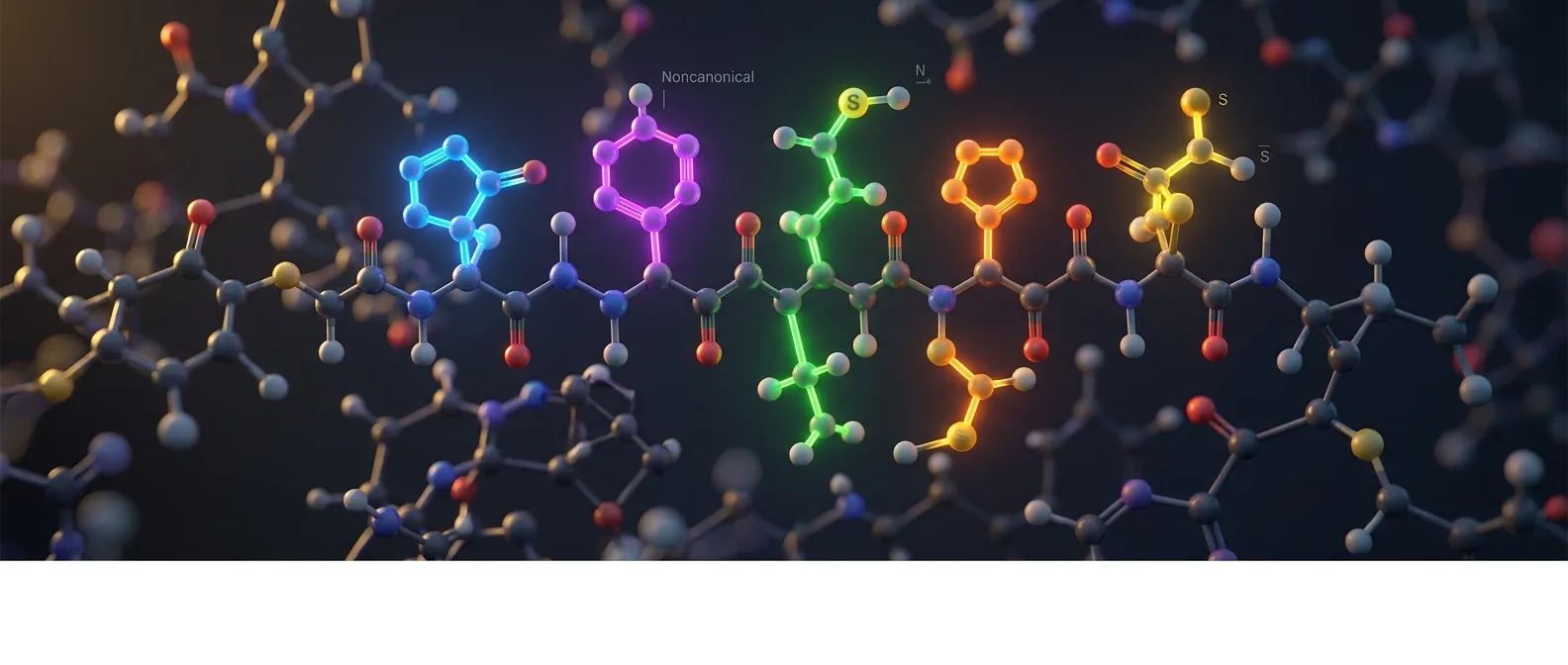
Six noncanonical amino acids embedded in a single protein — that's the new record scientists smashed in 2026. Behind this breakthrough lies a completely different approach to genetic engineering that abandons traditional methods and hijacks what researchers call rare codons.
Traditional genetic code expansion hit a wall. When researchers wanted to slip noncanonical amino acids into proteins, they had to use stop codons — the cellular signals that tell ribosomes to quit building. The method worked, but barely, with low efficiency and severe limitations.
📖 Read more: 10 Animals That Glow in the Dark: Bioluminescent Wonders
🔬 The Rare Codon Revolution
The new technique developed in 2024 and perfected this year doesn't touch stop codons. Instead, it exploits something far cleverer. Scientists discovered that certain codons — specifically TCG — are so rare in mammalian cells that they can steal them without breaking normal cellular function.
Think of it like an old city where some streets get so little traffic you can tear them up and build something new without affecting the flow. The TCG codon, which normally codes for serine, appears so infrequently that replacing it causes zero problems.
The Statistics Behind Recoding
In a typical mouse autosomal chromosome, the TCG codon appears just 46,635 times, compared to the TTC codon which shows up 473,915 times. This 10-fold difference enables safe recoding without cellular disruption.
⚡ Five Different Amino Acids Simultaneously
The technique's real power lies in what it makes possible. By combining rare codons with improved stop codon methods, researchers managed to incorporate five completely different noncanonical amino acids into the same protein.
We're talking about proteins with fluorescent amino acids for tracking, click-chemistry handles for bioconjugation, or even photo-activatable groups that change protein behavior only when hit with specific wavelengths of light. From simple protein observation to precise activity control.
The New Amino Acids and Their Superpowers
Each noncanonical amino acid has distinct capabilities. One of the most intriguing is trans-cyclooct-2-en-1-yl amino acid, which enables bioorthogonal reactions — chemical reactions that work only inside biological environments without interfering with other processes.
Another is azido-phenylalanine, which acts like a chemical hook. It can link to any molecule with the right "lock," allowing researchers to attach drugs, signaling molecules, or even other proteins at precisely defined sites.
📖 Read more: 10 Creatures That Glow in the Ocean's Darkness
🧬 The Engineering Behind the Breakthrough
The technique's success hinges on systematically engineering three critical components. First, researchers developed orthogonal aminoacyl-tRNA synthetase and tRNA pairs that recognize exclusively the recoded codons. Second, they optimized transport mechanisms to get noncanonical amino acids into cells. Third, they used AI models to predict which codons would work best.
Using AI in genetic engineering is relatively new, but here it paid off spectacularly. Instead of researchers blindly testing different codon and amino acid combinations, algorithms predicted which variants would achieve the highest efficiency.
🔧 Real-World Biotech Applications
The technique has immediate practical applications. In pharma, it enables creating proteins with enhanced stability and selectivity. In medicine, it opens paths to more effective gene therapies and better diagnostic tools.
One concrete example involves creating macrocyclic peptides — molecules that behave like drugs but with much greater durability and selectivity. With the new technique, these peptides can be produced directly inside biological systems, dramatically cutting production costs.
Molecular Clockwork in Real Time
One of the most exciting applications is creating "time-controlled" proteins. By embedding photo-degradable amino acids at critical sites, researchers can control exactly when a protein activates or deactivates. Simply by exposing it to light of a specific wavelength.
This means therapies that activate only at their targets, diagnostics that "light up" only in disease presence, or biocatalysts that function only when needed. It's like having an on/off switch for biological processes.
📖 Read more: 10 Mind-Blowing Facts About Your Body You Never Knew
💡 Challenges and Limitations
The technique isn't without challenges. Recoding rare codons requires extensive validation that other cellular proteins remain unaffected. Each new noncanonical amino acid must also cross the cell membrane — not always straightforward.
A significant practical hurdle remains the cost of noncanonical amino acids. While the new technique boosts efficiency, many of these specialized molecules are still expensive for industrial use. New biosynthetic pathways for their production will likely be needed.
"Being able to do it isn't enough — we need to do it efficiently and economically. That's the next major barrier to widespread adoption of this technology."
Synthetic biology researcher
📊 Performance vs Previous Methods
The new approach's advantage becomes crystal clear when compared to traditional techniques. Methods based on amber stop codons typically achieve 10-30% incorporation efficiency for noncanonical amino acids. Rare codon recoding hits 80-95%.
But the real difference isn't just numbers. The old technique was limited to one, maybe two noncanonical amino acids per protein. The new method allows five or six different ones, opening completely new possibilities in molecular design.
What This Means for Researchers
For protein researchers, the implications run deep. Instead of designing around technology limitations, they can now focus on the biological function they want to achieve. It's the difference between painting with three colors versus having the entire palette.
Particularly in structural biology and enzymology, where precise placement of fluorescent or other functional groups is critical, the ability to make multiple modifications per protein fundamentally changes experimental possibilities.
🔮 Future Directions
Current research focuses on expanding the spectrum of available noncanonical amino acids and optimizing biosynthetic pathways for their economical production. The goal is reaching a point where recoding becomes as easy as cloning.
Parallel development of new AI tools will enable prediction and design of improved proteins with noncanonical amino acids. If protein folding prediction with AlphaFold was the first wave, designing proteins with noncanonical amino acids is the next.
Long-term, this technology could lead to entirely new categories of biomaterials and therapeutics. Self-repairing proteins, enzymes that function in extreme conditions, or even biological systems that can be "programmed" for specific tasks.
However, as often happens with pioneering technologies, the distance from lab to clinic or industry is vast. How quickly we cover that ground depends as much on technical progress as on the economic viability of applications. And there we're still waiting for answers.