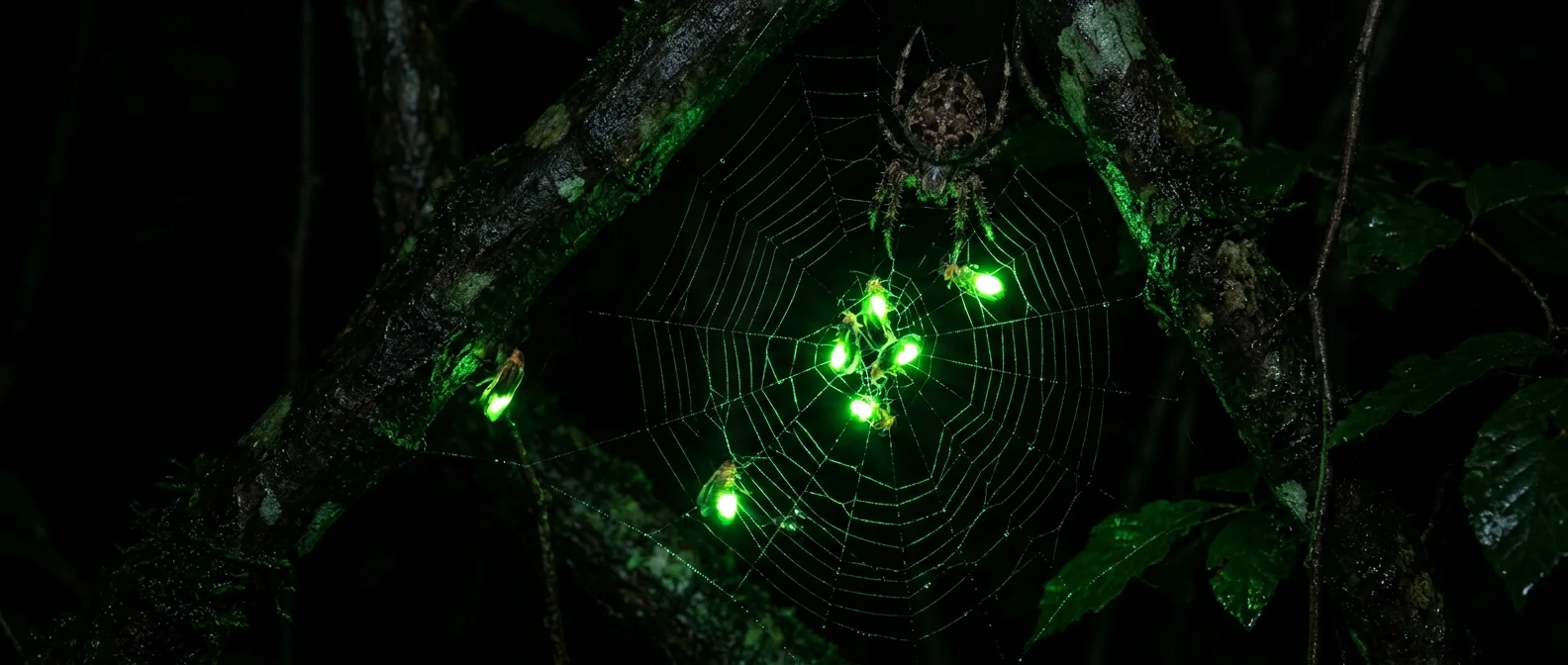
Picture walking through a subtropical forest in Taiwan late at night. Among the conifers, tiny lights flicker near the ground — fireflies blinking as they search for mates. Some remain motionless, trapped in spider webs, glowing involuntarily as bait for the web's owner. This isn't a horror movie scenario — it's a real hunting strategy discovered by scientists in 2025.
📖 Read more: World's Largest Spider Web: 111,000 Spiders Share One Colony
Discovery in Taiwan's Forests
At the Xitou Nature Educational Area of Taiwan's National University, researchers from Tunghai University observed something remarkable and unprecedented. Spiders of the species Psechrus clavis — known as sheet web spiders — weren't immediately consuming fireflies caught in their webs. Instead, they left them there, alive and glowing, for about an hour.
Dr. I-Min Tso, lead researcher of the study, described the behavior as unique. The spiders would return periodically to check on their captive fireflies, as if inspecting their prey-attracting “device.” The glow wasn't random — it functioned as a luminous trap that drew increasingly more insects to the web.
Key Study Details
- Tunghai University, Taiwan — the research team
- Publication: Journal of Animal Ecology, August 28, 2025
- Location: Xitou Nature Educational Area, Taiwan
- Fireflies remained captive for up to 1 hour
The LED Experiment
The researchers didn't stop at observation. They designed a groundbreaking field experiment: placing small LEDs in real spider webs, calibrated to mimic the wavelength and intensity of firefly light. Other webs remained empty as control samples.
The results were stunning and exceeded every prediction. Webs with LEDs attracted triple the number of prey compared to empty webs. But the most astonishing finding concerned fireflies themselves: ten times more fireflies were trapped in the illuminated webs. The glow doesn't just attract random insects — it functions as a substitute mating signal.
Spider vs. Firefly
What makes this behavior even more fascinating is the selective treatment of different prey. Video recordings by the researchers revealed a clear pattern: when a moth was caught in the web, the spider consumed it immediately. When a firefly was trapped, however, the spider left it alive — keeping the glow as a tool.
📖 Read more: Parasitic Ant Species Clones Itself to Hijack Other Colonies
Dr. Tso explained that this suggests a form of recognition. "The way the spider handles prey differently shows it can use some kind of signal — likely bioluminescence — to recognize fireflies and adapt its behavior accordingly," he stated. The spider doesn't react mechanically. It evaluates, decides, exploits.

How Firefly Bioluminescence Works
The firefly Diaphanes lampyroides, known as the winter firefly, is found in abundant populations in Taiwan's subtropical forests. Unlike many firefly species that flash rhythmically, this species emits continuous, steady light without pulses. Females remain stationary at one spot and glow steadily, attracting males.
This exact characteristic makes winter fireflies perfect victims for spiders. When a male sees a steady light near the ground, it flies toward it thinking it's a female mate. If that light comes from a firefly trapped in a spider web, the male also ends up in the trap. The romantic search becomes a deadly snare.
Notably, the majority of captive fireflies were males. Researchers hypothesize that males confused the steady glow of trapped individuals with females waiting for mates — a tragic confusion that led them straight into the web.
Nocturnal Hunting Strategy
Psechrus clavis belongs to the category of nocturnal “sit-and-wait” predators. Instead of actively hunting, it builds massive sheet-shaped webs near the ground and waits. In dark forests, this strategy has a fundamental disadvantage: without light, few prey fly so low at night.
This is precisely where the firefly enters the game. The luminous glow of a trapped firefly functions like a beacon — a unique point of light in the darkness that catches the attention of every nocturnal insect. Moths, beetles, and naturally more fireflies head toward the web, dramatically increasing capture chances.
📖 Read more: Pelican Eel: The Living Mouth-Bag of the Deep
Response Comparison to Different Prey
Moth
Immediate consumption after capture — no strategic benefit from delay
Firefly
Remains in web up to 1 hour — serves as glowing bait to attract prey
Comparison with the Anglerfish
The strategy of Psechrus clavis strongly resembles the anglerfish, one of the most famous users of bioluminescence in the animal kingdom. The anglerfish has evolved a luminous lure — a modified fin ray with bioluminescent bacteria — that hangs in front of its mouth, enticing prey in the darkness.
The crucial difference? The anglerfish invested millions of years of evolution to develop its own bioluminescence. The spider, conversely, found a "shortcut": instead of producing light itself, it exploits another organism's bioluminescence. Researchers characterized this strategy as an example of “outsourcing” in nature — the spider delegates prey attraction to the prey's own signals. This represents a striking example of evolutionary economy.

Evolutionary Advantage and Interpretation
From an evolutionary perspective, exploiting foreign bioluminescence offers tremendous advantages. Producing bioluminescent substances requires significant energy investment and complex biochemical processes. The spider avoids this cost entirely, gaining the same benefits — increased prey attraction — without any energy expenditure.
The study also revealed an even deeper issue. The sexual signals of fireflies, which evolved exclusively for reproduction, have simultaneously become exploitation tools for a completely different species. This shows how complex predator-prey relationships can become — signals serving one purpose can be “hijacked” for something entirely different.
📖 Read more: Why You Can't Tickle Yourself: The Brain's Prediction System
Zero Energy Cost
The spider doesn't waste energy producing light — it uses the prey's bioluminescence
Prey Recognition
The spider distinguishes fireflies from other insects and adapts its behavior accordingly
Strategic Delay
Postponing consumption demonstrates planning — short-term sacrifice for long-term gain
Signal Exploitation
Firefly sexual signals become death traps through third-party species manipulation
Implications for Ecosystems
This discovery illuminates a broader phenomenon in ecology: predators aren't always passive recipients simply waiting. Even species without advanced nervous systems, like spiders, can develop complex strategies that resemble “thinking.” Psechrus clavis doesn't just use force — it employs deception, patience, and strategic planning.
Dr. Tso emphasized: "Our study sheds new light on how nocturnal sit-and-wait predators can address the challenges of attracting prey. It offers a unique perspective on the complexity of predator-prey relationships." East Asia, with its dense subtropical forests, still hides countless secrets of such interactions.
The research was published in the Journal of Animal Ecology of the British Ecological Society on August 28, 2025. The authors — Ho Yin Yip, Sean J. Blamires, Chen-Pan Liao, and I-Min Tso — propose future studies with real fireflies instead of LEDs, though they acknowledge the practical difficulty of such experiments. Until then, Taiwan's forests continue to glow — only some lights don't herald romance, but trap.