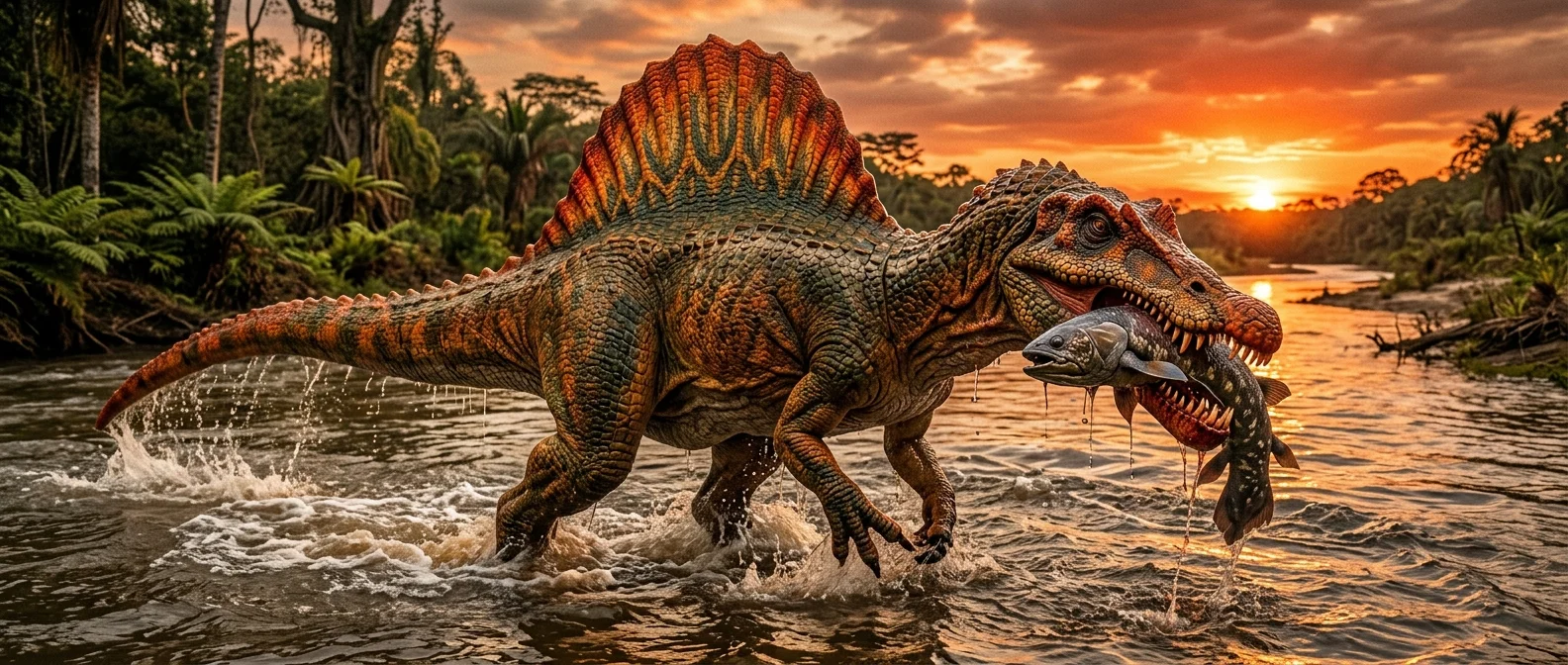
A 50-foot dinosaur plunges into a murky North African river. Its tail beats the water like an oar, dense bones keep it submerged, and conical teeth snap around a massive fish. This isn't a crocodile. This is Spinosaurus aegyptiacus — the largest carnivorous dinosaur that ever walked the Earth, and the only one proven to swim.
🌊 The First Dinosaur to Enter the Water
For decades, paleontologists treated Spinosaurus like just another big theropod — something like an oversized T. rex with a weird sail on its back. Until 2014, when a study by Nizar Ibrahim from the University of Chicago, published in Science, changed everything: Spinosaurus was semi-aquatic. The first dinosaur with proven aquatic adaptations.
The evidence was overwhelming. Short hind limbs — like those of early whales. Dense, solid bones — similar to penguins', perfect for staying submerged rather than floating. Broad, flat claws — likely useful for paddling. Long, narrow snout with conical teeth — a perfect trap for slippery fish.
🏴☠️ Bigger Than T. rex
Spinosaurus wasn't just big. It was the largest carnivorous dinosaur on record — surpassing both Tyrannosaurus rex and Giganotosaurus. A 2005 study in the Journal of Vertebrate Paleontology estimated its length between 52 and 59 feet, weighing 7 to 9 metric tons. Some researchers questioned the methodology and proposed a shorter but heavier build — 41 to 47 feet and possibly 20 tons.
The partial skeleton Ibrahim analyzed showed a 50-foot animal that was still growing. Whatever the final numbers, one thing is certain: this predator was massive, and what made it even more terrifying was that it hunted in water.
⛵ The “Sail” — A 100-Year Mystery
Its most distinctive feature: 7-foot spines protruding from the vertebral column, connected by skin in a sail-like structure. What was its purpose?
The list of hypotheses is long. Initially, many assumed thermoregulation — absorbing solar heat during cold mornings. But Ibrahim found the spines were made of dense bone with minimal blood vessels, wrapped tightly in skin — characteristics that don't support thermoregulation. Jack Bowman Bailey, in a 1997 study, proposed there was no sail at all, but a large fat-filled hump, like a bison's.
The most likely explanation? Display. “The sail was visible from great distances, even when the animal was swimming,” Ibrahim explained. It conveyed information about age, size, sex — to other Spinosaurus and potential competitors. Some researchers believe it was brightly colored, like the fins of certain modern reptiles.
🦷 Fish-Eater's Mouth, Not a Hunter's
Unlike T. rex, Spinosaurus didn't have serrated teeth for slicing flesh. Its teeth were conical and smooth — designed to grip, not cut. The front of the upper jaw had 6-7 needle-like teeth on each side, with 12 more behind them. Upper and lower teeth interlocked like a trap — an adaptation that appears repeatedly in fish-eating animals, from ichthyosaurs to pterosaurs.
🐟 What Exactly Did It Eat?
Coelacanths. Sawfish. Massive lungfish. Sharks. Spinosaurus lived in a river system teeming with enormous fish, and its skull “has 'fish-eater' written all over it,” according to Ibrahim. Chemical analyses, published in 2010 in Geology, confirm that its diet was primarily fish-based.
But it wasn't limited to aquatic prey. In 2004, researchers found a tooth from Irritator challengeri — a related spinosaurid — embedded in pterosaur remains. Spinosaurids, it seems, weren't exclusively fishers. If something came close enough, it became a target.
🦴 A Story of Destruction and Rediscovery
The first Spinosaurus fossils were discovered in 1912 by Richard Markgraf in Egypt's Bahariya Formation. Ernst Stromer described them in 1915 — detailed notes, drawings, measurements. Everything science needed.
Then World War II destroyed it all. Allied bombing in Munich incinerated the original fossils. If not for Stromer's meticulous notes, we'd know almost nothing about this dinosaur. For decades, Spinosaurus remained nearly a ghost — known mainly from paper, not stone.
🔄 Spinosaurus vs T. rex — Two Worlds
Spinosaurus
- Length: 50-59 feet
- Semi-aquatic predator
- Conical teeth (fish-eater)
- Massive sail on back
- Walked on all fours on land
T. rex
- Length: ~40 feet
- Exclusively terrestrial
- Serrated teeth (bone-crusher)
- Massive head, tiny arms
- Bipedal hunter
🏜️ The “Hell Heron” from the Sahara
In February 2026, a team of 20 researchers led by Paul Sereno from the University of Chicago announced in Science something entirely new: Spinosaurus mirabilis, a new species of spinosaurid, buried deep in Niger's Sahara.
The most striking feature? A massive blade-shaped crest, covered in keratin — the same material as human fingernails. Networks of blood vessels within the crest indicate it was brightly colored during the animal's lifetime. The teeth interlocked tightly — a biological trap for slippery fish.
"I imagine this dinosaur as a kind of 'hell heron' that had no problem wading into 6 feet of water on its strong legs, but probably spent most of its time in shallow water, trapping the large fish of the era."
— Paul Sereno, University of Chicago, 2026The discovery changed something crucial in the discussion. The fossils were found 300 to 600 miles from the nearest ancient coastline. Near river sediments, within a forested environment. This means spinosaurids weren't marine hunters — they were masters of inland waterways across a continent.
🗺️ Where It Lived — And Why We Know So Little
Spinosaurus inhabited Egypt and Morocco during the Cretaceous period, 112 to 97 million years ago. Two species have been named: Spinosaurus aegyptiacus (Egyptian spine lizard) and Spinosaurus maroccanus (Moroccan spine lizard). Its environment wasn't desert — it was rich wetlands with extensive river systems.
There's conviction that the Sahara hides many more Spinosaurus fossils, but harsh conditions make excavations extremely difficult. No complete skeleton has ever been discovered. Each new find is an achievement — and each achievement rewrites what we thought we knew.
In 2011, a spinosaurid neck vertebra was found in Australia — thousands of miles from North Africa. This dinosaur family had a much wider distribution than anyone imagined.
🔬 Why Spinosaurus Changes Everything
Before Spinosaurus, dinosaurs were considered exclusively terrestrial creatures. The marine reptiles of the era — ichthyosaurs, plesiosaurs, mosasaurs — weren't dinosaurs. Spinosaurus broke that rule. It showed that evolution doesn't respect the boxes humans create, and that a massive theropod could leave land, enter water, and become the absolute master of an entirely different environment.
The story of Spinosaurus is the story of a science that constantly corrects itself. Fossils destroyed in war. Decades of silence. A discovery that changed everything. And in the middle of the Sahara, a Tuareg on a motorcycle who led a team of scientists to something no one had seen for 95 million years.