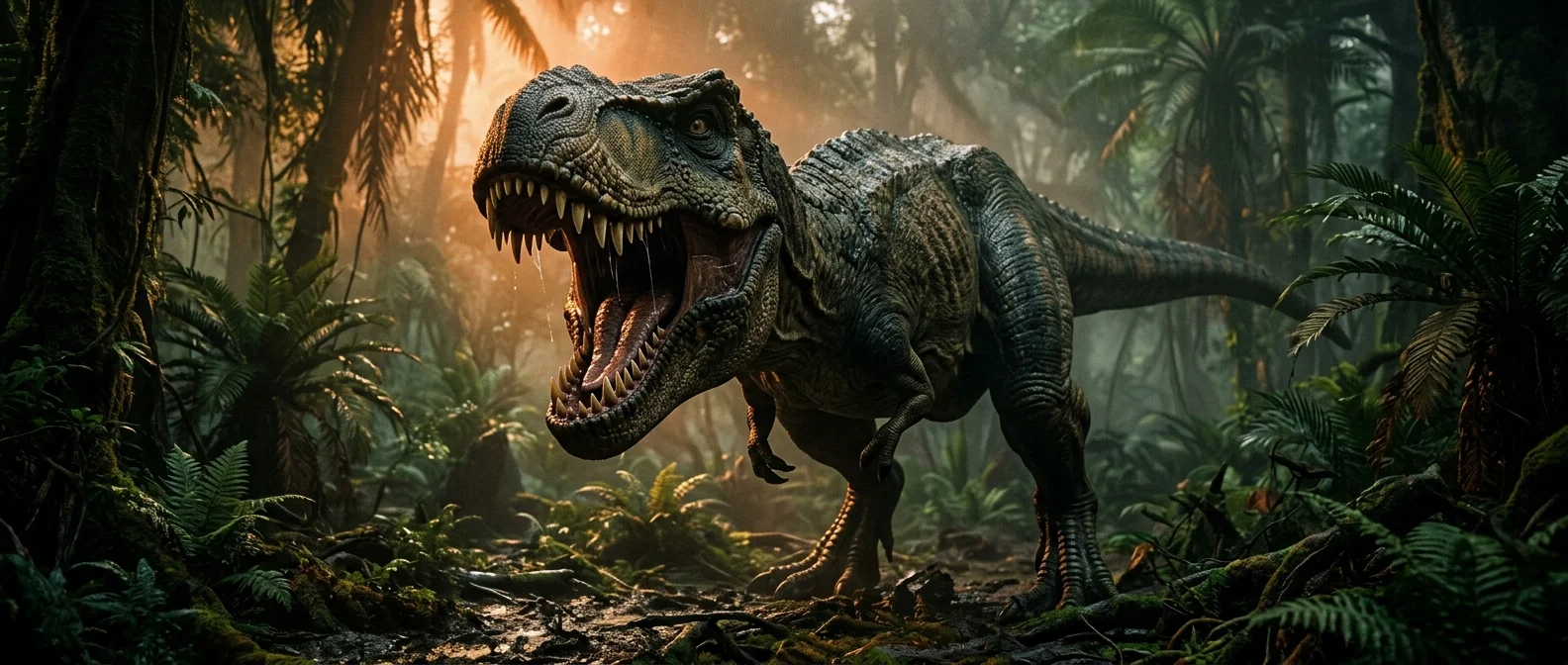
Picture yourself standing on the plains of modern-day Montana, 67 million years in the past. The air smells of damp vegetation, conifers taller than apartment buildings cast shadows across the earth, and somewhere nearby — very nearby — the ground shakes rhythmically. Tyrannosaurus rex has just spotted something. You think you know this predator from museums and movies. These 10 facts will make you see it completely differently.
📖 Read more: Nanotyrannus: Real Mini T-Rex or Juvenile Impostor?
🦴 1. It Wasn't Always the Giant You Imagine
The T. rex you know — 40 feet long, 7 tons heavy — wasn't born that way. Its juveniles were something entirely different: slender, graceful, almost unrecognizable. Paleontologist Thomas Carr from Wisconsin's Carthage College describes them as “Dobermans” — fast and elegant.
Around 13 to 14 years old, everything changed. The skull deepened dramatically, teeth thickened, the body became “like a pit bull” according to Carr. This transformation happened within just a few years. An animal that yesterday hunted frogs could suddenly take down a Triceratops.
🔄 Juvenile vs Adult T. rex
Juvenile (under 14 years)
- Slender, graceful body
- Up to 74 narrow teeth
- Hunted small prey
- Newborn: ~3 feet long
Adult (14+ years)
- Massive, muscular body
- Up to 54 enormous teeth
- Apex predator of its era
- Length 40+ feet, weight ~7 tons
💪 2. The Arms — The Great Mystery
No animal is more iconically disproportionate. A body weighing as much as a truck, with arms smaller than a human's. Why?
Theories abound: maybe it used them during mating, perhaps to hold prey close to its body, possibly to push itself up from the ground after resting. Some researchers even suggested they served to stab prey at close range. Nobody has proven anything definitively. And maybe that's part of the appeal — the largest terrestrial predator we know carried a mystery in its hands. Literally.
🦷 3. A Mouth Full of Knives
Forget lion teeth. T. rex packed 60 teeth, with the largest known crown — the part above the gums — reaching 4.6 inches. Each one was serrated, designed to slice flesh and crush bone.
Like sharks, T. rex didn't keep the same teeth forever. It constantly lost and replaced them with new ones. This is why we find fossilized T. rex teeth relatively easily across western North America — they had to end up somewhere. Every time it bit down, it risked losing one. But there was always another waiting.
🔨 4. Bone-Crushing Bite
34,520 Newtons doesn't mean much on its own. Let's put it in scale: a lion bites with about 4,500 Newtons. T. rex was nearly 8 times more powerful.
A 2017 study calculated that the pressure from a single tooth reached 2,974 megapascals — enough to pulverize bones. Bite marks on fossilized Triceratops and Edmontosaurus bones confirm it: T. rex didn't strip flesh from bones. It ate those too. Analysis of fossilized feces revealed bone fragments inside — the most direct evidence you can imagine.
🐢 5. Slower Than You Think
In Jurassic Park, T. rex chases a jeep. In reality? A 2021 study that factored in the vertical movements of its massive tail found that its preferred walking speed was just 3 mph. Almost slower than a brisk human walk.
Could it run? Probably. Some calculations give speeds of 10 to 25 mph in short sprints, but even the upper estimate wouldn't be enough to catch a modern horse at gallop. T. rex didn't need speed. It had something much better.
👃 6. Bloodhound Nose, Eagle Eyes
T. rex hunted primarily with its senses. Analysis of the brain case reveals unusually large olfactory bulbs — it could smell carcasses and living prey from enormous distances. It was simultaneously a predator and a powerful “opportunistic scavenger,” capable of intimidating any competitor and monopolizing the meal.
"It's complete fiction that T. rex couldn't see something standing still. This myth was started by the 1993 movie Jurassic Park."
— Thomas Carr, paleontologist, Carthage CollegeIts vision was equally impressive. Its eyes faced partially forward, providing stereoscopic vision — crucial for accurately calculating distances during an attack. Combined with hearing that picked up low frequencies, T. rex perceived the world around it far better than you might imagine.
🌏 7. It Came from Asia
It wasn't born American. Its closest anatomical relative is Tarbosaurus bataar — a tyrannosaur discovered in Mongolia. A 2016 study by Thomas Carr and Steve Brusatte (University of Edinburgh) analyzed bones from 28 different tyrannosaur species and constructed an evolutionary tree. The direction was clear: the roots begin in Asia.
🌉 The Beringia Bridge
Around 68 million years ago, sea levels dropped enough for a strip of land to connect the two continents through Beringia. Asian dinosaurs crossed into North America — and T. rex was part of this massive “invasion.” The king was, in reality, an immigrant.
🪶 8. No Feathers — Velvet-Like Scales
Many theropods — the dinosaur group that includes T. rex — had feathers. Yutyrannus, a primitive tyrannosaur, was completely covered. Logical question: was T. rex also feathered?
The answer, according to available fossils, is no. Well-preserved skin samples from neck, torso, tail, and legs show scales — very small and fine ones. “It would have looked like it was wearing velvet,” says Carr. As a massive animal, T. rex probably didn't need feathers for insulation — its body size was sufficient to maintain stable temperature.
🤝 9. Maybe It Didn't Hunt Alone
In Canada, researchers studied three parallel tyrannosaur tracks — three dinosaurs walking side by side, in the same direction, at a site in British Columbia. Does this prove companionship? Not definitively — the tracks could have been made at different times.
But there's more telling evidence: facial bite marks. Many tyrannosaur skulls bear bite marks from their own kind. Carr believes these occurred during group feeding — multiple T. rex around a carcass, fighting over the best pieces. “You can't bite someone in the face from far away,” he notes. These wounds prove at least one thing: they lived close to each other.
🥚 10. The Only Known Pregnant T. rex
In 2005, a study in Science magazine revealed something unprecedented: a T. rex specimen with medullary bone — special bone tissue filled with calcium that forms only in females during egg-laying. This T. rex, which died around age 15, was likely pregnant at the time of death.
It remains the only confirmed female specimen. Along with Sue — the most complete T. rex fossil in the world, housed at Chicago's Field Museum and died at 33 — they constitute the two most valuable windows into the species' biology.
And this leaves a huge gap. Of the hundreds of specimens found, only one has been identified as female. We know far more about how this dinosaur bit than how it reproduced.
Tyrannosaurus rex vanished 66 million years ago when a 6-mile-wide asteroid struck Earth. What the impact didn't destroy, the ecological collapse that followed finished off — fires, acid rain, darkness. But even after it was lost, it never stopped fascinating us. Each new fossil brings another answer — and usually two new questions.