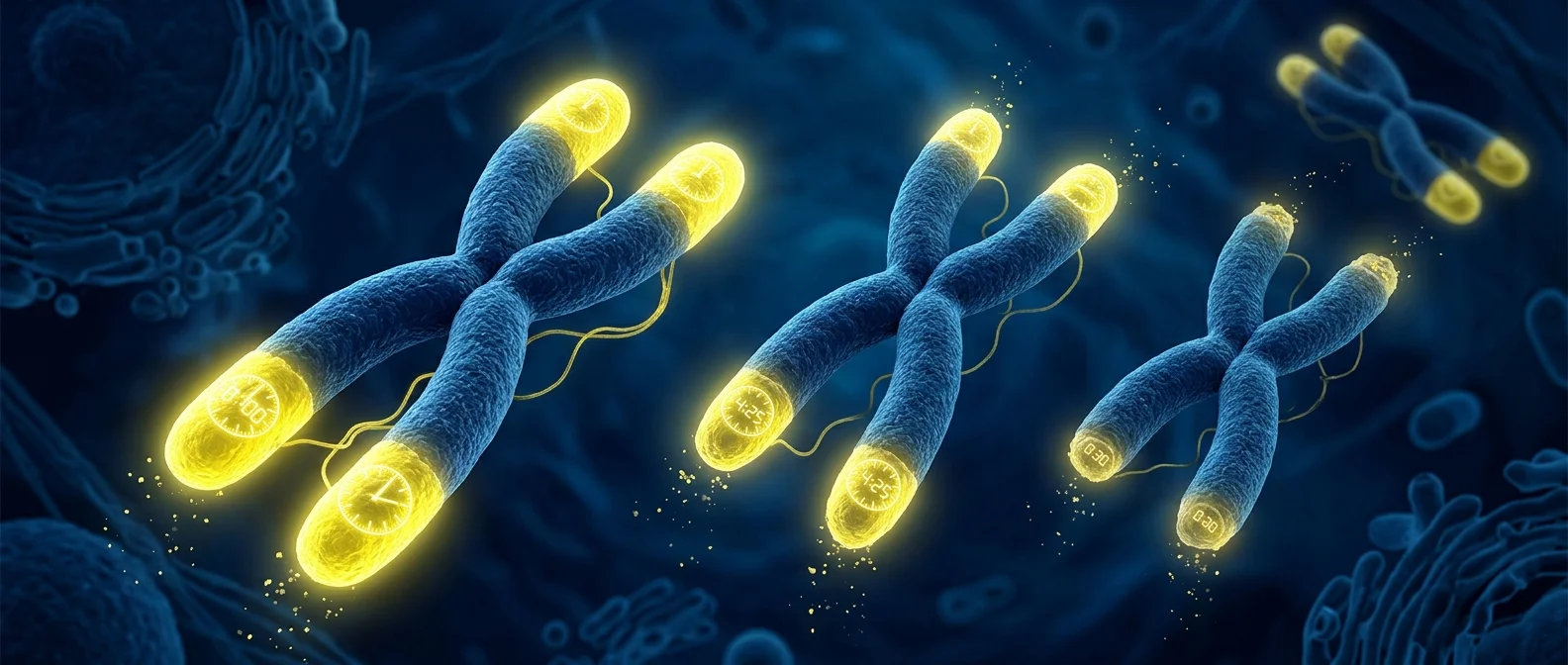
Imagine every cell in your body carries an invisible countdown timer. It doesn't tick, doesn't make noise — but with each cell division, it gets a little shorter. When it reaches zero, the cell stops functioning. This isn't science fiction. It's the biology of telomeres, and it literally determines how fast you age.
📖 Read more: 332m Dive Without Breathing: How Does the Body Survive?
What Exactly Are Telomeres?
At the ends of every chromosome exist repetitive DNA sequences — specifically the sequence TTAGGG, repeated thousands of times. These sequences don't code for any proteins. Their role is purely protective: they function like the plastic caps on shoelace tips. Without them, chromosomes would fray, stick together, and destroy critical genetic data. At birth, a human's telomeres are roughly 10,000 base pairs long. By old age, this drops below 4,000. The wear is gradual but relentless — we lose an average of 20 to 40 base pairs each year depending on our lifestyle.
The Hayflick Limit: The Countdown Begins
In 1961, Leonard Hayflick discovered something that overturned decades of beliefs. Human cells cannot divide indefinitely — there's a strict upper limit. Specifically, most somatic cells can only perform 50 to 70 divisions before stopping permanently. The reason? With each DNA replication, DNA polymerase cannot fully copy the chromosome ends. So 50 to 200 base pairs are lost each time. The first dozens of divisions only “consume” telomeric DNA — essentially expendable material. But once this reserve is exhausted, the damage begins hitting genes vital for survival. The beginning of the “end” for a cell doesn't resemble dramatic collapse — it looks like slow, silent exhaustion. The first signs appear as the cell's inability to respond to growth signals.

Shelterin: The DNA Bodyguard Squad
Telomeres aren't alone. A team of six proteins, known as the shelterin complex, surrounds and stabilizes them. The proteins TRF1, TRF2, POT1, TIN2, TPP1, and RAP1 work together to hide chromosome ends from DNA repair mechanisms. Why is this important? Because without shelterin, the cell would perceive the free ends as broken DNA and activate apoptosis mechanisms. Essentially, shelterin “tricks” the cell into believing everything is fine — until telomeres become so short they can no longer hide. At this point, the proteins p53 and pRb, the main “guardians” of the cell cycle, activate and stop any further division. The balance between shelterin protection and protein response determines whether a cell will live or enter senescence.
Telomerase: The “Immortality” Enzyme
There's an enzyme that can reverse telomere shortening. It's called telomerase, discovered in 1984 by Elizabeth Blackburn and Carol Greider while studying the single-celled protozoan Tetrahymena thermophila. Telomerase adds TTAGGG sequences to chromosome ends, counteracting natural wear. The problem? In most somatic cells of an adult, telomerase is deactivated. It remains active only in stem cells, reproductive cells, and certain immune cells. This discovery earned Blackburn, Greider, and Jack Szostak the Nobel Prize in Physiology or Medicine in 2009. Telomerase belongs to a special category of enzymes — reverse transcriptases — because it uses an RNA template to construct DNA. Each time it acts, it creates a small piece of new telomeric DNA, replenishing what was lost.
Cancer: When the Clock Stops Counting
If telomerase can regenerate telomeres, why don't we activate it everywhere? The answer hides a paradoxical danger. In approximately 85-90% of all cancers, cancer cells have reactivated telomerase. This allows them to divide indefinitely — bypassing the Hayflick limit and becoming essentially immortal. HeLa cells, derived from Henrietta Lacks in 1951, continue multiplying in laboratories worldwide precisely because their telomerase never shuts off. This means telomerase is simultaneously the hope and nightmare of cellular biology — a double-edged sword. Research labs worldwide are seeking ways to selectively control telomerase: activating it in healthy cells while silencing it in cancerous ones. So far, the challenge remains enormous.
📖 Read more: How 31 Wolves Changed Yellowstone's Rivers Forever

Stress, Trauma and the Damage You Can't See
In 2004, a publication in Proceedings of the National Academy of Sciences by Elissa Epel and Elizabeth Blackburn changed how we view the relationship between psychology and aging. They studied mothers caring for chronically ill children and discovered something striking: the more years of caregiving the mothers had, the shorter their telomeres were. The difference was equivalent to 9 to 17 years of additional biological aging. Most shocking: chronological age didn't predict telomere length — but stress level did. Cortisol, the primary hormone of chronic stress, dramatically increases oxidative burden in cells and accelerates telomere shortening. Chronic daily stress literally ages you gradually from within.
Can You Slow Down the Clocks?
The good news is that the rate of shortening isn't fixed — it's significantly influenced by lifestyle. Aerobic exercise increases telomerase levels in white blood cells. A study by Werner et al. (2009) in Circulation showed that long-distance runners had significantly longer telomeres compared to sedentary individuals of the same age. The Mediterranean diet, rich in antioxidants, omega-3 fatty acids, and plant fiber, is also linked to slower wear rates. Even meditation appears to help: a study by Lavretsky et al. published in International Journal of Geriatric Psychiatry found that intensive meditation for just 12 minutes daily increased telomerase activity by 43% within two months. Sleep also plays a role: fewer than 6 hours per night is repeatedly linked to shorter telomeres in multiple population studies.
Factors Affecting Telomeres
Positive: Aerobic exercise, Mediterranean diet, meditation, social relationships, adequate sleep, antioxidants (vitamin C, vitamin E)
Negative: Chronic stress, smoking, obesity, insomnia, sugar, depression, alcohol consumption, inflammation
Senescent Cells: The Body's Zombies
When telomeres reach critically low length, the cell enters a state of cellular senescence. It doesn't die, but stops dividing. This sounds harmless, but it isn't: senescent cells secrete a mixture of inflammatory molecules known as SASP (Senescence-Associated Secretory Phenotype). These compounds — interleukins, metalloproteinases, and chemokines — damage neighboring healthy cells and fuel chronic inflammation. Senescent cells accumulate with age and are implicated in diseases like arthritis, atherosclerosis, and neurodegenerative conditions. Pharmaceutical agents called senolytics now target the selective elimination of these zombie cells. In mouse experiments, administering senolytic substances like the combination dasatinib and quercetin improved physical endurance, reduced inflammation, and increased average lifespan. Clinical trials in humans are already underway.
«Telomeres don't just determine how long you'll live — they determine how you'll age.»
— Elizabeth Blackburn, Nobel Laureate in Physiology 2009Sources:
- Blackburn, E.H., Greider, C.W. & Szostak, J.W. — «Telomeres and telomerase: the path from maize, Tetrahymena and yeast to human cancer and aging», Nature Medicine, 2006
- Epel, E.S. et al. — «Accelerated telomere shortening in response to life stress», Proceedings of the National Academy of Sciences, 2004