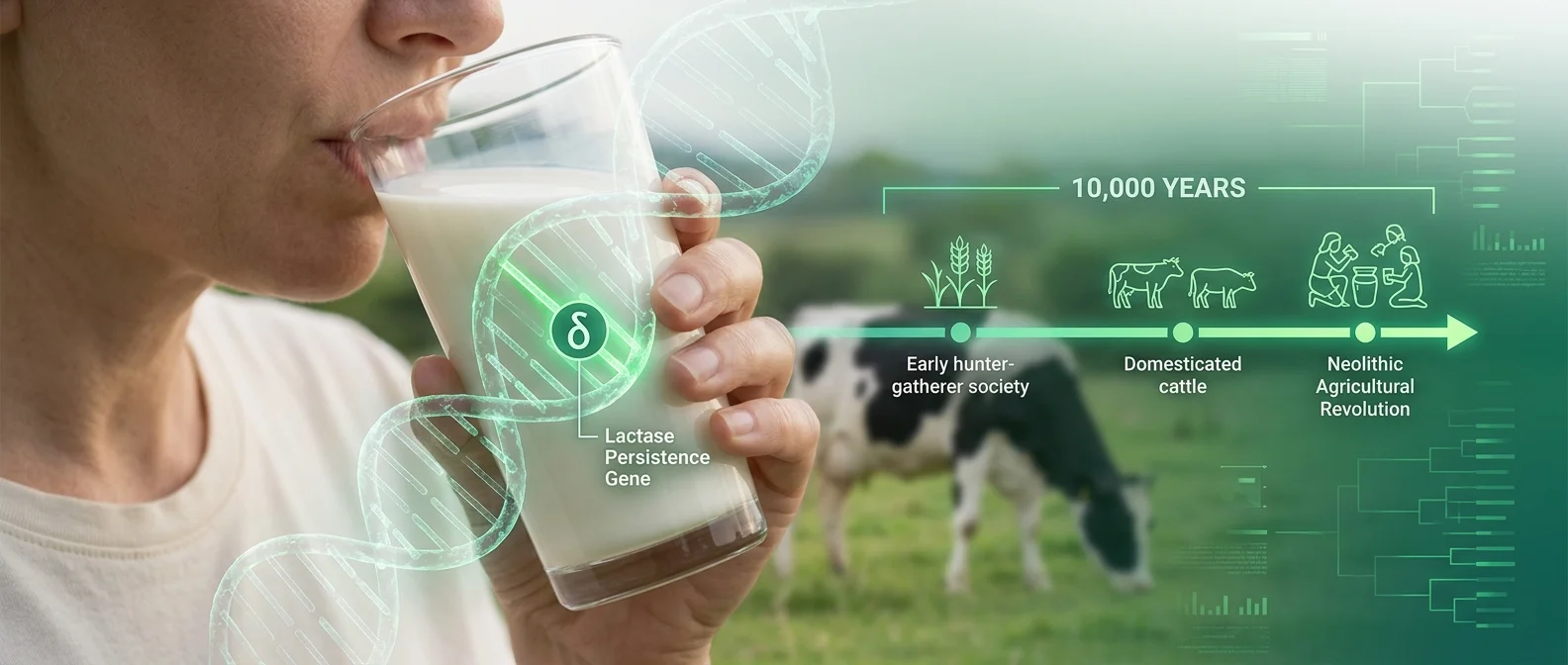
You pour milk into your morning coffee without a second thought. It feels completely natural, almost automatic. Yet if you could travel back 10,000 years, no adult on the planet could drink milk without stomach problems. The ability to digest milk after weaning isn't the norm — it's a mutation. And one of the most powerful selections human evolution has ever recorded.
📖 Read more: Carnivorous Plants That Devour Insects: Nature's Predators
An Enzyme That Shuts Down
Every mammal is born with the ability to digest lactose — the sugar in mother's milk. The enzyme lactase, produced by cells in the small intestine, breaks lactose into glucose and galactose, molecules small enough to be absorbed into the bloodstream. After weaning, however, something evolutionarily expected happens: lactase production drops dramatically. In dogs, cats, cows — in every mammal. And until recently, in humans too.
This decline is the “normal” state — the default setting of our biology. About 65-70% of the global population today is lactose intolerant — meaning the majority of humanity follows the prevailing biological rule. If you drink milk comfortably at 30, you're not “normal” — you carry an evolutionary mutation. Literally. And this mutation has an exceptionally interesting and complex history.
The -13910*T Mutation
The most widespread lactose tolerance mutation is called -13910*T. It's located in a regulatory region near the LCT gene, which codes for lactase. This single nucleotide change (C to T) keeps the gene “switched on” — lactase continues to be produced after weaning, for life. One letter in DNA, and your metabolism changes radically.
This mutation appeared in Europe about 7,500-10,000 years ago, in populations that had already begun domesticating animals and establishing the first permanent farming communities. It wasn't the only one: in East Africa, a completely different mutation (-14010*C) appeared independently in pastoralist peoples. The same in the Middle East. Three different mutations, three different continents, the same result — a phenomenon known in biology as convergent evolution. Evolution “discovered” the same solution multiple times independently, adapting different populations to the same dietary reality.

Animal Domestication: The Pressure That Changed Our DNA
The Neolithic revolution wasn't just agriculture — it was animal domestication too. Cows, goats, sheep. Suddenly, there was a new, rich source of calories, protein, and fat: milk. But most adults couldn't even digest it. Unless someone happened to carry the mutation. During famines, droughts, crop failures, or epidemics, this advantage became a matter of life and death — an extra glass of milk could keep a child alive.
Natural selection worked here with impressive speed. Genetic analyses from modern and ancient populations show that the -13910*T mutation spread faster than almost any other known human mutation — a striking phenomenon known as “strong positive selection” — one of the fastest gene expansions in human history. Today, over 90% of Scandinavians carry the mutation. In East Asian populations, which historically had no significant pastoralist tradition, the percentage drops below 10%.
The Map of Intolerance
The global distribution of lactose tolerance tells a story of migration, pastoralism, and climate. In Northern Europe, tolerance approaches 95%. In Southern Europe (Greece, Italy), it drops to around 50-70%. In China and Japan, just 5-10%. In East Africa, the Maasai — pastoralists for millennia — have high tolerance, while neighboring agricultural tribes have none at all.
Greece sits in an interesting position. With a tolerance rate of about 50-60%, several dozen points below Northern Europe, milk was never as central to the diet as feta and yogurt — fermented products that break down significant amounts of lactose during production, making them accessible even to the intolerant. Mediterranean wisdom of millennia meets molecular biology here: you don't need a genetic mutation if you ferment properly and patiently.
What Happens When You Lack Lactase
Without lactase, lactose reaches the large intestine unbroken — a part of the body not designed to handle it. There, billions of gut bacteria ferment it enthusiastically, producing hydrogen gas, methane, and carbon dioxide — meaning bloating, cramps, severe abdominal pain. Meanwhile, the osmotically active molecules created draw water into the intestinal lumen, causing diarrhea. The severity of symptoms depends on the amount of milk, consumption speed, microbiome composition, and residual lactase activity — every person reacts differently.
Intolerance isn't an allergy — this distinction is crucial. It doesn't involve the immune system, doesn't cause anaphylaxis, isn't life-threatening — just unpleasant and sometimes very bothersome. Many lactose-intolerant adults can consume small amounts of dairy without notable symptoms — especially fermented products like yogurt, kefir, and hard cheeses like Parmesan and cheddar, which contain virtually no lactose due to fermentation and aging.

Ancient DNA: The Evidence
Recent years have brought surprises from ancient DNA analysis. Skeletons of farmers in Central Europe from 7,000 years ago don't carry the mutation — meaning they domesticated cows before they could even digest milk. They likely used milk for cheese, while liquid consumption came later, when the mutation spread through natural selection.
A 2022 study in Nature, one of the largest archaeogenetic studies ever conducted, analyzed DNA from over 1,700 ancient skeletons across Europe and found that the mutation's prevalence increased sharply only in the last 3,000 years — much later than we thought. The hypothesis? Famines and epidemics intensified natural selection. In times of hunger, the ability to extract valuable nutrients from milk was vital. The pressure was biologically enormous — those with the mutation survived and reproduced, and the mutation spread within a few generations.
Culture Against Biology
You don't need to drink milk to get its nutrients — this is perhaps the biggest misconception. Many cultures without lactose tolerance developed fermentation technologies that elegantly overcome biology: yogurt in the Mediterranean, kefir in the Caucasus, kumis (fermented mare's milk) in Central Asia, paneer in India. Fermentation breaks down lactose through bacterial action, making dairy accessible to everyone.
In China, where dietary lactose intolerance consistently reaches 90%, the fresh milk industry only expanded after 1990 as a cultural import from the West. The gastrointestinal problems that followed in millions of consumers created a market for lactose-free milk — an industrial product that would be completely unnecessary and incomprehensible in Scandinavian populations. Biology determines the market, and the market adapts to biology.
A Mutation Writes History
The story of lactase is much more than digestive biology. It's an example of gene-culture coevolution — one of the best-documented examples in biology. Culture (pastoralism) created evolutionary pressure that changed our DNA, which in turn shaped cultures. Northern dairy traditions, Mediterranean cheese-making, Asian milk avoidance — all explained through a sequence of a few genetic letters.
Next time you drink milk without problems, think that this ability isn't yours by birthright as an adult — it was inherited from ancestors who herded cattle somewhere in the marshes and plains of Northern Europe thousands of years ago. A single genetic letter separates you from intolerance. And this microscopic letter wrote thousands of years of dietary, cultural, and evolutionary history.
Sources:
- Enattah, N.S. et al. “Identification of a variant associated with adult-type hypolactasia.” Nature Genetics, 30(2), 233-237, 2002
- Evershed, R.P. et al. “Dairying, diseases and the evolution of lactase persistence in Europe.” Nature, 608, 336-345, 2022