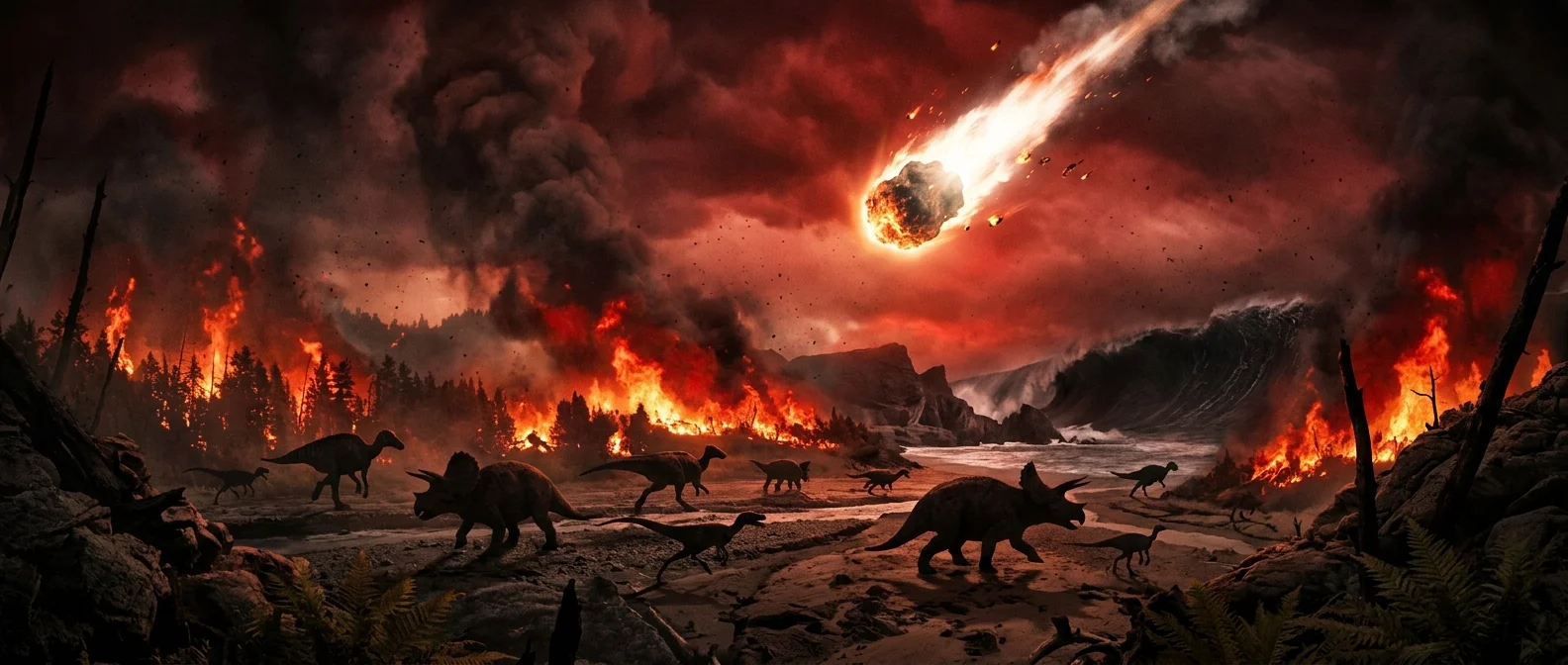
We know the dinosaurs went extinct. What rarely gets discussed is what exactly happened on that day — 66 million years ago — when a 10-kilometer-wide space rock slammed into Earth at 72,000 kilometers per hour. This isn't an article about theory. It's a step-by-step reconstruction of the most catastrophic day in the history of life on our planet.
📖 Read more: Feathered Dinosaurs: Discovery That Rewrites History
🌅 T-Minus 24 Hours: The Last Normal Day
In the late Cretaceous Period, the planet hums with its usual rhythm. Herds of Triceratops graze across plains in what is now Montana. Pterosaurs ride thermal updrafts above volcanic plateaus. In India, the Deccan Traps have been spewing thousands of cubic kilometers of lava for millennia — slowly poisoning the atmosphere with CO₂. The climate is warming, ecosystems are already under stress. But life continues.
No one — no creature — suspects what's approaching. An asteroid, part of an ancient group of space debris, is on a collision course with Earth. It's traveling at 20 kilometers per second. In less than 24 hours, it will change everything.
💥 T-Zero: Impact — Yucatan Peninsula
The asteroid enters the atmosphere. In fractions of a second, friction heats it to tens of thousands of degrees — but it doesn't have time to burn up completely. It's too large. It strikes Earth at what is now Chicxulub, on the northwestern coast of Mexico's Yucatan Peninsula.
The impact energy equals billions of nuclear bombs. The crater that opens instantly is at least 180 kilometers in diameter and tens of kilometers deep. Rock, water, and sediment are blasted into space. A fiery sphere — the fireball — expands for hundreds of kilometers around the impact site, carbonizing every living thing in its path.
🔥 The First Minutes: The World Burns
Within minutes, seismic waves penetrate the entire planet. Earthquakes measuring 11-12 on the Richter scale — hundreds of times stronger than the largest earthquake ever recorded — shake every continent. Millions of tons of rock, vaporized stone, and tektites (glass beads from melted soil) are launched into suborbital trajectories.
These incandescent fragments begin raining back down on Earth like fire from the sky. At every point on the planet where they fall, they ignite massive forest fires. Within hours, thermal radiation from the re-entering debris raises surface temperatures to the point of spontaneous combustion. Forests across entire continents catch fire almost simultaneously.
🌑 The First Hours: Darkness Falls
The cloud of dust and soot is already out of control. Billions of tons of fine dust, suspended ash, and sulfur gases rise into the stratosphere. Sunlight begins to weaken. Less than 24 hours after impact, the sky around the crater is almost completely dark.
This darkness won't last hours or days. It will persist for months — possibly years. Dust in the stratosphere will block sunlight from reaching the surface, plunging the planet into what scientists call an “impact winter.” Temperatures plummet dramatically. Photosynthesis stops.
☠️ The First Weeks: Food Chain Collapse
Without photosynthesis, plants die. Without plants, herbivores starve. Without herbivores, carnivores have no food. The food chain collapses from the bottom up like dominoes. But the destruction doesn't stop on land.
In the oceans, phytoplankton — the base of the marine food chain — dies en masse without light. Only about 13% of coccolithophorid and planktonic foraminiferal genera survive. Ammonites — the iconic shells that had dominated oceans for 300 million years — disappear completely. Along with them go belemnites, rudists, and large foraminifera.
📖 Read more: Halszkaraptor: The Duck-Dinosaur That Actually Swam
⚖️ Before and After
Before Impact
- Dinosaurs: dominant terrestrial creatures
- Ammonites: in every ocean
- Pterosaurs: ruling the skies
- Complete food webs functioning
After Impact
- ~80% of species extinct
- Ammonites: complete extinction
- Only birds & crocodiles from archosaurs
- Food webs destroyed
🧪 The First Months: Acid Rain and Chemical Chaos
The impact vaporized massive amounts of sulfate rocks in the Yucatan Peninsula. These gases — primarily sulfur dioxide — react with rain, creating sulfuric acid. Acid rain falls across the entire planet, poisoning soils, rivers, and shallow marine ecosystems. Reef corals decline by four-fifths. Marine organism shells cannot form in such acidic water.
Meanwhile, the burning of forests worldwide releases enormous amounts of CO₂ into the atmosphere. Initially, the “impact winter” cools the planet. But as dust gradually settles, the CO₂ remains — triggering a greenhouse effect that will warm the planet for thousands of years afterward. The planet swings from freezing to heating in just a few decades — a climate change of inconceivable speed.
🔎 How We Know: The Alvarezes and Iridium
This discovery story began in the early 1980s. American geologist Walter Alvarez and his father, Nobel Prize-winning physicist Luis Alvarez, discovered a thin clay layer rich in iridium — an element rare on Earth's surface but common in asteroids — precisely at the Cretaceous-Paleogene geological boundary. This layer was found worldwide.
The discovery triggered a scientific revolution. Initially fiercely contested — many paleontologists argued that dinosaurs were dying gradually due to climate change or volcanic activity. Confirmation came when the crater itself was discovered: Chicxulub, buried beneath sediments in the Yucatan Peninsula, 180 kilometers in diameter. Beyond the main crater, a second smaller crater was discovered at Boltysh, Ukraine in 2002, 2,000-5,000 years older — raising the possibility of multiple impacts.
🐊 Who Survived? The Mystery of the Survivors
Perhaps the most mysterious part of this story isn't who died, but who survived. Of the archosaurs — the group of reptiles that included dinosaurs, pterosaurs, crocodiles, and birds — only two lineages managed to cross the K-T boundary: birds and crocodilians. Turtles, lizards, and snakes were barely affected. Amphibians and mammals escaped relatively unscathed.
These patterns seem paradoxical. Why did a massive Tyrannosaurus die while a tiny crocodile survived? Why did rodent-sized mammals manage to cross to the other side? The most likely explanation: small creatures that could hide in underground burrows, live on little food, and endure low temperatures had an advantage. Large, specialized creatures — requiring enormous amounts of food — were doomed.
— Encyclopaedia Britannica, K-T Extinction"The K-T extinction is responsible for the elimination of about 80% of all animal species at or very close to the boundary between the Cretaceous and Paleogene periods, about 66 million years ago."
🌱 Epilogue: Dawn of a New World
The last night of the dinosaurs didn't last one night. It lasted months of darkness, years of winter, decades of chemical catastrophe. But the planet didn't die. From the ashes of a collapsed world, new ecosystems slowly began rebuilding. Mammals — small, nocturnal, insignificant creatures in the age of dinosaurs — suddenly found every ecological niche open. Within a few million years, they had spread to every corner of the planet.
The last night of the dinosaurs was the first dawn of mammals. And somewhere in that lineage — among the tiny survivors that emerged trembling from their burrows after the cataclysm — was the ancestor of every primate, every ape, every human. Without that asteroid, we wouldn't exist.