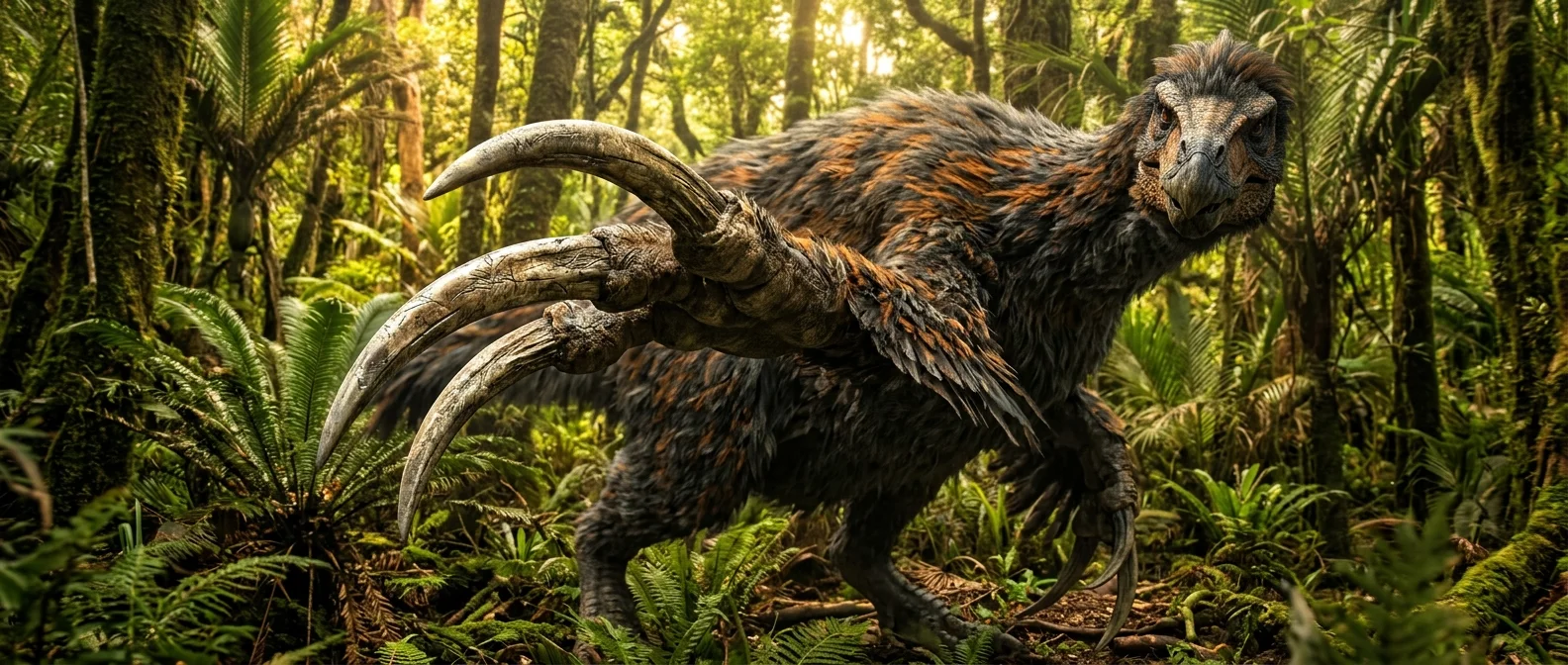
Picture a 33-foot dinosaur with a long neck like a sauropod, a body like a bear, and three massive claws on each hand — each one and a half feet long, curved like farmer's scythes. This isn't a creature of fantasy. This is Therizinosaurus, perhaps the strangest dinosaur that ever walked the Earth.
📖 Read more: Dinosaurs Had Cancer: What Ancient Bones Reveal
A Body That Defies Classification
Therizinosaurus lived during the Late Cretaceous, about 70 million years ago, in what is now Mongolia. Its name means “scythe lizard” — a reference to the massive sickle-shaped claws that resembled a farmer's harvesting tools. These claws, 20 inches of pure bone, are considered the longest ever found on a terrestrial animal.
But that's not the strangest thing about it. Therizinosaurus belongs to the theropods — the group of dinosaurs that includes Tyrannosaurus, Allosaurus, and Velociraptor. Bipedal carnivores, almost all of them. Therizinosaurus, however, was herbivorous. A bipedal theropod that didn't eat meat. It's like discovering that a lion feeds exclusively on salad.
The Mystery of Classification
For decades, nobody knew exactly what Therizinosaurus was. The first fossils were discovered in Mongolia in the 1950s, but they were fragmentary: some arm bones, ribs, and leg bones. Paleontologist Evgeny Maleev named it in 1954, but the truth is he didn't have enough evidence to understand what kind of animal he was dealing with.
These related species became the keys: Alxasaurus, Erlikosaurus, and Beipiaosaurus were smaller but more completely fossilized. By studying their skeletons, scientists were able to confirm that Therizinosaurus and its relatives were indeed theropods — but theropods that took a completely different evolutionary path.
From Meat to Plants: An Evolutionary U-Turn
The therizinosauroid group represents one of the most dramatic dietary transitions in the animal kingdom. According to the Encyclopaedia Britannica, the shift from carnivory to herbivory occurred early in the group's evolution. The most primitive therizinosaurid, Falcarius, is considered a transitional species: it already had teeth suitable for plant-eating and broader hips, but still retained the pelvis and running legs borrowed from its carnivorous ancestors.
Typical Theropod Features
- Bipedal stance
- Sharp teeth (carnivory)
- Narrow hips (speed)
- Short arms
Therizinosaurid Features
- Bipedal stance (retained)
- Leaf-shaped teeth (herbivory)
- Broad hips (heavy gut)
- Massive arms with claws
This transition required dramatic physical changes. Teeth changed shape to slice leaves. Hips broadened to accommodate a larger digestive system — essential for processing plant fibers. And the arms, instead of shrinking like in T. rex, developed massive claws. But for what purpose?
The transition from carnivory to herbivory wasn't unique to therizinosaurids — but it was the most dramatic. Other theropods, like the ornithomimids, followed a similar path, but none developed such extreme adaptations. Therizinosaurus's body was heavy and bulky — about 5 tons — with a low center of gravity, ideal for static feeding. It stood like a bear, stretched like a giraffe, and held branches like an anteater.
The Scythes: Tools, Not Weapons
Therizinosaurus's massive claws — 20 inches of pure bone, likely even larger with their keratin sheaths — are the largest claws of any terrestrial animal ever discovered. Each hand had three fingers, each equipped with a curved scythe-like claw.
📖 Read more: Megalodon: Ocean's Ultimate Apex Predator Revealed
But they weren't necessarily weapons. According to London's Natural History Museum, experts aren't sure if the claws were robust enough for combat use. Their most likely function was practical: pulling branches and vegetation closer to the mouth — exactly like modern anteaters do with their own long claws. A second possible use: threat display. A 33-foot animal raising three half-meter claws would certainly make predators think twice before attacking.
Feathers, Eggs, and Embryos
One of the most exciting discoveries about therizinosaurids came from Beipiaosaurus: fossils of this smaller relative revealed large areas of feathered covering on the chest, arms, and legs. This means Therizinosaurus was likely feathered — a giant covered in primitive plumage.
Even more remarkable: therizinosaurid embryo skeletons have been found inside fossilized eggs. These embryos possess unmistakable theropod characteristics that are lost by adulthood — providing valuable information about bone formation sequences in dinosaurs. The discovery definitively confirmed their position on the family tree.
Blind in Jurassic World? Not Really
Jurassic World Dominion (2022) featured a blind Therizinosaurus in a scene that went viral. But according to the Natural History Museum, there's no reason to believe Therizinosaurids were normally blind. An animal can lose its sight from injury, disease, or brain damage, but this doesn't apply to an entire species.
The cinematic portrayal, while impressive, defies biological logic. A massive herbivore needed its vision to locate food, recognize predators, and communicate with other members of its species. The scene's massive popularity, however, brought Therizinosaurus into the spotlight — something paleontology hadn't achieved in decades.
A more realistic picture: Therizinosaurus may have been herbivorous, but that doesn't mean it was gentle. As the Natural History Museum notes, many modern herbivores — elephants, rhinos, hippos — can be extremely dangerous. A 5-ton animal equipped with half-meter claws wasn't easy prey for any predator — even Tarbosaurus, the “Asian T. rex” that shared its Late Cretaceous Mongolian habitat.
An Unknown Body
Here lies the greatest paradox: Therizinosaurus, one of prehistory's most iconic creatures, is known only from fragmentary bones — arms, ribs, and some leg bones. We don't have a complete skull. We don't have a whole skeleton. Every reconstruction we see today is based on educated guesses — estimates based on related species like Erlikosaurus, which was smaller but much more completely preserved.
To this day, this massive dinosaur remains an enigma. A theropod that doesn't eat meat. A predator's body that feeds on ferns. Scythe claws that probably weren't for fighting. And a body that, without its smaller relatives, would remain completely unclassifiable. Therizinosaurus reminds us that evolution doesn't follow rules — it just works.
In Mongolia's Nemegt Formation, where its fossils were found, Therizinosaurus shared its world with an impressive cast: Tarbosaurus (the region's largest predator), the armored ankylosaur Tarchia, the giant hadrosaur Saurolophus, and dozens of smaller dinosaurs. Late Cretaceous Mongolia was a world of floodplains, slow rivers, and dense vegetation — ideal for a bulky herbivore with scythe-like claws and an endless appetite.