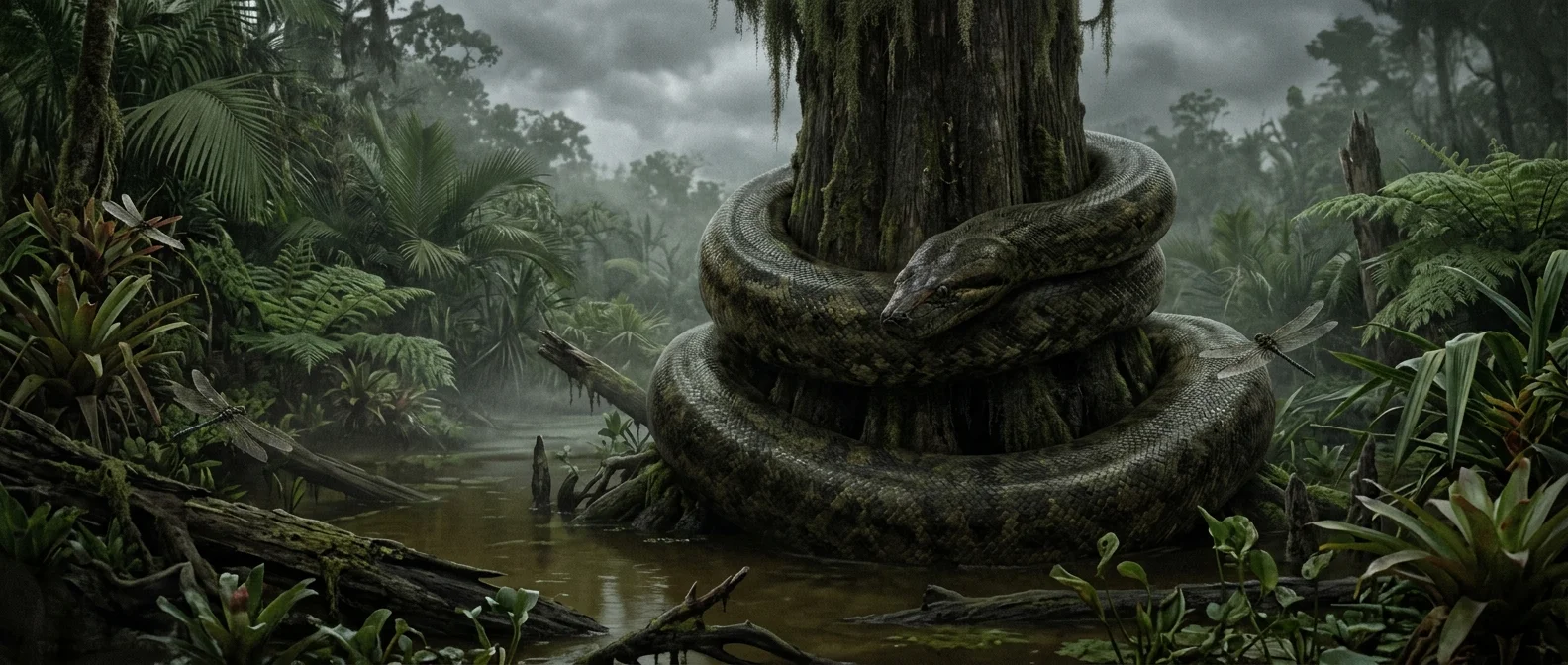
Five years after the dinosaurs vanished, Earth was a hot, tropical greenhouse. In the swampy forests of what is now Colombia, one animal ruled supreme: a snake so massive that as it slithered past you, it would reach your waist. Titanoboa was the planet's apex predator — and the largest snake that ever lived.
📖 Read more: T-Rex: 10 Shocking Facts About the King of Dinosaurs
Numbers That Defy Belief
Titanoboa (Titanoboa cerrejonensis) lived during the Paleocene Epoch, 60 to 58 million years ago. This means it never coexisted with dinosaurs — it appeared several million years after their mass extinction. Based on estimates from its vertebrae, the average adult length was approximately 42.7 feet (13 meters) with an average weight of 2,500 pounds. Some individuals may have approached 50 feet.
Titanoboa
- Length: ~42.7 ft (average adult)
- Weight: ~2,500 lbs
- Vertebrae: 250+
- Era: Paleocene
Green Anaconda (today)
- Length: ~21 ft (average)
- Weight: ~550 lbs
- Record: ~31.5 ft (measured)
- Era: present day
No living snake has ever been documented exceeding 31.5 feet — not the legendary reticulated python, not the green anaconda. Titanoboa was roughly twice the size of even the largest modern anaconda. A realistic way to visualize it: as it slithered, it reached the waist of an average human — like a moving wall.
The Discovery: Bones Among the Coal
The discovery story begins at the Cerrejón coal mine in northern Colombia, near Lake Maracaibo. There, beneath layers of coal, paleontologists found something remarkable: hundreds of fossilized bones from unknown animals. Crocodiles, turtles, fish — easily recognizable. But among them were bones that no one could classify. Initially, they were thought to be parts of crocodilians.
📖 Read more: Mosasaurus: Ancient Ocean Predator That Ruled the Seas
Titanoboa was scientifically described in 2009, five years after excavation. Fossils from approximately 30 individuals have been recovered — most adults, but also some juveniles. Most specimens consist of vertebrae and ribs, typical for snake fossils. At least one nearly complete specimen with a skull has been recovered. The fact that so many individuals had similarly gigantic vertebrae proves that 42 feet was the norm, not the exception.
The method for calculating size was quite reliable. Paleontologists measured the vertebrae — individual segments of the spinal column — and applied ratios based on modern snakes. Titanoboa is estimated to have had over 250 vertebrae, while a modern python has about 200-400 but in much smaller size. Each individual vertebra of Titanoboa was massive in comparison: a photograph published by the research team shows an anaconda vertebra next to a Titanoboa vertebra — the difference is like a golf ball next to a tennis ball.
Why So Massive? The Temperature Theory
Snakes, as cold-blooded animals, depend on environmental temperature for their metabolism. During the Paleocene, Earth was exceptionally hot — significantly warmer than today. According to Encyclopaedia Britannica, "a snake would need an extremely warm environment, like that which characterized the Paleocene, to grow as large as Titanoboa."
Jonathan Bloch confirms: "We believe these reptiles got so large because it was much hotter in the past, which allowed these cold-blooded animals to get larger than what we see even in the warmest parts of the world today." The relationship between size and temperature makes Titanoboa a unique “witness” to the climate of that era — a kind of natural thermometer from 60 million years ago. If we want to learn how hot the planet was in an age before human measuring instruments, we need only measure the vertebrae of a snake.
📖 Read more: Mummified Dinosaur: 67-Million-Year-Old Skin Preserved
Life in the Swamps: A Lost World
Titanoboa spent most of its time in water. The geological structure of the Cerrejón mine and the fossils found alongside it — mangrove plants, crocodilians, turtles, fish — show that the area was flooded. Like modern anacondas, Titanoboa likely hid in shallow waters, concealed in vegetation, waiting to ambush its prey.
The area resembled modern swamp forests of the Mississippi Delta or the Everglades — but it was tropical, even hotter, and with virtually no mammal large enough to threaten this giant. Titanoboa was unquestionably the apex predator of its ecosystem — likely for 10 to 20 million years.
📖 Read more: Triceratops: The Armored Tank of the Cretaceous Period
The First Tropical Rainforest
What makes Cerrejón even more significant: it didn't just reveal Titanoboa fossils. It revealed the first evidence of tropical rainforest after dinosaur extinction. Until then, most of our knowledge about life immediately after the dinosaurs came from cooler regions. Tropical forests covered the rocks — centuries of coal mining removed layers of earth, exposing fossils that would otherwise remain buried. Many of the plants found there are still recognizable in tropical forests today. This means Titanoboa lived in the nascent tropical rainforest — the first of the post-dinosaur era.
According to Bloch, it "provides a unique window into the past, immediately after dinosaur extinction in South America" — and shows that biodiversity in the tropics was already explosive within a few million years after the catastrophe.
Modern Relatives and Vanished Giants
Titanoboa belongs to the same superfamily as today's anacondas and boas. It's not yet clear whether it was more closely related to the anaconda or the boa. What is clear is that no modern descendant even approaches its size — reaching at most two-thirds of its length in the most extreme cases.
Notably, Titanoboa, as a constrictor snake, was not venomous. It killed by constriction — wrapping its massive body around prey and squeezing until suffocation. With a weight over one ton and the length of a bus, it could swallow animals considerably larger than modern snakes can handle. The crocodiles of that era — some quite large — were likely on the menu. This places it in a unique position: an apex predator without legs, teeth sharp but almost exclusively for gripping, and only body mass for killing.
Titanoboa reminds us that size in the animal kingdom isn't constant — it depends on climate, resources, and competition. In an era without large predators in the tropics, in a greenhouse-hot climate, evolution created a snake that could swallow a crocodile whole. And that's not hyperbole: the turtles and crocodilians of Cerrejón were among Titanoboa's likely prey.
Sixty million years later, the world's largest snake doesn't even reach 32 feet. The planet cooled. Mammals conquered the apex positions. And snakes shrank. Titanoboa remains proof that once, the world belonged to something much slower, much more cold-blooded — and much, much larger.