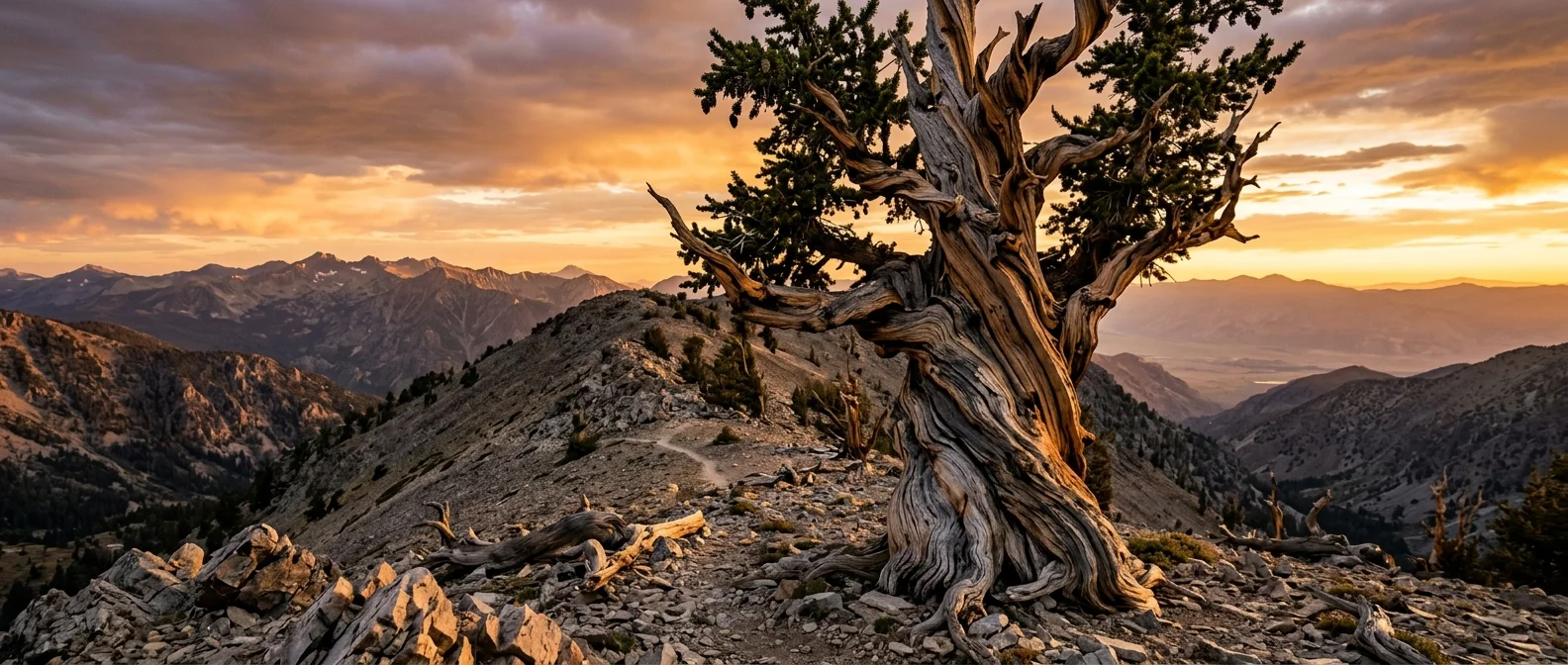
Somewhere in California's White Mountains, at 10,000 feet elevation, stands a bristlecone pine that was already ancient when the pyramids of Giza were built. Nobody knows exactly where it is — the U.S. Forest Service keeps its location classified. We know it only as "Methuselah," and its rings count over 4,856 years of life. How does a tree survive that long? What does nature know about longevity that we're still figuring out? While our smartphones break after two years, this tree has weathered five millennia.
📖 Read more: The 507-Year-Old Clam: Earth's Oldest Animal
📖 Read more: Corpse Flower: Giant Bloom Smells Like Death Every 10 Years
Bristlecone Pine: Portrait of an Ancient Survivor
The bristlecone pine (Pinus longaeva) looks nothing like any tree you've seen. Twisted trunks, bare wood, almost skeletal. Most of the wood is dead — only a thin strip of bark stays alive. This isn't weakness, it's strategy. The tree sacrifices parts of itself to survive: fewer living tissues mean less need for water and nutrients. They grow in dolomitic limestone, in soil so poor that no other tree can compete — and that protects them from competition and fire. The soil is so dry and barren that vegetation is minimal — which means no fuel for fires. The bristlecone claimed the most hostile corner of the planet — and that isolation became its shield. Bristlecone pines reach just 30-50 feet tall, often less. They look more like sculptures than trees — their twisted branches are the result of millennia of wind and ice, functioning as natural sculptures that resist weathering.
4,856 Years: A Life in Numbers
Methuselah sprouted around 2831 BCE. When Abraham left Mesopotamia, this tree was already 800 years old. When Moses climbed Sinai, it was 1,300. When Christ was born, it had nearly three millennia behind it. Each ring represents one year of life — some paper-thin in drought years, others wider when rain came. Edmund Schulman discovered it in 1957 and named it Methuselah, after the biblical patriarch who lived 969 years. But Methuselah the tree far surpassed him — and keeps going. Every year it adds another ring, quietly, on a mountain where wind blows almost constantly. Average temperature at 10,000 feet in the White Mountains drops to -4°F in winter, and winds hit 100 mph. Yet Methuselah keeps pushing out new needles every spring.

The Secret: Slow Growth, Hard Resin
The bristlecone's longevity isn't luck. Its wood is extremely dense, packed with resin that resists fungi, insects, and decay. Its growth is extraordinarily slow — some years, the growth ring is just 0.3 millimeters. For comparison, a normal pine in fertile soil develops rings 5-10 millimeters each year. This slow growth creates wood almost petrified in density. Even after death, a bristlecone can stand upright for thousands of years without decomposing in the dry climate of the White Mountains. Dead bristlecone trees are used for dendrochronology dating back 10,000 years. This means we have a continuous climate record covering the entire Holocene — the epoch when civilization was born. This method is used today even in astrophysics: supernovas that occurred thousands of years ago left traces of radioactive carbon in bristlecone rings.
Dendrochronology: Diaries Made of Wood
Bristlecone rings don't just count age — they're climate archives. Each ring reveals that year's temperature and rainfall. Andrew Ellicott Douglass developed dendrochronology in the early 20th century, but bristlecones made it precise. The method even calibrated carbon-14 radiocarbon dating, correcting errors of hundreds of years. This calibration radically changed our understanding of prehistoric timing, proving many civilizations were older than we thought. Without bristlecones, archaeology would have wrong dates for entire civilizations.
📖 Read more: Why Snakes Turn Cannibal: Disturbing 2026 Trend
Prometheus: The Tree That Was Cut Down
In 1964, graduate student Donald Currey cut down a bristlecone in Nevada's Wheeler Peak — and counted 4,862 rings. It was the oldest known tree on the planet, called Prometheus. Its felling is considered one of the greatest environmental tragedies in science history. The reaction was so intense it led to the creation of Great Basin National Park and stricter laws protecting ancient trees. The Prometheus story reminds us that science can destroy what it tries to study if it's not careful. After the destruction, Currey said he was shocked that he had no idea of the tree's age when he got permission to cut it. The log is now on display at the Great Basin National Park museum.

Other Ancients: Who Else Competes
Methuselah isn't alone. An unnamed bristlecone in the same mountains, discovered in 2012, measured 5,067 years — it's now the actual oldest. In Chile, a cypress (Fitzroya cupressoides) known as "Gran Abuelo" is estimated to exceed 5,000 years, though this is still being researched. In Sweden, the Norway spruce Old Tjikko has a root system 9,550 years old, though the visible trunk is only centuries old. The distinction between "individual" age and "clonal" age is a central question in longevity biology. Research shows ancient trees share common traits: extremely slow growth, isolated locations, and resistance to extreme conditions. Now something has shifted: humans are changing the environment faster than Methuselah can adapt.
Climate Change: The New Enemy
For 5,000 years, bristlecones beat everything: drought, ice, 90-mph winds. But climate change brings something new: warmer temperatures at high elevations. This means species that couldn't reach high altitudes before — like limber pines — now climb up and compete with bristlecones for space. Meanwhile, warmer winters wake insects earlier, exposing trees to parasites they never faced before. Studies show temperature at high elevations in California has risen 2.7°F in recent decades — enough to upset 5,000 years of balance. The slow growth that protected them for millennia might now become their weakness — because they can't adapt that fast. The irony cuts deep: the tree that survived 50 centuries faces threats created in 50 years.
What Methuselah Teaches Us
The real value of these trees isn't just their age — it's what they tell us. Their rings reveal volcanic eruptions, drought periods, even solar activity from thousands of years ago. The scientific value of dendrochronology goes far beyond botany: it's used in climatology, archaeology, even astrophysics. Methuselah isn't just a tree — it's a living archive of five millennia of planetary history. And every year, it writes another page. While we build and tear down, it just grows — slowly, steadily, indifferent to the empires that passed and wars that were forgotten. If you want a reminder of how small human history is, just think that Methuselah was here before all of it. And with a little care, it'll be here after. Because longevity doesn't require speed — it requires patience, endurance, and the wisdom to grow slowly.
"If you want to feel respect for time, stand before a bristlecone. You'll understand how small human history really is."
— Tom Harlan, dendrochronologist, University of ArizonaSources:
- Schulman, E. — "Bristlecone Pine, Oldest Known Living Thing," National Geographic, 1958
- Salzer, M. W. et al. — "Recent unprecedented tree-ring growth in bristlecone pine at the highest elevations," Proceedings of the National Academy of Sciences, 2009