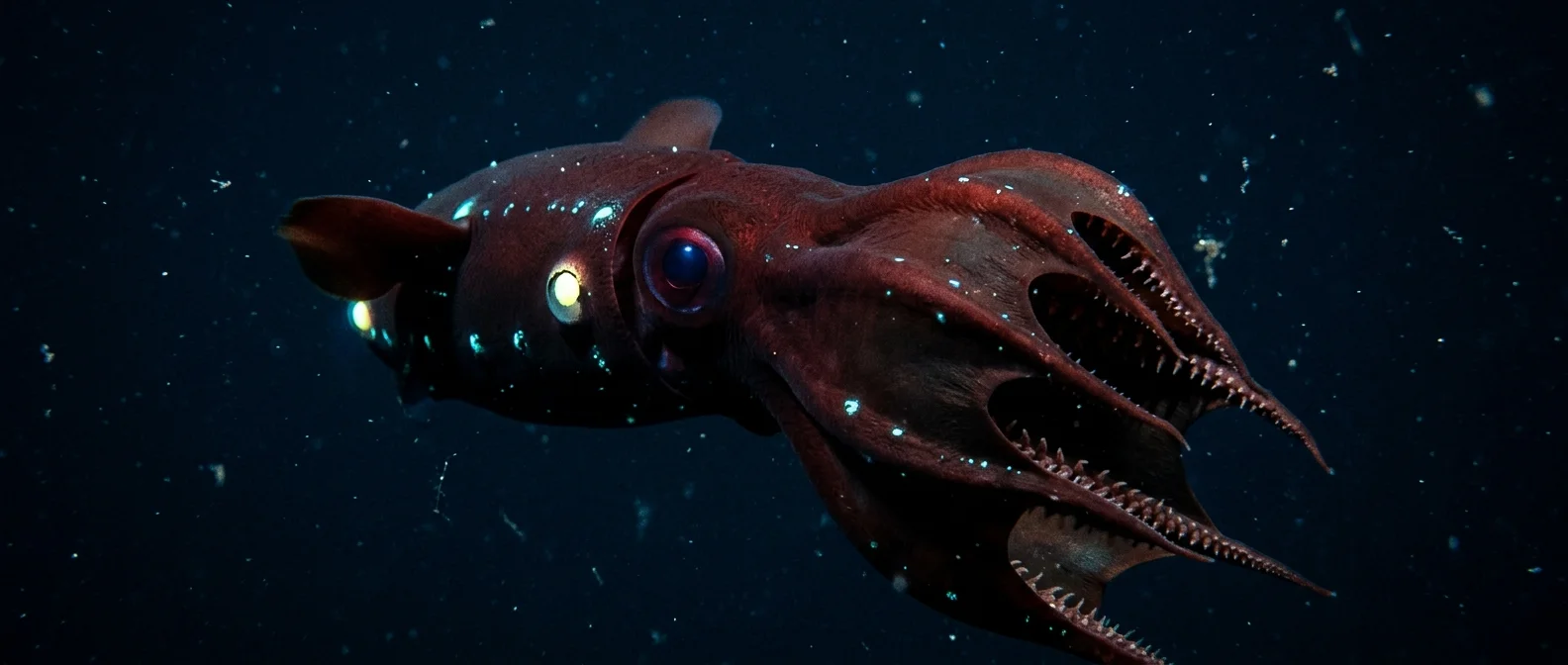
Vampyroteuthis Infernalis: The Gentle Deep-Sea 'Monster' That Survives Where Others Die
With a name that literally means Vampyroteuthis infernalis — “vampire squid from hell” — you'd expect something terrifying. Instead, this creature is a gentle janitor of the deep, feeding on marine “snow” — dead debris that drifts down from the surface into darkness. What follows isn't a horror story. It's something better: the biography of a living fossil that thrives where most creatures die — in the oxygen minimum zone, hundreds of meters below any ray of light.
📖 Read more: 10 Creatures That Glow in the Ocean's Darkness
📋 Classification File: Neither Squid Nor Octopus
First twist: the vampire squid isn't a squid. It belongs to its own order, Vampyromorphida — the last survivor of an ancient cephalopod group that was once abundant. Imagine a creature somewhere between octopuses and squids, without truly belonging to either. It has 8 arms connected by webbing — like a vampire's cloak — and 2 thin thread-like sensory organs that unfurl far longer than its body. These threads aren't hunting tentacles. They're sticky antennas that collect marine snow as the animal hovers silently. At full length it reaches just 30 centimeters — smaller than a school ruler. But smallness here is an advantage: less mass means less energy needed, less oxygen consumed, greater survival odds in the ocean's poorest zone.

🌊 Oxygen Minimum Zone: Home in the Suffocating
The vampire squid lives at 600 to 900 meters depth — and in some cases down to 3,300 meters. This range corresponds to the Oxygen Minimum Zone, a region with less than 5% of surface oxygen. There, temperatures barely exceed 2°C. Almost no light penetrates. For most marine creatures, this means death. For the vampire squid, it means safety: few predators can function in such conditions. Its metabolism is the lowest recorded in any cephalopod — almost “idle mode” that allows survival on minimal food. The hemocyanin in its blood — the same blue copper protein that octopuses use — has evolved here for extreme efficiency: it binds oxygen even at concentrations that would collapse any vertebrate's physiology. Every cellular system is tuned to minimum — a biological version of power-saving mode.
🔴 Invisible in Darkness: The Red Strategy
In the deep ocean, red light never penetrates. This means a dark red body — like the vampire squid's — appears completely black to predators' eyes. It's perfect camouflage without chromatophores or shape-shifting: simply color that exploits physics. Its eyes, correspondingly, are massive relative to its body — the largest proportionally of any animal on Earth — optimized to collect every photon that reaches those depths. The same principle applies to the internal tissue of its webbing: the inner side of the arms has darker coloration than the outer — a double layer of invisibility. Even its eggs are transparent, nearly invisible in water. Nature designed every part of this organism around one idea: don't attract attention.
💡 Bioluminescence: Light Instead of Ink
Shallow-water squids eject ink to confuse predators. At 800 meters, in absolute darkness, ink wouldn't be visible. So the vampire squid evolved something entirely different: bioluminescent mucus. When threatened, it ejects a cloud of glowing fluid — blue-green spheres of bioluminescence that shine in the darkness for seconds. The predator becomes disoriented by the flash while the vampire disappears silently in the opposite direction.
But it has a second trick. The tips of its arms glow blue-green — controllably, like flashlights. In a study by MBARI (Monterey Bay Aquarium Research Institute), the photophores at the arm tips function simultaneously: they confuse the animal's silhouette, making it impossible for predators to understand what exactly they're seeing. A comparison is worth making: shallow cephalopods use chromatophores for camouflage — they change color. The vampire squid does the opposite: in a dark environment, it doesn't hide by changing color — it “explodes” into light, creating confusion instead of invisibility.

📖 Read more: First Video of Colossal Squid: Ocean's Ultimate Predator
🛡️ The "Pineapple": Defensive Inversion
The most impressive defensive move? The vampire squid can turn itself completely inside-out. It raises its arms above its head, inverting the webbing — and reveals rows of dozens of sharp, pointed cirri (spiny projections). In this posture, the animal resembles a spiky fruit — no predator would want to bite something like that. The cirri don't actually wound, but the visual message is clear: not worth the trouble. Researcher Henk-Jan Hoving observed this posture dozens of times through ROV (remotely operated vehicles). Every time, predators — mainly large-mouthed fish — backed away. The combination of inversion + bioluminescent mucus + glowing arm tips creates a defensive triad without equal in any other cephalopod.
❄️ Marine Snow: Food from the Dead
Until 2012, no one knew what it actually ate. The work of Hoving & Robison at MBARI proved that the vampire squid is a detritivore — it feeds on “marine snow,” a constant stream of microscopic dead particles falling from upper layers: dead plankton, abandoned larval shells, microorganism waste, decomposing crustacean fragments. The two long sensory filaments are covered with sticky mucus and sweep through the water. When particles stick, the arm slowly draws them toward the mouth.
This discovery was significant: no other cephalopod feeds this way. Most squids and octopuses are active hunters. The vampire squid evolved into a passive collector — a strategy that explains its extremely low metabolism. Why waste energy hunting when food falls by itself? The importance of this food chain extends beyond the animal itself: by sweeping up marine snow, the vampire squid and other deep-dwelling organisms “sequester” organic carbon at great depths — a process known as the biological carbon pump. This partially regulates the climate of the entire planet.
🧬 Living Fossil: Sole Survivor
The order Vampyromorphida once included many species. Today only one remains: Vampyroteuthis infernalis. Vampyromorph fossils date back over 200 million years — before even the Jurassic. This means this creature survived three mass extinctions. The strategy? Find a place nobody wants — the oxygen-free zone — and stay there. Reduce needs. Feed on whatever falls. Don't compete with anyone.
If evolution is a game, the vampire squid doesn't play to win. It plays to survive — and that proves to be enough. A 2015 study confirmed something even more unusual: unlike most cephalopods that reproduce once and die, the vampire squid reproduces multiple times throughout its life. It finds ways to cheat every biological rule. Its distribution is global — tropical and temperate oceans, from the Atlantic to the Pacific — but always at the same depths, always in the oxygen minimum zone. No other cephalopod has specialized in this ecosystem.
Thousands of meters below sunny surfaces, in waters that would kill most creatures, a small dark red animal hovers silently. It doesn't hunt. It doesn't compete. It simply exists — for 200 million years. Perhaps true power isn't speed or teeth. Perhaps it's patience. On a planet full of hunters, the vampire squid reminds us that the oldest survival strategy isn't dominance — it's accepting the darkness.