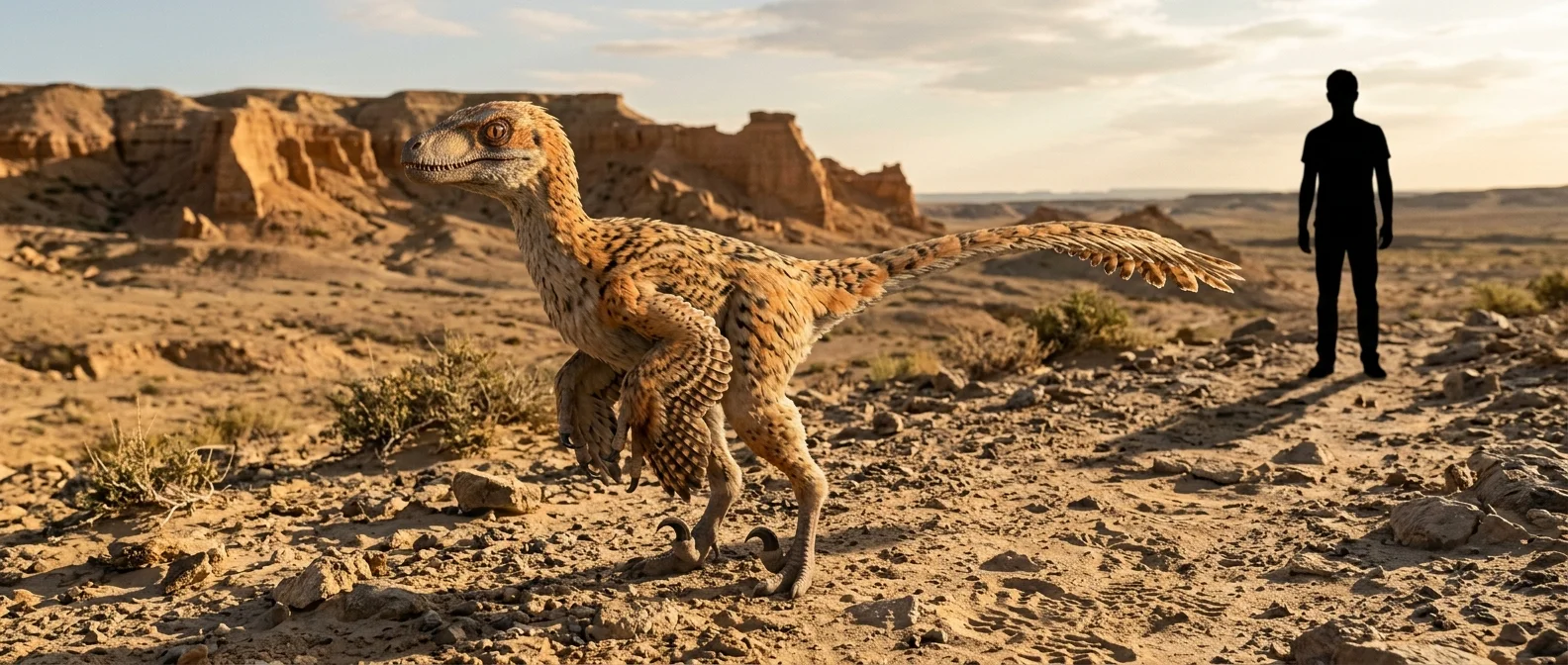
Few dinosaurs achieved the fame of Velociraptor — but almost everything the public believes about this predator is wrong. The image of a terrifying, human-sized, scaly hunter from blockbuster films is, at best, a fantasy based on the wrong dinosaur entirely. The real Velociraptor was something completely different — and far more fascinating.
📖 Read more: Triceratops: The Armored Tank of the Cretaceous Period
Myth #1: It Was Massive
In movies, Velociraptor appears as a creature standing at adult human height — large enough to open doors and chase people through corridors. The truth? It was roughly the size of a small turkey.
The real Velociraptor mongoliensis measured about 6.5 feet long (including its tail), stood just 1.6 feet tall at the hip, and weighed at most 33 pounds. To put this in perspective: it was smaller than an average Labrador retriever. The dinosaur actually modeled in films was Deinonychus — a significantly larger relative that would have resembled the cinematic fantasy much more closely.
Adding insult to injury, shortly after the first film's premiere, scientists discovered Utahraptor — a dromaeosaurid even larger than the fictional “Velociraptors” of the big screen.
Myth #2: It Was Bald
The second major cinematic deception: Velociraptor is always portrayed with naked, reptilian skin. This misconception was definitively overturned in 2007, when researchers discovered quill knobs on an exceptionally well-preserved Velociraptor forearm from Mongolia.
These knobs are attachment points for flight-related feathers in modern birds. While Velociraptor's short arms prevented it from flying or gliding, the presence of feathers suggests that dromaeosaurid ancestors once flew — and later lost this ability. The feathers likely served for thermoregulation, mating displays, egg protection, or traction while running uphill.
🎬 Velociraptor: Movies vs Reality
🎥 In Movies
- Height: ~6 feet
- Skin: Naked, reptilian
- Behavior: Pack hunter
- Intelligence: Opens doors
- Based on: Deinonychus
🦴 In Reality
- Height: 1.6 feet (at hip)
- Covering: Feathers
- Behavior: Mostly solitary
- Diet: Small animals, insects
- Was: Like a large turkey
📖 Read more: Pachycephalosaurus: Head-Butting Terror That Scared T-Rex
The Deadly Claw
If there's one feature the movies got right, it's the sickle-shaped claw. Velociraptor had on the second toe of each foot a retractable, curved claw measuring 3.5 inches long — like a switchblade that deployed only when needed. Normally, it kept this claw raised off the ground, exactly like a folded knife.
According to a 2011 study in PLOS ONE, these claws didn't function as slashing weapons — they worked as hooks, similar to the talons of modern birds of prey. Velociraptor likely leaped onto its prey, hooked its claws into flesh, and held on while using its beak and teeth to finish the job.
What It Actually Ate
Forget the human-hunting scenes. Velociraptor “spent the vast majority of its time eating small things” — reptiles, amphibians, insects, small dinosaurs and mammals, according to paleontologist David Hone of Queen Mary University of London.
This battle, however, was likely an exception. “Few predators ever attack prey larger than 50% of their own body mass,” Hone explains. The Velociraptor that attacked the Protoceratops — a sheep-sized herbivore — may have been starving or simply “young and stupid.”
In 2012, researchers discovered something even more unexpected: a large pterosaur bone inside a Velociraptor's stomach. The pterosaur had a wingspan of about 6.5 feet — large enough to be challenging prey. Most likely, the Velociraptor had scavenged it, revealing the animal as an opportunistic hunter and scavenger rather than the super-predator of cinema.
"Few predators ever attack prey larger than 50% of their own body mass. Velociraptor spent the vast majority of its time eating small things."— David Hone, paleontologist, Queen Mary University of London
📖 Read more: T-Rex: 10 Shocking Facts About the King of Dinosaurs
A Bird Dressed as a Dinosaur
Velociraptor was one of the most “bird-like” dinosaurs ever discovered. It possessed a specialized wrist bone that allowed it to rotate its wrist sideways in a wing-flapping motion — exactly the same movement birds use in flight. This enabled it to thrust its arms forward to grab fleeing prey.
It belonged to the family Dromaeosauridae — small to medium-sized bird-like dinosaurs. Its skull, measuring 9 inches long, was concave on top and convex below. The snout — narrow, long, and shallow — comprised 60% of the entire skull. Its jaws held 13-15 teeth above and 14-15 below, serrated mainly on the rear edge.
Its tail was rigid and inflexible, made of fused bones, and functioned as a counterbalance — keeping it stable while running or jumping. It could reach speeds up to 37 mph in short bursts.
Discovery and Legacy
The first Velociraptor was discovered in August 1923 in Mongolia's Gobi Desert by Peter Kaisen, during the American Museum of Natural History's first expedition. The find included a crushed but complete skull and a claw. In 1924, Henry Fairfield Osborn, then museum president, gave it its name — from Latin velox (swift) and raptor (seizer).
To this day, all Velociraptor fossils come from the Gobi Desert — V. mongoliensis from Mongolia and V. osmolskae, recognized only in 2008, from China's Inner Mongolia. It lived in a dry, sandy environment — explaining why many of its fossils preserved so well in sand dunes.
Velociraptor may not have been the terrifying hunter we imagined. But it was an extraordinarily evolved creature — feathered, fast, agile, with tools deadly despite their microscopic scale. The real Velociraptor doesn't need movies to impress. The truth is enough.