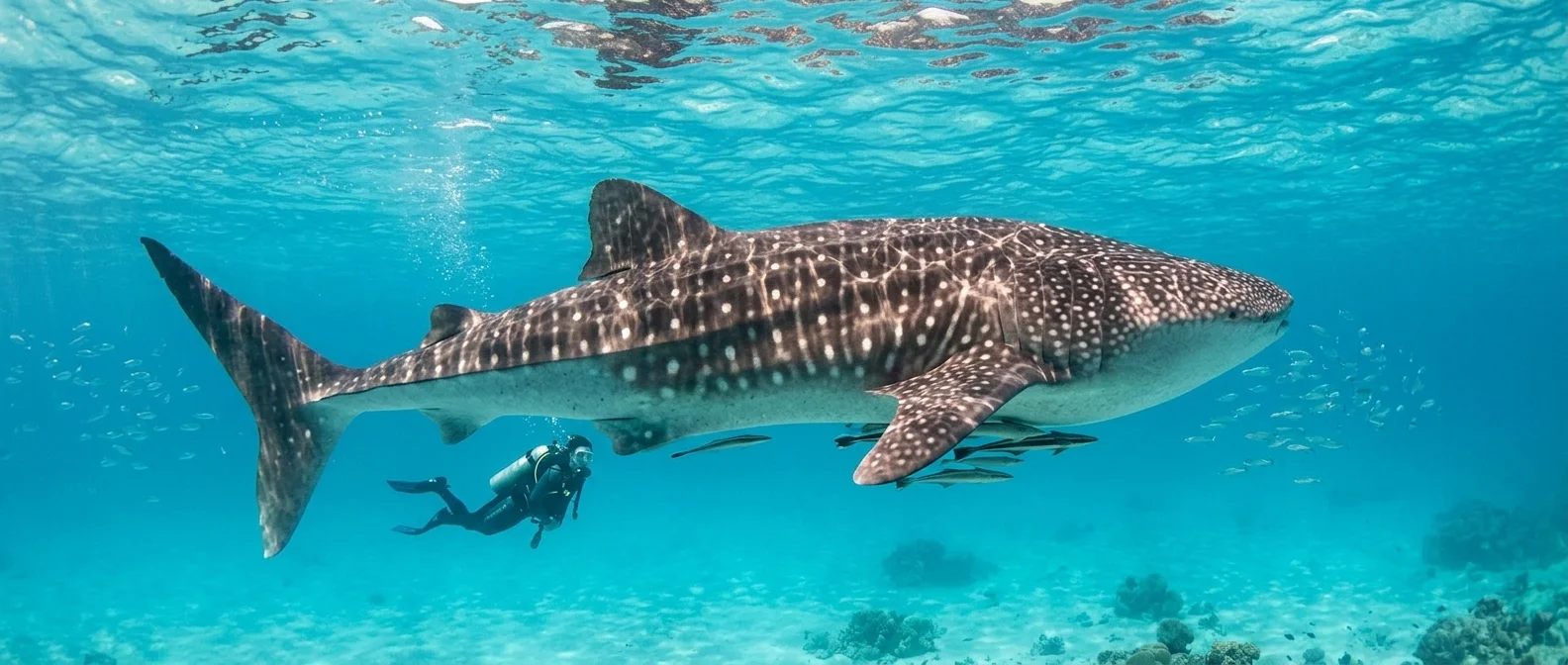
Somewhere in the crystal waters of Australia's Ningaloo Reef, a shadow emerges from the depths — slow, majestic, almost hypnotic. A 40-foot creature with a mouth gaping three feet wide like a portal, filtering thousands of gallons of water every hour. White spots scattered across its dark skin, unique as fingerprints. This is the whale shark — the largest fish alive on Earth. And scientists just discovered this colossus isn't simply carnivorous: it eats plants too, making it the planet's largest omnivore.
Portrait of an Ocean Giant
The whale shark (Rhincodon typus) is the sole member of the Rhincodontidae family and undisputedly the largest living fish. Adults typically reach 40-60 feet in length, though reports exist of individuals exceeding 65 feet. Despite its intimidating size, it's completely harmless to humans — a gentle giant that feeds exclusively through filter feeding, sucking in massive volumes of plankton-rich water, krill, and small fish.
The characteristic pattern of white spots and stripes over a gray-blue background is unique to each individual — functioning like a biological fingerprint. Researchers use pattern recognition algorithms (similar to those used for stars in the sky) to identify individual whale sharks from photographs, creating databases with thousands of catalogued specimens worldwide.
Anatomy of a Colossus
The whale shark's mouth sits at the front of its head — unusual for sharks — and can open to a width of 5 feet. Inside, it carries over 300 rows of microscopic teeth, but these are essentially vestigial: it doesn't use them for chewing. Instead, 20 gill rakers function like a massive strainer, trapping anything larger than 2-3 millimeters while water passes through the gills. The specialized feeding technique, known as cross-flow filtration, resembles an industrial filter: rather than clogging the filters, particles are directed toward the esophagus through hydrodynamic currents.
Its skin reaches 6 inches thick — the thickest in the fish world — functioning as natural armor. Beneath the characteristic white spots, dermal denticles (tooth-like structures) cover the entire surface, reducing friction during swimming. Even their eyes are protected: unlike most sharks, whale sharks can retract their eyes into their sockets and cover them with a protective layer of dermal denticles, forming a biological shield.
The Planet's Largest Omnivore
Until recently, scientists believed whale sharks were strictly carnivorous — filter feeders that consumed exclusively zooplankton and krill. In July 2022, a team from the Australian Institute of Marine Science (AIMS) overturned this belief. Analyzing tissue biopsies from whale sharks at Ningaloo Reef, they revealed the animals fed significantly on plant material, primarily Sargassum seaweed.
The Evidence in Tissues
Using stable isotope analysis of amino acids and fatty acids, researchers compared the chemical signatures of potential foods (plankton, seaweed) with those in whale shark tissues. Surprise: the tissues contained compounds characteristic of Sargassum. As Dr. Patti Virtue explained: "Their tissue doesn't have the fatty acid signature of an animal that feeds on krill — it's very strange." Even more striking: fecal analysis showed they eat krill but don't metabolize it effectively.
"This forces us to rethink everything we thought we knew about whale shark diet," said Dr. Mark Meekan of AIMS. "On land, the largest animals were always herbivorous. In the ocean, we believed large animals fed one step higher in the food chain. It turns out evolution on land and in water might not be so different." The study, published in Ecology, redefined the whale shark as the world's largest omnivorous organism.

Eyes for the Depths: Rhodopsin Evolution
Whale sharks don't just live in shallow waters — documented dives take them to depths of 6,200 feet, into the heart of the mesopelagic zone. How do they see in near-absolute darkness? In March 2023, researchers at Osaka Metropolitan University revealed in PNAS that rhodopsin — the eye protein that detects dim light — in whale sharks has evolved with two amino acid substitutions that shift sensitivity toward blue light.
Blue Light Detection
Blue light penetrates deeper into the ocean than any other wavelength. The whale shark's rhodopsin specialized precisely for this.
Paradoxical Mutation
One amino acid substitution corresponds to a position that in humans causes night blindness (congenital stationary night blindness). In whale sharks, however, it improves vision.
Cold Dependence
The modified rhodopsin is thermally unstable — it breaks down at 98°F. But in the frigid temperatures of the deep, it works perfectly.
Species Comparison
Compared to zebra sharks and bamboo sharks (close relatives), only whale sharks carry these unique rhodopsin changes.
"The beauty of this research is that it works even for species where information is limited — large or wild animals difficult to observe," explained Professor Mitsumasa Koyanagi. Using genetic information and molecular biology, the team decoded how a 60-foot fish “sees” in eternal darkness at depths of nearly 1.2 miles.
Planetary-Scale Migrations
Whale sharks undertake some of the longest migrations in the animal kingdom. Satellite tracking by the Smithsonian Tropical Research Institute revealed individuals crossing entire oceans, following temperature zones and plankton concentrations. A female named “Rio Lady” was tracked with a satellite tag for over four years — a record for the species.
Approximately 20 locations worldwide function as whale shark hotspots — including Ningaloo Reef (Australia), the Maldives, Belize, the Galápagos, and Isla Mujeres (Mexico). At these sites, dozens or even hundreds of whale sharks congregate seasonally, attracted by plankton blooms during coral spawning or nutrient upwelling events.

Threats and Future
The whale shark is classified as Endangered on the IUCN Red List. Primary threats include: ship strikes (which may increase as climate change shifts migration routes), accidental entanglement in fishing nets, plastic pollution, and targeted fishing in certain Asian countries for their fins.
Ship Strikes: Growing Risk
A 2024 study warned that ocean warming could increase whale shark collisions with large vessels. As the animals follow shifting plankton clouds to new areas, they increasingly intersect with commercial shipping lanes. Their slow speed (~3 mph) makes them extremely vulnerable.
However, whale shark ecotourism provides a powerful economic conservation incentive: the industry generates millions of dollars annually for local communities in Australia, Mexico, and the Maldives. Citizen scientists contribute by submitting photographs to identification databases, creating a global monitoring community spanning 22 years and covering thousands of individual animals.
The whale shark isn't just the largest fish — it's a living archive of evolutionary wisdom. Eyes specialized for the depths, a stomach that digests plants but ignores krill, and skin patterns as unique as fingerprints. Each new discovery reminds us that this 60-foot colossus still harbors secrets worth marveling at — and that protecting it isn't just proper, but critical for marine biodiversity.