📖 Read more: Narwhal: Real-Life Unicorn Finally Reveals Its Secrets
🌊 Something's Changing in the Ocean
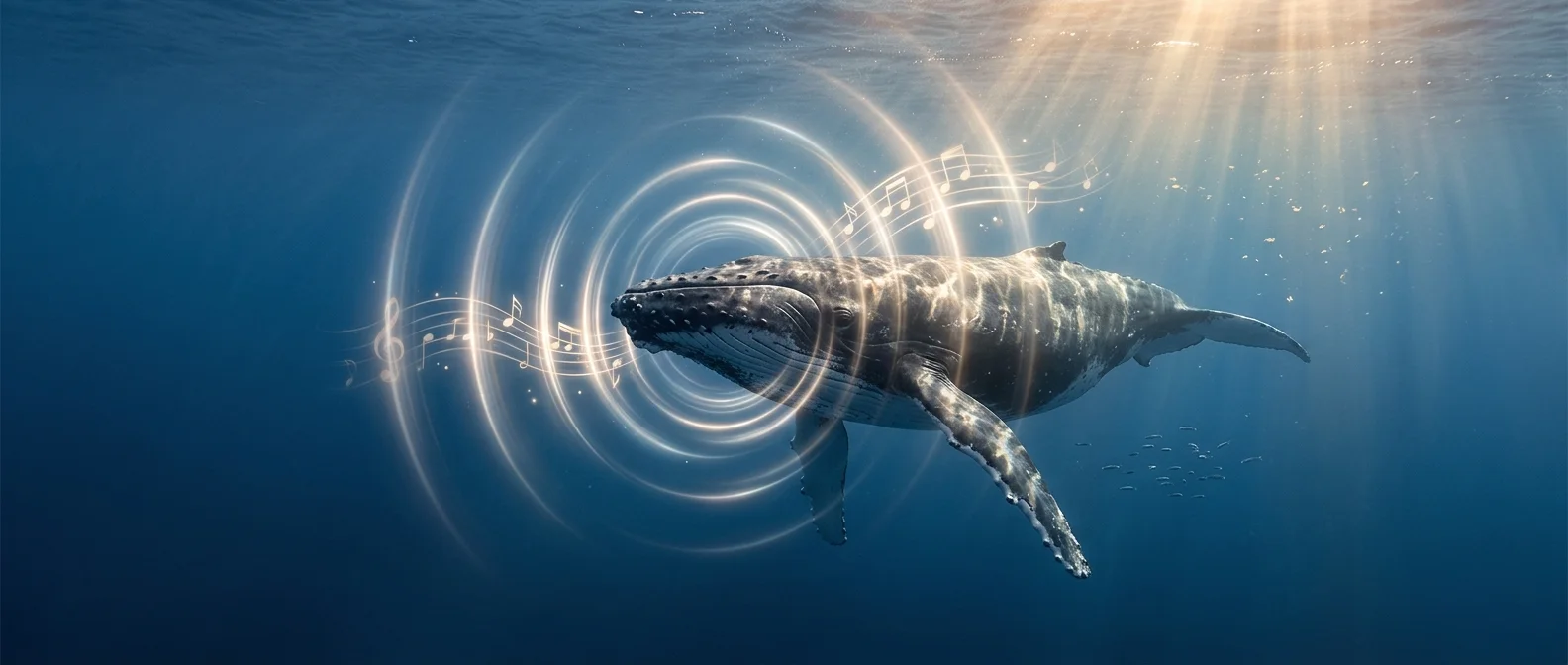
Somewhere in the waters of the South Pacific, a hydrophone records a melody no researcher has heard before. It's not engine noise or seismic activity. It's the song of a humpback whale — but in completely new verses. Last year, the whales in this region sang something entirely different. Who taught them the new melody?
Megaptera novaeangliae, the humpback whale, doesn't simply sing. It composes, revises, teaches, and learns. Its song changes gradually each year — and sometimes transforms completely, like a cultural revolution. This process, known as “cultural song transmission,” represents one of the most remarkable examples of non-human culture on the planet.
🎵 Frequency 1: The Anatomy of a Song
A humpback whale song isn't a random sequence of sounds. It has structure more rigid than many human musical compositions. It consists of units — individual acoustic elements like moans, cries, and pulsed beats. Units organize into phrases, phrases into themes, and themes into a complete song that can last 10 to 30 minutes.
The most striking aspect: every male in a given region sings exactly the same song during the same period. As if they share a common musical piece. But this piece never remains static. From one breeding season to the next, small changes accumulate: new units replace old ones, the sequence of themes shuffles, the rhythm shifts. Within two to three years, the song can become unrecognizable compared to its original version.
This gradual evolution is remarkable enough on its own. It proves that whales don't mechanically reproduce inherited acoustic patterns — they actively learn, memorize, and modify complex sound sequences. No gene encodes this melody. It transmits exclusively through learning, from animal to animal.
📻 Frequency 2: The Cultural Revolution
Gradual evolution is one part of the story. The most stunning phenomenon unfolds when a completely new song appears in a population — and fully replaces the old one within a single season. Researchers call this a “song revolution.”
📖 Read more: Why Orcas Are Attacking Boats in Europe: The 2026 Mystery
The phenomenon was first documented in the western Pacific. A new song appeared in Australia and within a few years had spread eastward, passing from New Caledonia to Tonga and finally to French Polynesia. The spread followed a consistent geographic direction — west to east — like a wave of cultural change traveling thousands of miles through the ocean.
This means it's not random mutation. Some whales hear a new song — likely during migrations or in shared feeding areas — and decide to adopt it, completely abandoning the old one. The process resembles remarkably how a hit song spreads through human cultures.
📻 Song Revolution
When a completely new song appears and fully replaces the old one in a single season, researchers call it a “song revolution.” The spread follows consistent geographic direction — west to east — like a cultural wave thousands of miles across the ocean.

♂️ Frequency 3: Why Only Males Sing?
One of the most intriguing mysteries concerns who sings. In humpback whales, only males produce these long, complex melodies. Females don't sing songs — though they produce other types of sounds for communication with their calves.
The dominant theory connects song to sexual selection. Males sing primarily during breeding season, in tropical waters where mating occurs. Perhaps females choose mates based on song quality, complexity, or innovation. Maybe a male singing the new, popular melody signals that it's socially informed — a kind of biological “fashion.”
There's also an alternative hypothesis: song might function as a positioning mechanism among males. Adult males compete fiercely for access to females. They display aggressive behaviors — fin slapping, violent charges, even physical collisions. Song could help avoid such confrontations, functioning as acoustic “identity” or presence declaration.
📖 Read more: Tool-Using Fish Rewrite Intelligence Rules Forever
🧠 Frequency 4: Whales That Learn
The ability to learn songs in humpback whales reveals something deeper: these animals possess what scientists call “vocal learning.” This is a rare ability in the animal kingdom — the capacity to hear new sounds and reproduce them. Besides humans, few species possess it: certain birds (parrots, songbirds), bats, elephants, seals, and cetaceans.
In whales, vocal learning goes beyond simple mimicry. A young male doesn't repeat mechanically. It must hear the song many times, assimilate its structure, memorize the sequence of dozens of themes and phrases, then reproduce it accurately. This implies significant cognitive abilities: working memory, sequential learning, possibly even some form of abstract thinking.
A humpback whale's brain weighs about 13 pounds — triple that of humans. The cerebellum accounts for 20% of total brain weight. While size doesn't automatically mean intelligence, the complexity of these songs testifies to neural functions that very few non-human animals can achieve.

🌐 Frequency 5: Social Networks Under Water
How exactly does a song transmit from population to population? Humpback whales undertake one of the longest migrations in the animal kingdom. In the North Pacific, some individuals travel 5,000 miles between Alaska's feeding grounds and Hawaii's tropical waters. In the Southern Hemisphere, whales migrate between Antarctic feeding waters and tropical breeding zones.
During these migrations, populations that normally live separately can meet in shared areas. There, a male from the western gulf might hear the song of a male from the eastern population — and bring it back to its own group. This mechanism explains how songs spread across vast distances without any physical barrier stopping them.
Four main humpback whale populations exist in the North Pacific: Mexico, Central America, Hawaii, and western North Pacific populations. In the North Atlantic, two populations migrate between the Gulf of Maine and Norway, with winter breeding grounds in the West Indies and Cape Verde. Seven additional populations inhabit the Southern Hemisphere. Each can potentially share songs through these migratory “hubs.”
📖 Read more: 52 Hertz Whale: The World's Loneliest Whale Calls
🏛️ Frequency 6: Whales, Culture, and Human Parallels
The word “culture” was traditionally applied only to humans. Today, whale studies challenge this limitation. Culture, in biological terms, means information transmission through social learning rather than genetic inheritance. By this definition, humpback whales undoubtedly have culture.
It's not just songs. Humpback whales show cultural transmission in their feeding techniques too. The “bubble net feeding” technique — where a group of whales creates circular bubble curtains to trap fish — transmits socially through populations. Same method, but with local variations: in New England, certain populations use simultaneous tail slapping with bubbles (lobtail feeding). This technique first appeared in the 1980s and spread gradually — clear evidence of cultural learning.
Notably, no young animal under two years has been observed using lobtail feeding, despite calves weaning at one year. This suggests a learning curve — juveniles need time to assimilate and practice these complex feeding techniques.
🎭 Three Forms of Whale Culture
Song
Complex melodies that change each season. Transmitted between populations through migratory hubs. Only males sing.
Feeding Techniques
Bubble net feeding — circular bubble curtains to trap fish. Lobtail feeding appeared in the 1980s and spread socially.
Migration Routes
Learned routes spanning thousands of miles, transmitted from generation to generation. Four populations in North Pacific, two in Atlantic.
🎼 A Final Note
Approximately 84,000 mature humpback whales live worldwide, according to IUCN estimates. The population is recovering after near-extinction from 20th-century industrial whaling — over 60,000 animals were killed between 1910 and 1916 in the Southern Hemisphere alone. The international hunting ban (1985) was crucial, but today they face new threats: ship strikes, fishing net entanglement, ocean noise, and climate change.
Ocean noise poses perhaps the most serious threat to these animals' culture. If whales can't hear each other due to engine noise and seismic surveys, song transmission breaks down. And when culture stops transmitting, it's lost — exactly as happens in human societies.
Humpback whales remind us that culture isn't a human monopoly. Every time a male changes its melody to match a new song, we see in action the same forces that shaped our own cultures: imitation, innovation, social coordination, selection. The ocean, ultimately, isn't silent. It's full of stories waiting to be heard.