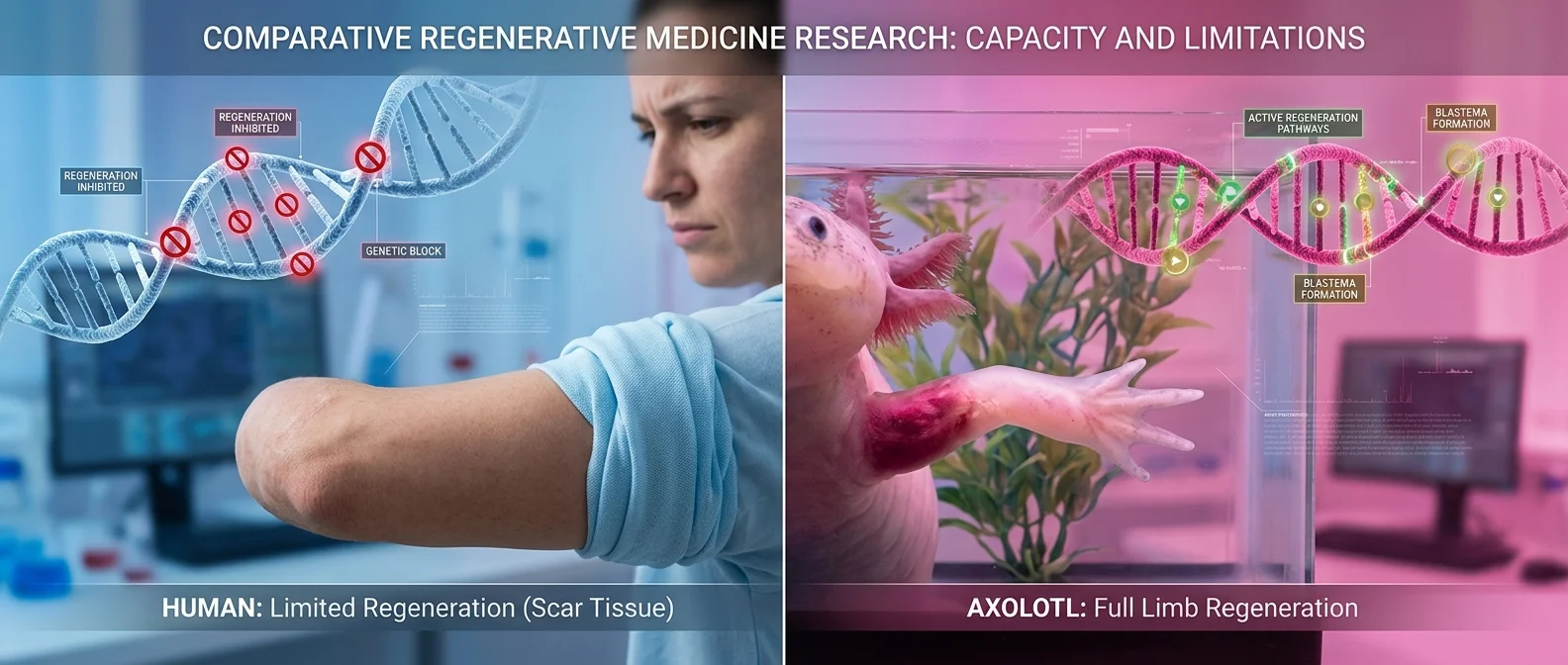
A starfish loses an arm and rebuilds it. A salamander loses its leg and within weeks grows a new one — complete with bones, muscles, nerves, blood vessels, even toes. You cut your finger and it takes days just to close the wound — and that's with a scar. Why don't we regenerate? The answer isn't that we can't — it's that something in our evolutionary history chose to stop us. And that something lies buried deep in our evolutionary past.
📖 Read more: Turritopsis Immortal Jellyfish: Can It Really Live Forever?
The World That Regenerates
Regeneration isn't rare in nature — it's the rule in many animal groups. Planarians, freshwater flatworms just one centimeter long, can be cut into hundreds of pieces and each piece will regenerate an entire body — including brain and nervous system. Starfish regrow arms within months. Zebrafish regenerate heart tissue after injury, even if 20% of their heart has been surgically removed.
But the king of regeneration among vertebrates is the axolotl (Ambystoma mexicanum), an amphibian from Mexico's lakes. The axolotl regenerates legs, tail, eyes, brain segments, even parts of the heart — perfectly, without scars, without limits — and does so repeatedly throughout its lifetime. This organism is now the most important model organism in regeneration research — labs worldwide study its genome trying to decode its secret.
Scars Instead of Regeneration
When a human gets injured, the body reacts quickly: blood cells form a clot, inflammatory cells clear damaged tissue and neutralize pathogens, and fibroblasts begin producing collagen. The result is scar tissue — functional but anatomically flawed. The scar hastily closes the wound, but doesn't restore structure. Hair follicles don't grow back, neither do glands or nerves — the tissue is functional but simplified, like a quick patch that seals the hole without restoring the architecture.
In salamanders something completely different happens. Instead of scarring, cells around the wound dedifferentiate — they revert to a more primitive state, losing their specialization and returning to an embryonic condition. Muscle, skin, and cartilage cells become blastic again, forming a blastema — a mass of undifferentiated cells resembling embryonic tissue. From there the entire structure rebuilds — bones, muscles, vessels, nerves, skin, exactly in the right position and proportion.

The Genes Exist — But Stay Silent
Here lies the most stunning discovery: the genes needed for regeneration exist in the human genome. They're not missing. The same signaling pathways — Wnt, FGF, BMP — function in mammals during embryonic development, creating limbs from scratch with impressive precision. But after birth, these pathways go almost completely silent — like a switch that closes permanently.
The reason appears related to so-called “genetic switches” — regulatory sequences that turn genes on or off at specific times. In mammals, these switches close after development. In salamanders, they remain open or can be reactivated after injury. The difference isn't what genes you have — it's when and how you turn them on — and this difference is epigenetic, not genetic.
📖 Read more: Why We Get Goosebumps: The Science Behind Chills and Thrills
The Price of Protection
A dominant theory, continuously gaining ground, argues that mammals evolutionarily “chose” scarring over regeneration because of cancer. Cell dedifferentiation — the mechanism enabling regeneration — dangerously resembles the mechanism of transformation into cancer cells. Cells that lose their specialization and begin multiplying uncontrollably — this describes both regeneration and cancer simultaneously. The difference lies in control: in salamanders, multiplication is strictly regulated. In cancer, control is lost.
The p21 gene regulation, a powerful tumor suppressor in mammals, suppresses uncontrolled cell multiplication — but simultaneously suppresses regenerative capacity. Mice in which the p21 gene was experimentally disabled showed increased regeneration ability in ears and skin — but also increased cancer risk, confirming the dilemma evolution faced. Evolution chose safety over regeneration — a compromise solution that protects us from tumors but deprives us of repair capability.
Babies Who Regrow Fingers
Something remarkable and barely known: human embryos and newborns can regenerate — limitedly but truly. Children up to 2 years old who lose the last phalanx of a finger can regenerate it completely — with nail, bone, and nerves. This happens only if the wound is left open, without stitches. Scarring prevents natural regeneration — the same reaction that protects us from infections simultaneously blocks regeneration.
This clinical observation changes everything: it means even in humans, the regeneration mechanism isn't completely lost — it's dormant. Stem cells at the nail base appear to play a central role. In adults the ability remains in rudimentary form — that's why our nails regenerate but fingers don't. The difference lies in what the genetic control mechanism allows and forbids.

Regeneration as a Target
Regenerative medicine is evolving rapidly. Researchers at Tufts University managed to activate leg regeneration in adult Xenopus laevis frogs — a species that naturally doesn't regenerate — using a “bioreactor” with five drugs placed on the stump for just 24 hours. After 18 months of monitoring, the animals had developed functional legs with bones, muscles, and nerves — a result that changed the field and was published in Science Advances in 2022, proving regeneration can be activated even in species that don't naturally have it.
📖 Read more: Therizinosaurus: 3-Foot Scythe Claws on a Gentle Giant
Meanwhile, CRISPR technology opens new paths in gene editing: if we identify the exact genetic switches that differentiate salamanders from humans, we could theoretically reopen them selectively, without disrupting the rest of genetic balance. The road is long and full of ethical questions, but the direction is clear — regeneration is no longer science fiction, but a research target with concrete results.
Why Some Animals Can
The axolotl isn't simply more “primitive” — it has a genome ten times larger than humans, packed with regulatory sequences we're only now beginning to decode with third-generation sequencing technologies. The Prod1 protein, exclusive to salamanders, regulates positional identity in the regenerating limb — arm or leg, left or right, up or down. Without this spatial memory, tissue would develop chaotically, like a tumor, and wouldn't “know” what shape to take — hand, foot, tail. Salamanders have solved this spatial identity problem in ways science is only now beginning to understand.
Zebrafish regenerate hearts through a different mechanism: existing cardiomyocytes partially dedifferentiate and begin dividing. In mammals, cardiomyocytes lose this ability shortly after birth — that's why a heart attack leaves permanent scar tissue and permanently reduces pumping function.
The Future of Regeneration
The question is no longer “why don't we regenerate” but “how will we reactivate what we already have.” The pathways exist, the genes exist, even in adult humans there are traces of regenerative ability. The liver regenerates up to 70% of itself. Bones heal. Nerves regenerate slowly but they regenerate. Blood renews continuously.
Perhaps in one generation the idea that “we don't regrow hands” will seem as outdated as the idea that “we don't fly” before the Wright brothers. Our biology didn't ultimately limit us — it simply gave us a riddle that waited millions of years to be solved. And science, slowly but surely, is solving it.
Sources:
- Brockes, J.P. & Kumar, A. "Appendage regeneration in adult vertebrates and implications for regenerative medicine." Science, 310(5756), 1919-1923, 2005
- Muneoka, K. et al. “Mammalian regeneration and regenerative medicine.” Birth Defects Research Part C: Embryo Today, 84(4), 265-280, 2008