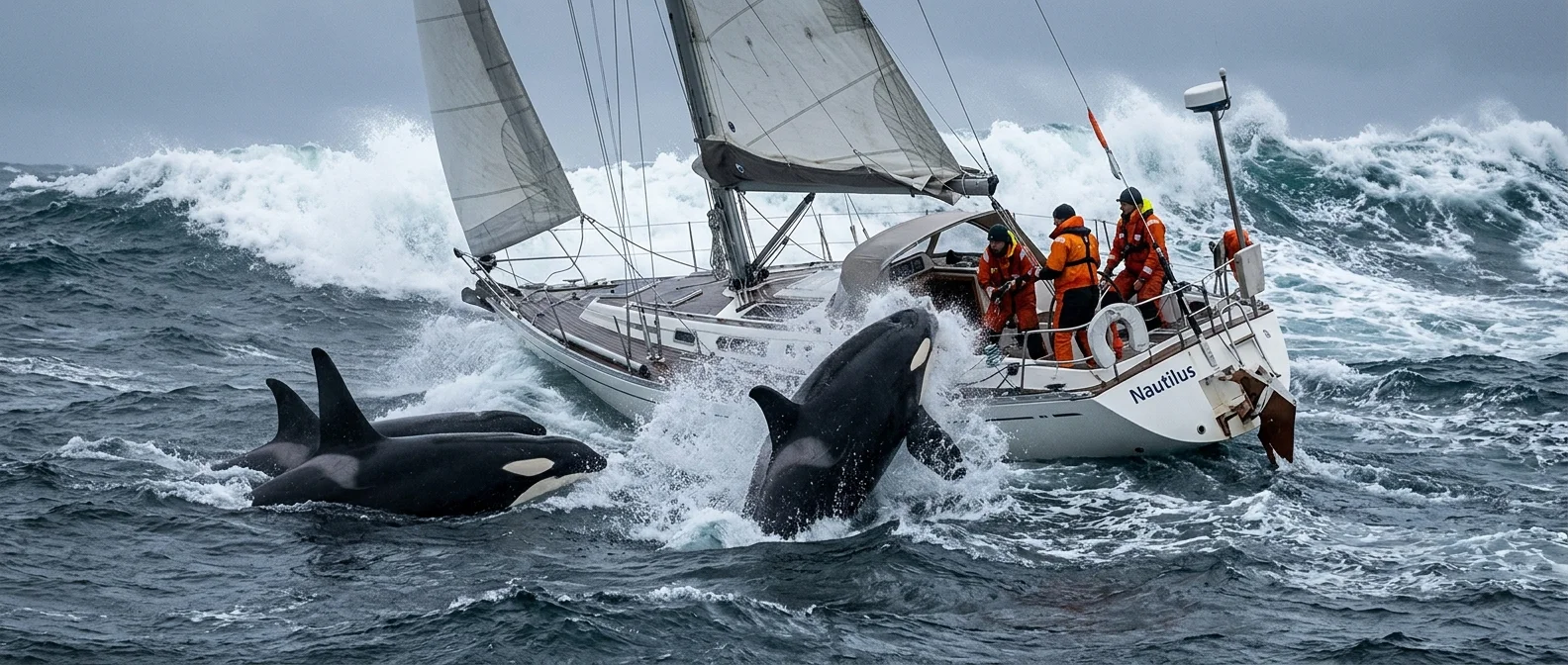
On average, once every two days since 2020, an orca strikes a boat off the Iberian Peninsula. This isn't legend, it isn't a horror movie — it's statistics. A pod of roughly 40 critically endangered killer whales has developed an unprecedented habit: breaking boat rudders. And scientists say they're probably just… playing.
📖 Read more: Orcas Evolve New Hunting Techniques to Kill Great Whites
📜 Record #1 — The Beginning: Summer 2020
Nobody knows exactly how it started. The first documented interaction was recorded near the Strait of Gibraltar. Sailors reported that killer whales approached their boats and began striking the rudder — specifically the rudder, nothing else. Initially, nobody believed them. Within months, reports numbered in the dozens. Boats returned to harbor with shattered rudders, small cracks in the hull, and crews in shock.
The Spanish Coast Guard issued the first warnings. The GT-Atlántica group, as this subpopulation of roughly 40 Iberian orcas was scientifically named, suddenly became a global topic. The planet asked: why? Killer whales use echolocation to “scan” objects around them — they can literally “see” the structure of a rudder underwater. They're not striking blindly. They know exactly what they're hitting.
🔢 The Numbers Speak
From 2020 to today, the orcaiberica.org team has recorded over 670 interactions between orcas and boats. Several boats sank completely. Zero human injuries throughout this entire period. The target, almost always, is one: the rudder.
⚓ Record #2 — White Gladis: Protagonist or Scapegoat?
The media needed a villain. And they found one: White Gladis, an adult female killer whale with distinctive markings on her body. According to a popular theory, Gladis was once injured by a boat and “decided to take revenge.” The story went viral. The “revenge” narrative was born.
The reality? Much less dramatic — but far more interesting. Naomi Rose, senior marine mammal scientist at the Animal Welfare Institute, puts it clearly: "These are not attacks — they are almost certainly play. The goal is to break the rudder. They don't want to sink the boat. They don't want to hurt anyone. Trust me: if they wanted to sink boats, they would sink them."

Iberian orcas approach a boat near the Strait of Gibraltar — a scene that has repeated hundreds of times since 2020.
📖 Read more: Whales Change Their Songs: Culture Beneath the Waves
🎭 Record #3 — It's Not Revenge: It's Culture
Here the story gets profound. Killer whales are among the few animals on Earth that produce culture — they transmit traditions and behaviors between generations. Some “fads” are temporary, like the famous trend of wearing dead salmon like hats on their heads. Others persist.
The collision with boats appears to belong to the second category. And this changes everything. You can ignore a temporary trend — a cultural trait, you cannot. Some orcas born after 2020 are already growing up within this “tradition.” "I'm afraid this is becoming a cultural element of this population," Rose admits. They're not just learning to hit rudders — they're learning that this is what we do.
The main food source of the GT-Atlántica pod is tuna — bluefin tuna. Almost all interactions with boats occur in deep waters, over 50 meters depth, exactly where they hunt. At the same time, recent observations show some orcas venturing into shallow coastal waters in Galicia to hunt… octopus. Their geography is changing.
🌊 Record #4 — The Data: August 30, 2025
A normal day in Galicia. Two boats were emergency-towed — one yacht with a nearly destroyed rudder, the other with serious damage. The Spanish Coast Guard issued a new warning for sailors off the Galician coast. Notable: these interactions occurred in coastal river estuaries, in shallow waters — the first time so close to shore.
The most concerning aspect wasn't the damage — it was the location. Until now, almost all interactions occurred in open waters, far from coasts. If orcas begin “playing” in harbors and estuaries, the situation changes radically. Crews described terror. "The truth is we were very scared… when we realized the killer whales were hitting the boat," a crew member stated. But simultaneously: zero injuries, zero sinking. The orcas examined several other boats around before leaving on their own, after a patrol boat intervened.
🏛️ Record #5 — Porphyrios: The Predecessor
This story isn't new. In the 6th century AD, a massive sea creature called Porphyrios terrorized boats in the Bosphorus near Constantinople — for 50 entire years. Byzantine historians (mainly Procopius) described it as a “whale” — a giant aquatic monster that sank ships.
Modern researchers now believe Porphyrios was most likely a killer whale — or a group of killer whales that gradually replaced each other, creating the illusion of an immortal monster. The parallel with today's situation in Iberia is striking: an apex marine predator, in a strategic maritime zone, repeatedly clashing with human vessels. The only difference? The Byzantines didn't have GoPros.
📖 Read more: Fish Recognize Themselves in Mirrors: Breakthrough Study

Porphyrios — the ancient sea “monster” of the Bosphorus — was most likely a killer whale. History repeats itself, 1,500 years later.
⚖️ Record #6 — What Science Says (and What We Don't Do)
In October 2024, the International Whaling Commission (IWC) published recommendations from a specialist workshop. The central demand was clear: do not attack the orcas. This population (GT-Atlántica) is critically endangered — only about 40 individuals. Every death could mean collapse. It's also illegal to harm or kill them under European legislation.
The recommendations were clear: stay calm, silent, move away slowly. Don't use noise unless the situation is truly critical — sound exposure can make them resistant. Some sailors, however, didn't listen. There are videos where they throw firecrackers at the animals, make noise, even try to hit them. Science's response: these reactions "are not only ineffective but may reinforce the behavior and increase the severity of damage to boats."
🧭 Record #7 — Solutions: Coexistence or Conflict?
The Spanish government is examining technical rudder modifications: rough surfaces, spikes, materials indifferent to teeth. Simultaneously, a real-time monitoring system is being developed — if you know where the orcas are, you don't go there.
Alex Zerbini, senior researcher at the Cooperative Institute for Climate, Ocean and Ecosystem Studies at the University of Washington, explains that interactions occur mainly "in open waters, where depth exceeds 50 meters." However, recent movement to coastal zones creates new questions. Are they hunting octopus in shallow waters? Exploring? Or simply following tuna on new routes?
The wisest proposal may also be the simplest. Rose summarizes it: "This is not a whale problem. It's a human problem. They live there. That's their home 24/7. We're just passing through it. We're in their living room. We're the guests."
The story of the Iberian orcas isn't a story of revenge. It's not even a story of attack. It's the story of an extremely intelligent, social, culturally active animal — that discovered a new game. Unfortunately, this game breaks rudders. And the world must decide: will it learn to share the ocean, or throw another firecracker? In 1,500 years, someone might write again about the sea “monsters” of Gibraltar. The difference? We know what these monsters are. The most intelligent predatory creatures of the ocean — who decided our rudders are the best toys of the deep.