You look at old photos and wonder where that face went. Hair changes color, joints creak earlier, recovering from a cold takes three days instead of one. Aging feels inevitable — like a law of physics. But science reveals something far more intriguing: aging isn't a one-way street. It's a biological process, and anything that's a process can, at least theoretically, be modified.
The First Wrinkle That Changes Everything
Ask ten people when they first felt old, and you'll get ten different answers. Someone will say “when I couldn't read without glasses,” another “when my knee cracked on the stairs.” Society treats aging as an aesthetic problem — wrinkles, gray hair, sagging skin. But the real drama plays out deeper, at the cellular level, where molecules lose their structure and genetic instructions slowly fade.
Biological aging starts much earlier than we think — and that's perhaps the first shocking thing for anyone diving deep. Studies show certain functions begin declining as early as age 25. The thymus gland, crucial for immune function, starts shrinking after puberty. Peak muscle strength peaks around 30. Yet these aren't signs of “failure” — they're the result of evolutionary logic. Nature designed you for reproduction, not eternity.
Telomeres: The Clocks at DNA's Ends
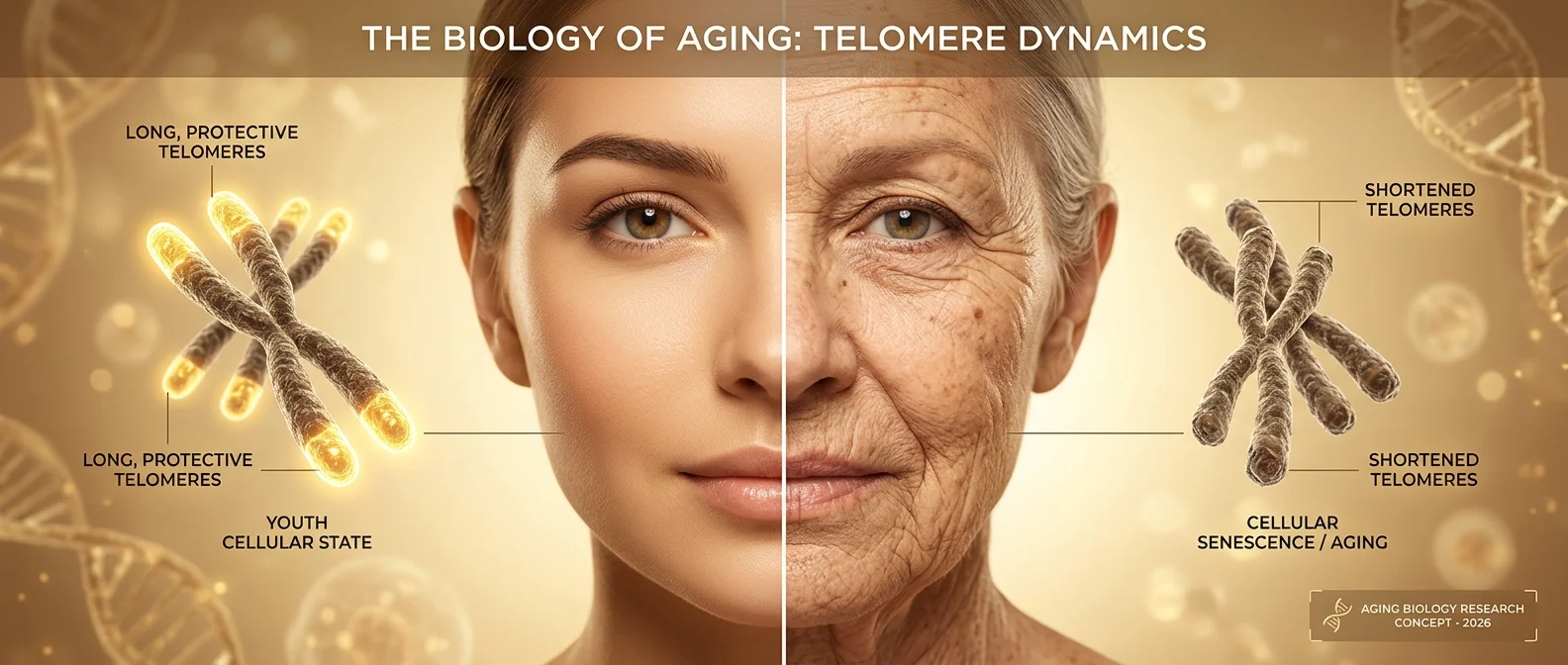
Imagine telomeres like the plastic caps on shoelaces. They keep chromosomes in shape and prevent fraying. Every time a cell divides, telomeres get a little shorter — like melting wax. After dozens of divisions, they become so short that the cell receives a signal: “Stop. You can't continue.”
The discovery of this mechanism was a milestone in biology and earned Elizabeth Blackburn, Carol Greider, and Jack Szostak the 2009 Nobel Prize in Medicine. They also identified telomerase, an enzyme that can lengthen telomeres. Problem: in adults, telomerase is nearly inactive in most cells. It's mainly active in stem cells — and unfortunately in cancer cells, which use it to multiply uncontrollably. Here lies a fundamental dilemma: more telomerase means less aging but possibly more cancer.

The Hayflick Limit: Cells with Expiration Dates
In 1961, Leonard Hayflick discovered something that caused an uproar. Until then, biologists believed cells could divide indefinitely. Hayflick proved the opposite: human cells in culture stopped dividing after about 50 divisions. This number — now known as the Hayflick Limit — was the first clear evidence that cells “count” their reproductions.
This discovery was later connected to telomeres: each cellular division shortens telomeres, and when they reach a critical length, a “senescent cell” mechanism activates. Instead of dying, the cell enters a state of arrest — alive but inactive, emitting inflammatory signals to its environment. Imagine someone sitting in the office, not working, but constantly shouting — annoying everyone around them.
Free Radicals: The Body's Rust
Every breath you take produces free radicals. These molecules are pure instability in molecular form — they have a lone electron, missing a pair, and “steal” it from neighboring molecules, creating a chain reaction of damage. Denham Harman proposed the free radical theory in 1956, and for decades it was the dominant explanation of aging.
Mitochondria, the cellular powerhouses, are the main source. They produce ATP but “leak” free radicals as a side effect. Over years, damage accumulates: DNA breaks, proteins deform, membranes lose functionality. However, recent evidence shows the picture is more complex. Some free radicals function as signaling molecules — the body uses them purposefully. High-dose antioxidant supplements, instead of slowing aging, sometimes interfere with these defensive signals.
Senescent Cells: The Zombies Within Us
Senescent cells are perhaps the most exciting new player in aging biology, having changed how we think about aging in the past decade. Don't picture dead cells. These are zombie cells: they don't multiply, don't die, just sit there secreting a cocktail of inflammatory molecules known as SASP (Senescence-Associated Secretory Phenotype).
This inflammatory cocktail damages neighboring healthy cells, drives them into senescence too, and creates a vicious cycle of decay that accelerates aging throughout the tissue. Experiments in mice showed something remarkable: when they removed senescent cells pharmacologically, the animals lived longer, had better cardiac function, and fewer cancers. Drugs that eliminate these cells are called senolytics, and many are already in human clinical trials.

Epigenetic Drift: When Instructions Blur
Your DNA doesn't change significantly as you age — but how it's read changes dramatically. This is epigenetics: chemical tags on DNA (mainly methylation) and chromatin that dictate which genes “turn on” and which “turn off.” Over time, this system loses precision — like a manual whose letters slowly fade.
Epigenetic noise — this slow breakdown of the regulatory code — is now considered one of the central mechanisms of aging. Genes that shouldn't be expressed activate, while crucial genes fall silent. Harvard's David Sinclair proposes that aging is essentially loss of epigenetic information — and has shown in the lab that “resetting” the epigenetic code in mice can reverse signs of aging in eye tissue. If confirmed on a larger scale, this means aging can partly be “rolled back.”
Anti-Aging Strategies: From Diet to Drugs
Caloric restriction remains the most consistently proven method of life extension in animal models. Worms, flies, mice — all live longer with 30-40% fewer calories. The mechanism appears to work through a molecular nutrient sensor, mTOR, which when “quieted,” activates cellular repair programs. Rapamycin, a drug that inhibits mTOR, extends mouse lifespan even when given at advanced age.
Other molecules are on the research radar. Metformin, a decades-old diabetes drug, is being examined in the TAME clinical trial as a potential anti-aging compound. Spermidine, naturally present in foods like soybeans, cheeses, and mushrooms, enhances autophagy — the process of “recycling” damaged cellular components. Regular exercise remains the most reliable, cheap, and accessible “anti-aging therapy” we have today: it strengthens mitochondria, reduces chronic inflammation, improves metabolism, and maintains neural plasticity.
Aging Reversal: A Future Drawing Near
In 2006, Shinya Yamanaka discovered that four genes can “reprogram” an adult cell into an embryonic stem cell state — regardless of age. This discovery, which earned him the 2012 Nobel Prize, opened a dizzying door: if you can “reset” a cell, can you perhaps make it partially younger without losing its function?
Labs worldwide are testing exactly this “partial reprogramming” — carefully, step by step, because full reprogramming can lead to cancer. Results in mice are impressive: improved muscle regeneration, better memory, even vision recovery. Meanwhile, biotech companies have invested billions in aging reversal research. Altos Labs, Calico (Google), Unity Biotechnology — the map fills with names. No one promises immortality — and perhaps shouldn't. But the idea that aging isn't inevitable and predetermined fate but a biological process that can be modified — this idea is no longer science fiction. It's a research program.
Sources:
- Hayflick, L. & Moorhead, P.S. “The serial cultivation of human diploid cell strains.” Experimental Cell Research, 25(3), 585-621, 1961
- López-Otín, C. et al. “The Hallmarks of Aging.” Cell, 153(6), 1194-1217, 2013