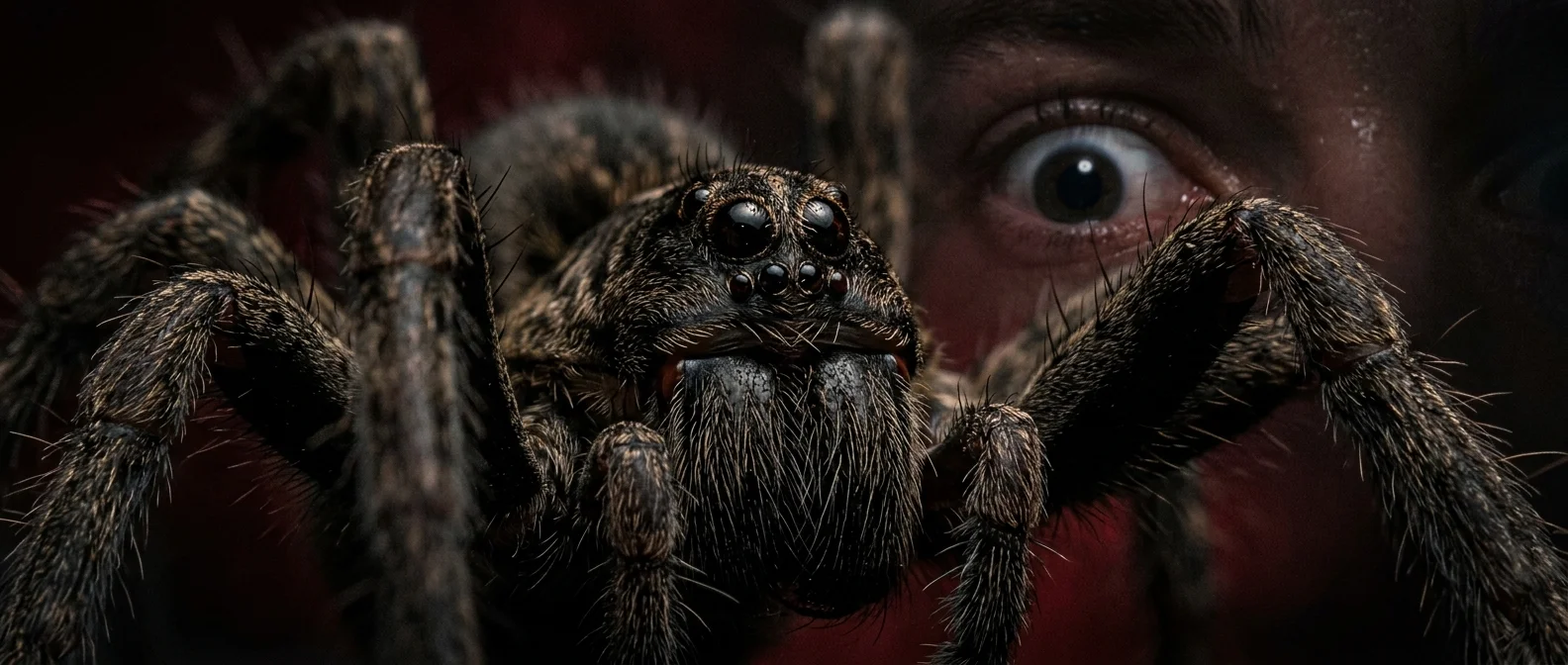
Picture this: you open a closet door and there, right in front of you, sits a spider. Your hand jerks back before you even think. Your heart pounds. You might scream. What terrified you is no bigger than your fingernail. In a city with no venomous spiders, the fear is completely irrational — yet impossible to control. Why? The answer lies deep in evolutionary history, in brain circuits that formed millions of years before Homo sapiens walked the earth.
📖 Read more: Why You Can't Tickle Yourself: The Brain's Prediction System
A Fear Older Than Us
Arachnophobia isn't a quirk or overreaction. It clinically affects an estimated 3% to 6% of the global population, with an even larger percentage — perhaps 25% or more — experiencing significant discomfort without meeting strict clinical phobia criteria. It's one of the most common specific phobias worldwide and appears across cultures that share no common geographic or historical foundation. From tropical Australia to frozen Scandinavia, humans fear spiders disproportionately to the actual danger these creatures represent.
The reason, according to evolutionary psychologists, isn't primarily cultural. It's biological. Our ancestral primates — mammals living in tropical forests 40-60 million years ago — coexisted daily with venomous spiders. A single bite could mean pain, tissue necrosis, possibly death. Those individuals who reacted faster to these creatures had a greater chance of surviving and reproducing. Fear gradually carved itself into neural circuits, passing from generation to generation.
The Amygdala: Firing Before You Think
Your reaction to a spider doesn't first pass through the cortex — you don't “think” that you should be afraid, don't logically assess the danger. Visual information first reaches the thalamus and, through a lightning-fast “dirty” pathway that bypasses the visual cortex, goes directly to the amygdala, an almond-shaped structure in the temporal lobe. The amygdala evaluates the stimulus in just 12-15 milliseconds and activates the fight-or-flight response: cortisol, adrenaline, increased heart rate, sweaty palms, muscle tension.
Neuroscientist Joseph LeDoux proved this “low road” in rats during the 1990s. The amygdala receives a blurry, quick image — enough to recognize a spider shape — and triggers a response before the cortex processes what you're actually seeing. That's why you startle even if what you saw turns out to be thread or shadow. The amygdala prefers false positives: better to fear without reason than not fear with reason.

📖 Read more: Your Nose Recognizes 1 Trillion Scents: How?
Prepared Learning: Pre-Wired Fear
In 1971, psychologist Martin Seligman proposed the theory of “prepared learning.” The idea: we aren't born with ready-made phobias, but our brains are “prepared” to learn certain fears much more easily than others. Spiders, snakes, heights, darkness — millennia of evolutionary pressure made these fears “easy lessons.”
Experiments by psychologists Öhman and Mineka at the Karolinska Institute dramatically confirmed the theory. Rhesus monkeys raised in laboratory captivity without any spider stimulus acquired spider fear after just one observation of a frightened monkey in a video. The learning was fast, stable, and resistant to extinction. But the same monkeys couldn't learn to fear flowers or rabbits, even if the terror scenes in the video were identical. The brain was evolutionarily programmed to accept only certain categories of fear — those that historically corresponded to real survival dangers.
Babies Who See Spiders
A crucial study was published in 2017 by Hoehl, Hellmer, Johansson, and Gredebäck in Frontiers in Psychology. Researchers showed 6-month-old infants images of spiders and flowers while measuring pupil dilation. The babies showed significantly greater pupil dilation — indicating increased arousal — when viewing spiders compared to flowers. At 6 months old, without experience, without training, without scary stories.
This doesn't mean babies “fear” in the conventional sense — they don't yet possess the cognitive structures for full phobia. But it means their brains automatically prioritize these specific stimuli. They detect them faster, give them clearly more attention, activate the autonomic nervous system more easily. Full fear doesn't need to be taught from scratch — it just needs a small spark to ignite the already existing evolutionary predisposition.
📖 Read more: Parasitic Ant Species Clones Itself to Hijack Other Colonies
Why Spiders and Not Cars
Traffic accidents kill over 1.3 million people annually worldwide. Spider bites kill very few — single digits in most countries, most years. Yet clinical phobias of cars are extremely rare, while arachnophobia exists in every corner of the planet. The explanation lies in evolutionary time. Natural selection works slowly, over thousands of generations, and cars have existed for only about a century — virtually nonexistent time for evolutionary adaptation of neural circuits.
Spiders, conversely, have posed dangers to mammals for millions of years. The Sydney funnel-web spider Atrax robustus, the black widow (Latrodectus mactans), the brown recluse (Loxosceles reclusa) — these species were real dangers to our ancestors. And even though we've reached the point of logically recognizing we're not in danger, evolutionary circuits don't cancel out so easily.

Culture: Filter or Amplifier?
Biology explains why the brain is “ready” for arachnophobia. But culture can amplify or reduce this predisposition. In many African and Australian societies, spiders are considered symbols of wisdom or creativity — Anansi in West African mythology is a spider-god. In these cultures, arachnophobia exists but at much lower rates.
In Western culture, movies, horror stories, and general negative representation amplify fear. Social learning functions as a multiplier: a child who sees their mother scream at a spider receives a powerful message — “this is dangerous.” Biology and culture work together, reinforcing each other in a cycle of mutual feedback.
📖 Read more: Spiders Keep Fireflies as Living Bait to Lure 10x More Prey
Therapy: How to Unlearn Fear
Arachnophobia is treatable. The most effective method is gradual exposure therapy: you start by viewing spider photographs, then videos, then a spider in a cage from a distance, then closer, until finally holding a harmless spider in your hand. The process “rewrites” the amygdala-cortex connection, creating new safety memories that compete with fear memories.
Studies show that a single exposure session lasting 2-3 hours can dramatically reduce symptoms in over 90% of patients, with results maintained even years later. Newer techniques use virtual reality (VR exposure therapy), allowing patients to confront virtual spiders in a controlled digital environment with gradually increasing realism. Results are comparable to live exposure, and the technique becomes increasingly accessible as VR equipment becomes cheaper.
Disgust: A Second Mechanism
Fear isn't the only reaction. Many arachnophobes report intense disgust — a response different from fear that activates different neural circuits (insula instead of amygdala). Disgust likely relates to contamination risk: in prehistoric populations, creatures crawling on food or in human dwellings might have been carriers of parasites or diseases.
Psychologist Graham Davey showed that disgust toward spiders statistically correlates with disgust toward rodents, cockroaches, and snails — creatures historically associated with infectious diseases. Fear keeps you away. Disgust prevents contact. Two primordial mechanisms, in a complex reaction to a microscopic creature that statistically has almost no chance of seriously harming you. And precisely this inconsistency between logic and emotion reveals how deeply rooted ancient survival mechanisms are in our brains.
Sources:
- Seligman, “Phobias and Preparedness,” Behavior Therapy, 1971
- Hoehl et al., “Itsy Bitsy Spider...: Infants React with Increased Arousal to Spiders and Snakes,” Frontiers in Psychology, 2017