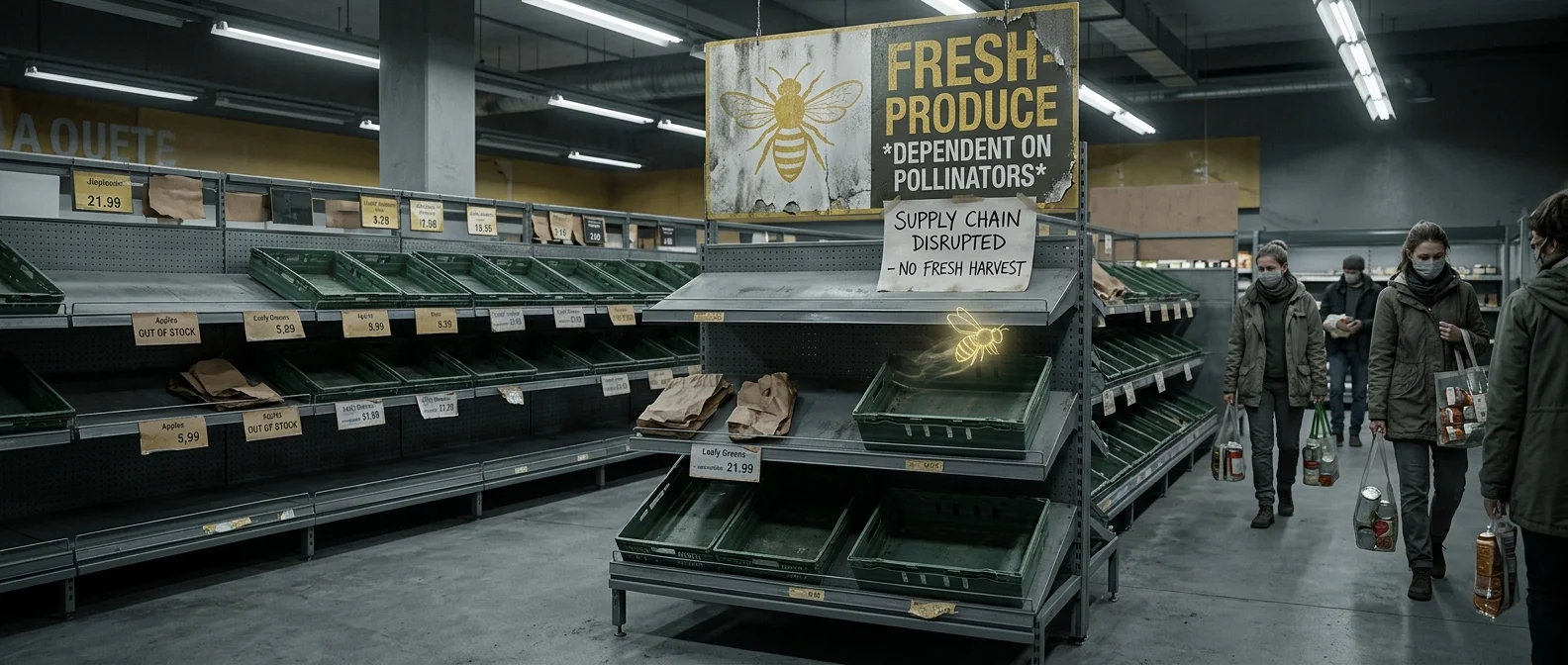
Every third bite of food on your plate exists because of a bee. Apples, almonds, avocados, coffee, chocolate, tomatoes — none survive without pollination. The honeybee (Apis mellifera) isn't alone in this work, but it's the heavyweight champion. Now imagine it vanishes. This isn't hypothetical — it's happening. Since 2006, beekeepers report mass Colony Collapse Disorder (CCD). Neonicotinoids, climate change, Varroa parasites — all converging to push bees past the breaking point. What happens when they're gone? The answer isn't just "less honey." It's famine.
📖 Read more: Birds Are Vanishing: 3 Billion Fewer Since 1970
📖 Read more: Frogs That Give Birth to Live Babies Without Tadpoles
Pollination: The Invisible Billion-Dollar Service
Pollination's economic value hits $235-577 billion annually worldwide, according to IPBES (2016). Seventy-five percent of crop plants depend — partially or completely — on animal pollination, while 35% of global food volume comes from pollinated crops. Without bees, almonds disappear first: California rents 1.8 million hives every February just for almond orchards. Apples, cherries, avocados, watermelons follow. This isn't theoretical — in China's Sichuan province, pesticide overuse wiped out bees and farmers now hand-pollinate using chicken feather brushes. Each worker pollinates 5-10 trees daily — a single bee visits 1,500-3,000 flowers per day. No human substitute matches that efficiency. Robotic pollinators exist in labs, but the technology remains decades from practical field deployment.
CCD: The Mass Colony Collapse
Colony Collapse Disorder gained official recognition in 2006 when US beekeepers reported entire hives emptying within days — without dead bees. Workers abandon their queen and never return. Between 2006 and 2023, the US lost 30-40% of colonies each winter on average — while normal losses run 10-15%. European losses are smaller but climbing — especially in Spain, Italy, and Greece. The cause isn't singular — it's a "cocktail of death": neonicotinoids, Varroa destructor parasites, Nosema ceranae fungus, climate change, monocultures that starve bees of pollen diversity. Global agriculture has created "food deserts" for bees: massive areas with one plant species that blooms for weeks then — nothing. Bees need variety: different pollens provide different amino acids and lipids — just like us. The van der Sluijs et al. (2013) study in Current Opinion in Environmental Sustainability documented that neonicotinoids act even at sub-lethal doses: they scramble bee navigation so workers can't find home.

📖 Read more: Caterpillars Hear Without Ears Using Microscopic Hairs
Without Bees: Food Chain Collapse
If bees vanish, the first consequences hit grocery shelves: fruits and vegetables become scarce and expensive. Vitamin A and C consumption would plummet, triggering disease outbreaks. Smith et al. (2015) in The Lancet estimated complete pollinator extinction would cause 1.4 million additional deaths annually from nutrition-related diseases. But the chain doesn't stop there: no fruits means no seeds, no seeds means no birds, no birds means insect pest explosions. The collapse would even hit cotton — bee-pollinated — and meat: cattle eat alfalfa that requires pollination. The disruption spreads beyond crop fields. Even coffee — primarily bee-pollinated — would become a luxury item, radically altering daily habits for billions. We're talking about reshaping human civilization around scarcity.
Varroa: The Hive Vampire
Varroa destructor might be the biggest threat. This microscopic mite — just 1.5 millimeters — attaches to bee bodies and feeds on fatty tissue, weakening immunity while spreading viruses. It emerged in Asia mid-20th century and spread globally within decades. Today it exists on every continent except Australia — though Australia detected Varroa for the first time in 2022 at Newcastle port, panicking beekeepers. Without treatment, colonies collapse within 1-3 years. In countries like New Zealand, entire Manuka honey export industries face extinction from parasite spread. Beekeepers use oxalic acid and amitraz, but Varroa develops resistance. The parasite spreads at least 5 viruses to bees — including lethal DWV (Deformed Wing Virus) that produces bees with twisted wings that can't fly.
📖 Read more: Yellowstone Wolves: They Even Changed the Rivers
Neonicotinoids: The Medicine That Kills
Neonicotinoids (imidacloprid, clothianidin, thiamethoxam) are the world's most widespread insecticides. They act systemically: absorbed by plants and appearing in pollen and nectar. Bees inhale and consume them unknowingly. The EU banned three neonicotinoids in outdoor crops in 2018, but exceptions get granted regularly. The US has no federal ban. The truth is neonicotinoids don't kill immediately — they disorient, weaken, then slowly kill. They're the most insidious enemy: bees visit flowers, collect nectar laced with poison, and leave without knowing where home is. Studies show even at 5 ppb (parts per billion), neonicotinoids reduce bee learning ability, memory, and disease resistance. It's chemical warfare disguised as agriculture.

📖 Read more: Will We Eat Algae in 25 Years? The Food Revolution Coming
Climate Change: Mismatched Clocks
Climate change shifts phenological timing: flowers bloom earlier, but bees emerge on schedule. This mismatch reduces available food during critical periods. In Europe, the Duchenne et al. (2020) study in Nature Ecology & Evolution documented mismatches reaching 6-14 days in some regions. Meanwhile, heat waves increase mortality — bees can't survive temperatures above 45°C. In Greece, 2023 heat waves caused mass hive deaths in Crete and the Peloponnese. Wild pollinators — wild bees, bumblebees, butterflies — suffer even more because they lack beekeeper care. The timing of life itself is breaking down.
Greece: 1.3 Million Hives Under Pressure
Greece leads the EU in hive density per square kilometer — over 1.3 million hives and 25,000 beekeepers. Greek honey (thyme, pine, fir) ranks among the world's finest. But climate change — droughts, fires, rising temperatures — pressures Greek bees. The 2021 Evia fires destroyed thousands of hives. Varroa is endemic. Thessaly monocultures starve bees of pollen diversity. Greek beekeeping — a 3,000-year tradition starting with Aristotle — faces an uncertain future. Honey production dropped 20% in the last decade due to drought and reduced flowering.
What Can Be Done: Solutions and Hope
The decline accelerates, but reversal remains possible. The EU neonicotinoid ban was crucial. Creating "pollination corridors" — flowering strips along highways and farmland — proves effective in Germany and Sweden. Urban beekeeping spreads across dozens of major European cities. Genetic research seeks Varroa-resistant bees — the SMR (Suppressed Mite Reproduction) program shows results. Each hive houses 50,000 workers sustaining global food systems. The cost of inaction isn't measured in dollars — it's measured in bites missing from our plates. The first step is simple: plant flowers on balconies, avoid pesticides in gardens, buy local honey. Every flower counts. In Greece, dozens of local initiatives — from Halkidiki to the Dodecanese — already create protection zones with native herbs and aromatic plants for bees.
"If the bee disappeared off the face of the Earth, man would only have four years left to live."
— Quote attributed to Einstein (disputed, but prophetic)Sources:
- van der Sluijs, J. P. et al. — "Neonicotinoids, bee disorders and the sustainability of pollinator services", Current Opinion in Environmental Sustainability, 2013
- Smith, M. R. et al. — "Effects of decreases of animal pollinators on human nutrition and global health", The Lancet, 2015