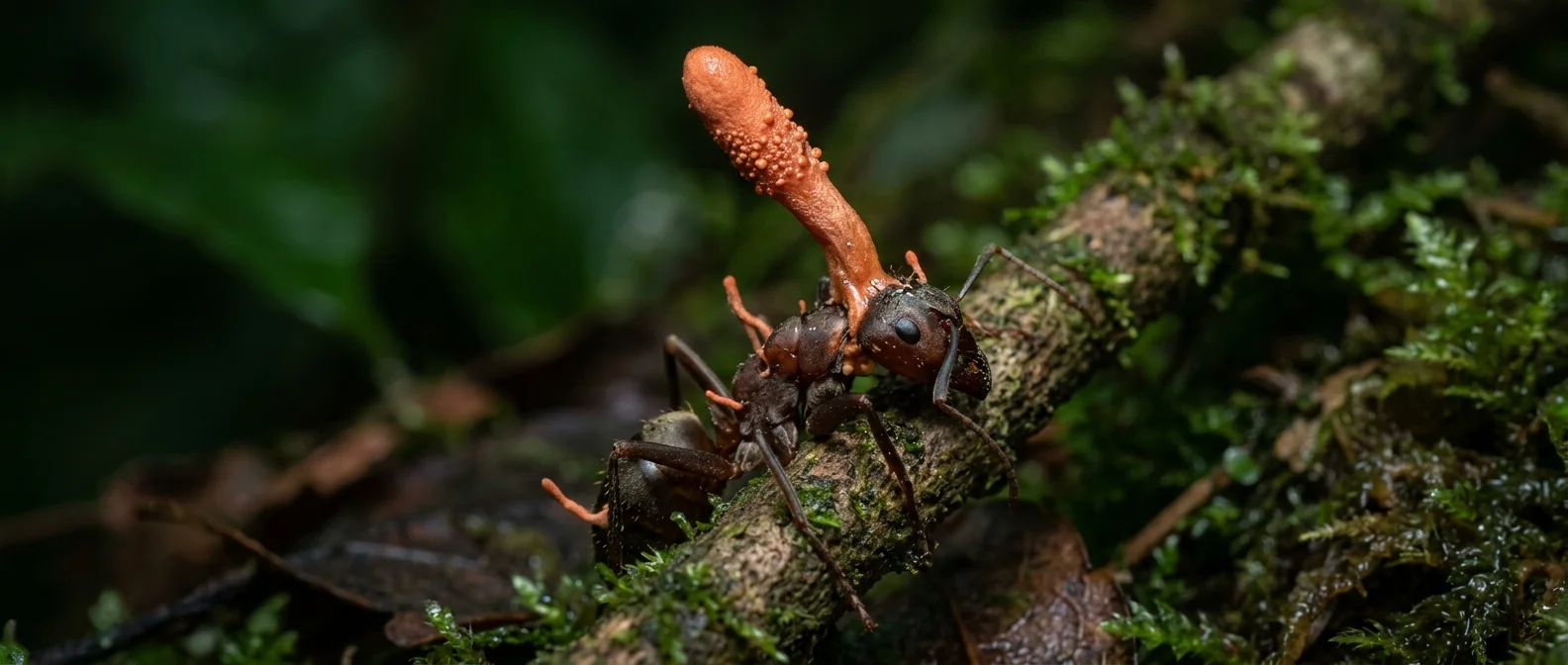
Deep in the Thai rainforest, a carpenter ant suddenly abandons its colony's trail and begins walking like it's drunk. Convulsions drop it to the forest floor. It crawls to a leaf exactly 25 centimeters above the soil, bites down on the leaf's central vein — and never moves again. Within days, a mushroom sprouts from its head. This cinematic nightmare isn't fiction — it's the daily reality for millions of ants, manipulated by nature's most Machiavellian parasite.
📖 Read more: Rainbow Eucalyptus: The Tree That Paints Itself
The Invader: Meet Ophiocordyceps
The fungus Ophiocordyceps unilateralis belongs to a group of parasitic fungi that have evolved specifically to exploit carpenter ants. Its spore attaches to a Camponotus carpenter ant's exoskeleton, penetrates through external joint articulations, and begins developing inside the body. Unlike most pathogens, Ophiocordyceps doesn't kill immediately — it needs its host alive and mobile. The infection, described in detail by Penn State's David P. Hughes, represents one of the most complex examples of microbial control over animal behavior.

Filling the Body, Conquering the Brain
Using transmission electron microscopy, Hughes' team revealed what happens inside the infected ant: the developing fungus literally fills the body and head, causing muscle atrophy and forcing muscle fibers apart. Simultaneously, it profoundly affects the central nervous system. While normal worker ants rarely leave their trails, “zombie” ants wander randomly, unable to find their way back to the nest. Convulsions drop them to the forest floor, into the moist, cool understory — exactly where the fungus needs to be.
📖 Read more: Tent-Making Bats: Nature's Master Architects
The "Death Bite": Synchronized with the Sun
The most chilling aspect of the infection is its temporal precision. Scientists discovered that at solar noon — when the sun reaches its zenith — the fungus synchronizes infected ant behavior, forcing them to bite the central vein on a leaf's underside. Multiplying fungal cells inside the ant's head detach fibers from jaw-opening and closing muscles, causing permanent “jaw lock” — the ant cannot release the leaf even after death.
Days later, a fruiting body — a stalk — grows from the dead ant's head and shoots spores into the air, ready to infect the next victim. The location, 25 centimeters above soil, provides ideal humidity and temperature conditions for fungal reproduction. "The fungus attacks on two fronts: first it uses the ant as a mobile food source, then destroys the muscles and nervous system," Hughes explained.
"Brain in a Jar": The Experiment That Revealed the Secret
In 2014, researcher Charissa de Bekker at Penn State designed a bold experiment: she removed ant brains, kept them alive in special nutrient medium, and cultured the fungus alongside them. “This was 'brain-in-a-jar' science at its finest,” Hughes commented. The results were stunning: the fungus secreted completely different chemicals depending on which brain species it encountered.
📖 Read more: World's Largest Organism Is a Fungus Covering 965 Hectares
Using metabolomic analysis, the team discovered thousands of unique chemical compounds — most completely unknown to science. Among them stood out two known neuromodulators: gamma-aminobutyric acid (GBA) and sphingosine — both implicated in neurological disorders. These substances were enriched only when the fungus developed next to the target species' brain.

The Fungus “Knows” Its Host
The most impressive revelation was that the fungus can infect and kill ants of other species — but cannot manipulate their behavior. “The target species' brain was key to understanding manipulation,” de Bekker stated. There's no single substance responsible — it's a complex cocktail of chemicals acting synergistically, fine-tuned through millions of years of coevolution. "What the fungus secretes changes depending on the brain it encounters — that's extremely impressive," she added.
📖 Read more: Artificial Photosynthesis 2026: Clean Fuel from Sun & Water
Colony Defense: A Second Fungus Against the First
Ant colonies aren't defenseless. Researchers discovered that a second fungus — a hyperparasite — attacks Ophiocordyceps before it can mature and release spores. This fungal “bodyguard” sterilizes the parasite's fruiting body, dramatically reducing viable spore numbers. Meanwhile, studies showed that infected ants face no aggression or isolation from nest mates — the colony doesn't “recognize” infection until it's too late. This invisible invasion explains why the fungus has remained so successful for tens of millions of years — fossilized infected leaves with bite marks date back 48 million years.
From Tropical Forests to South Carolina
For decades, “zombie ants” were considered exclusively tropical phenomena. But nature photographer Kim Fleming, a Donalds, South Carolina resident, discovered specimens during daily forest walks and posted them online. The photos caught Hughes' attention, and a new Ophiocordyceps species was named in her honor. The discovery confirmed these fungi thrive in temperate climates too — something climate change may expand further, with 2018 studies showing the fungus adapts to new climatic conditions.
The Brainless Controlling the Brained
"This is one of the most complex examples of parasites controlling animal behavior, because it's a microorganism controlling an animal — the brainless controlling the brained," Hughes emphasized. The series The Last of Us achieved global success by transferring this scenario to the human world — but reality is more impressive than fiction. Ophiocordyceps doesn't use force but chemistry — an invisible cocktail of substances that transforms an autonomous creature into a biological robot. Studying this mechanism opens pathways to new biological control methods for parasites in homes and farms — and deeper understanding of how microorganisms can manipulate complex nervous systems.
Sources:
- de Bekker, C. et al. “Species-specific ant brain manipulation by a specialized fungal parasite.” BMC Evolutionary Biology, 2014 — ScienceDaily / Penn State
- Hughes, D. P. et al. "Behavioral mechanisms and morphological symptoms of zombie ants dying from fungal infection." BMC Ecology, 2011 — ScienceDaily / Penn State