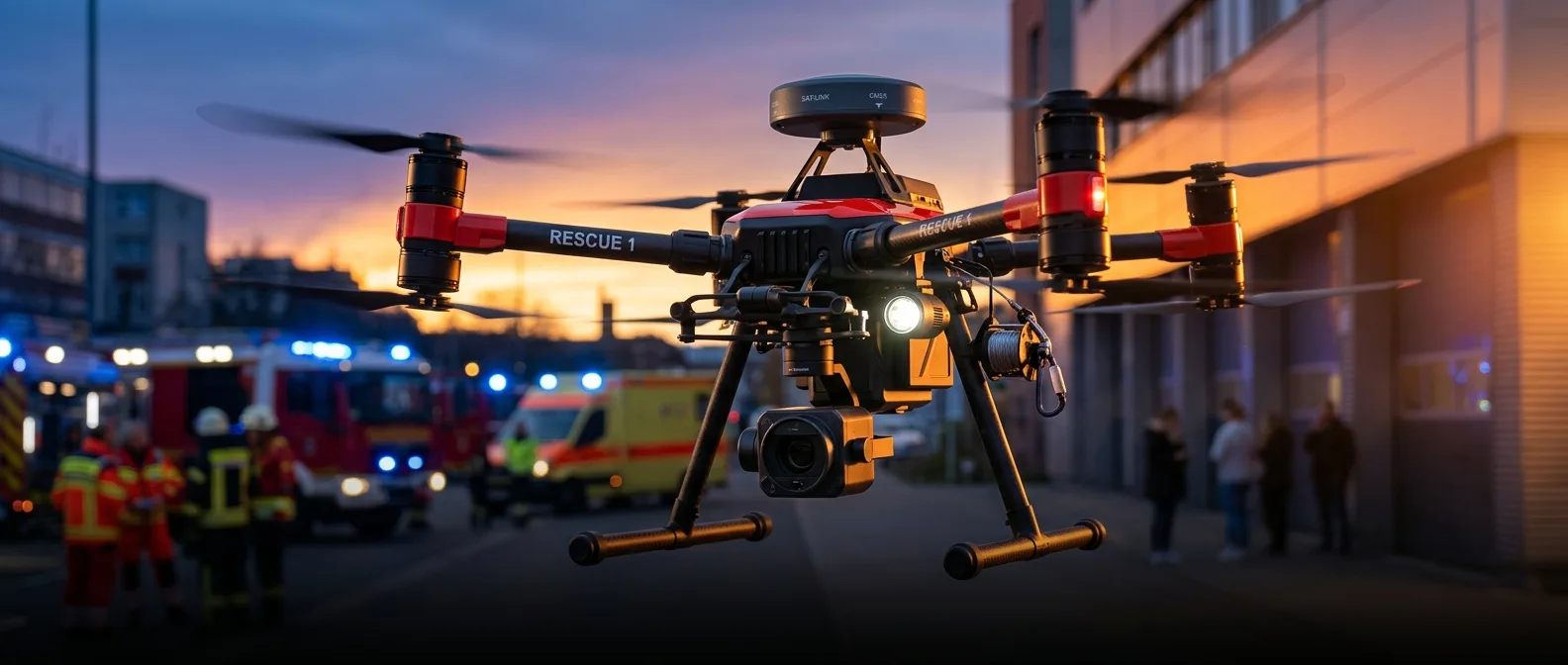
Six hours of flight time without charging. Global connectivity via satellite. This is the BRINC Guardian — the first drone built from scratch for America's emergency response systems.
Drone as First Responder (DFR) programs aren't experiments anymore. Dozens of US cities already deploy drones that reach emergency scenes in under two minutes — faster than patrol cars. But the tech still breaks down when it matters most. Batteries die at the worst moments. Range hits walls. Signal cuts out.
BRINC claims the new Guardian solves these problems once and for all. This isn't just another camera drone — it's an integrated system that stays airborne for over an hour, reaches eight miles out, and delivers life-saving gear before human responders even arrive.
🚀 Next-Gen Emergency Response Takes Flight
The first thing that changes is how the drone stays operational. Most current DFR systems need 20-25 minutes of charging after each mission. For emergency departments, that downtime means the drone sits useless when they need it most.
The Guardian tackles this with the Guardian Station — an automated dock that swaps batteries without human intervention. When the drone returns from a mission, it lands at its base, exchanges the dead battery for a charged one, reloads equipment, and returns to the air immediately.
Smart Equipment Selection Based on Emergency Type
Here's where things get serious. The Guardian isn't just an observer — it's an active participant in rescue operations. It can carry defibrillators (AEDs) for cardiac arrests, Narcan for overdoses, or life preservers for water rescues. The impressive part? It automatically selects what to bring based on the type of 911 call.
The system's AI analyzes keywords in 911 calls — "heart attack," "allergic reaction," "not breathing" — and prepares the appropriate payload before the drone even takes off. When it reaches the scene, it doesn't just watch. It acts.
🛰️ Starlink: The End of Connectivity Problems
The Guardian's biggest innovation is built-in Starlink connectivity. Every current DFR drone relies on cellular networks, which routinely fail exactly when needed most — during disasters, in remote areas, or when cell towers get overwhelmed by panicked citizens.
With Starlink, the Guardian maintains data connection from anywhere on Earth. For rural departments or disaster-struck areas, this completely changes the game.
"Connectivity is the biggest problem we face. When the cellular network goes down, the drone becomes useless"
DFR Program Commander in Texas
Range That Reshapes Rescue Geography
Most current DFR systems operate within a 3-mile radius from their base. The Guardian reaches 8 miles — a difference that means a department might need fewer bases to cover an entire city. That translates to lower costs but also faster response times.
It flies at speeds up to 60 mph and can stay airborne for over 62 minutes. That means more time at the incident scene, better monitoring, and the ability to handle multiple incidents simultaneously.
📹 Cameras That See Beyond Limits
The Guardian's imaging system has nothing in common with consumer drone cameras. It combines 4K video with 640x zoom — magnification levels that allow detail recognition from over 300 meters altitude.
Dual HD Thermal Cameras
For monitoring in complete darkness and detecting thermal signatures
640x Optical Zoom
Capability to identify faces from kilometers away
1,000-lumen Spotlight
Target illumination for better coordination with ground units
But the most impressive feature is the audio system. The Guardian packs speakers and sirens three times louder than patrol cars. In practice, this means it can communicate directly with suspects, give instructions to civilians, or coordinate ground units.
Laser Rangefinder for Absolute Precision
A feature often overlooked but critical for emergency operations: the built-in laser rangefinder. It provides precise distance measurements without operators needing direct line of sight to the target. For rescue coordination or police operations, this accuracy can prove vital.
🤝 Integration with 911 Systems
The Guardian isn't a standalone tool — it's part of an integrated ecosystem. Through partnership with Motorola Solutions, it plugs directly into emergency management platforms already used by thousands of departments.
When an officer hits the emergency button on their radio, it automatically triggers drone deployment to their location. No call to dispatch, no waiting for approval — immediate response that could prove decisive.
The 2026 Emergency Ecosystem: 911 call → AI analyzes keywords → Guardian launches with appropriate equipment → Arrives at scene before ground units → Delivers vital equipment → Provides live updates to responders
Motorola Solutions as Distribution Channel
Motorola isn't just a tech partner — it's the exclusive North American distributor for the Guardian. This means departments already using Motorola radios and systems won't need to navigate new procurement processes or integration procedures.
For most emergency services, the Guardian will arrive as an extension of existing infrastructure, not as a separate project. This could significantly accelerate adoption.
🏭 The American Manufacturing Strategy
Alongside the Guardian announcement, BRINC opened a new Seattle factory that doubles its production capacity. The choice isn't random — the company deliberately avoids Chinese supply chains at a time when US emergency services face pressure to abandon Chinese drones for national security reasons.
BRINC announced tripled revenues in 2025 and quintupled monthly production. These numbers show that demand for alternatives to Chinese systems is already there.
"More than 900 public safety departments use BRINC products. 20% of SWAT teams in the US run BRINC platforms."
BRINC Corporate Data
Economics and Total Cost of Ownership
One question that remains open is cost. BRINC systems are significantly more expensive than Chinese alternatives, even after tariffs narrowed the gap. The Guardian, with advanced Starlink tech and autonomous systems, won't be cheap.
But total cost of ownership could change dramatically with 95% availability. If a department can cover larger areas with fewer drones, and those drones stay available nearly 24/7, the numbers start making sense.
🎯 Frequently Asked Questions
How much does the BRINC Guardian system cost?
BRINC hasn't announced official pricing, but analysts estimate the complete system (Guardian + Guardian Station) will cost over $200,000 per unit, including installation and training.
Can the Guardian operate without Starlink?
Yes, the system has backup connectivity options through cellular networks. However, without Starlink, range drops to conventional 3-5 miles and it loses its main advantages in remote areas.
When will it be available in Europe?
BRINC is currently focusing on the US market through Motorola. There's no official announcement for European availability, but the company has expressed interest in international expansion after late 2026.
Think of it as evolution: from drones that simply watch, to drones that act. The Guardian doesn't replace first responders — it equips them with capabilities that until recently were only available in expensive helicopters. If the promise of 95% availability proves realistic, the emergency response landscape could change faster than we expect.Sources: