What Makes the DJI Inspire 3 Special
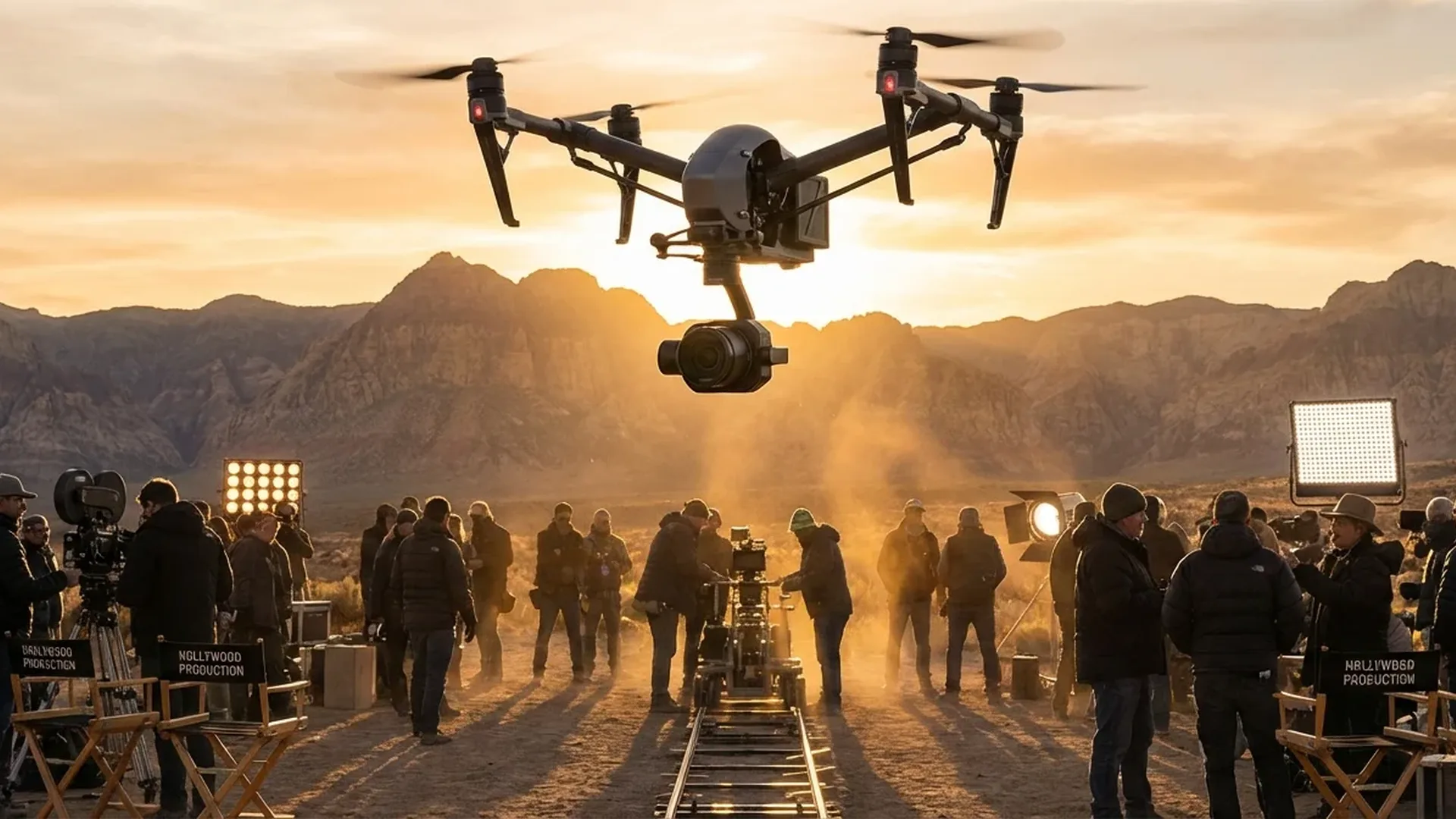
The DJI Inspire 3 doesn't compete with consumer drones — it competes with cinema cranes, cablecams, and dolly setups costing tens of thousands of euros. Announced in April 2023 as the successor to the Inspire 2 (2016), it represents the flagship of DJI's cinema drone lineup.
The upgrade from the Inspire 2 is dramatic: the sensor jumped from S35 6K to full-frame 8K, video transmission moved from Lightbridge 2 (7km, 720p/30) to O3 Pro (15km, 4K/30, 1080p/60), obstacle sensing expanded from 3 directions to omnidirectional, and flight time increased from 23 to 28 minutes. Every component was redesigned from the ground up.
Zenmuse X9-8K Air: A Cinema Camera in the Sky
At the heart of the Inspire 3 is the Zenmuse X9-8K Air — a gimbal camera with a 35mm full-frame CMOS sensor recording video at 8192×4320 pixels. It weighs just 516 grams (without lens), which is 50% lighter than the X9-6K and X9-8K gimbal cameras of the DJI Ronin 4D, thanks to purpose-built optimizations for aerial photography.
Recording Capabilities
8K/75fps ProRes RAW
Record Apple ProRes RAW in full-frame 8K resolution, ideal for cinema productions with maximum post-production flexibility. Requires a separate RAW License key.
8K/25fps CinemaDNG
Alternatively, record CinemaDNG at 8K and 25fps — perfect for cinematic frame rates (24/25fps), with fully uncompressed RAW data for ultimate color grading control.
DJI Cinema Color System
DCCS ensures authentic colors and seamless matching with ground-based cinema cameras like the Ronin 4D — critical for productions combining aerial and ground footage.
Dual Native ISO
EI 800/4000 at ≤30fps and EI 320/1600 at >30fps. Outstanding low-light performance without noise, on par with professional ground-based cinema cameras.
With 14+ stops of dynamic range, the X9-8K Air captures an enormous tonal range — from the deepest shadows to the brightest highlights. This means sunrise, sunset, or indoor-outdoor contrast scenes remain fully workable in color grading.
DL-Mount Lenses
The camera supports DJI's DL-Mount lens series:
- DL 18mm F2.8 ASPH — ultra-wide for landscapes and establishing shots
- DL 24mm F2.8 LS ASPH — versatile wide-angle
- DL 35mm F2.8 LS ASPH — classic cinematic focal length
- DL 50mm F2.8 LS ASPH — portraits and close-ups
- DL 75mm F1.8 — telephoto with large aperture for shallow depth of field
Key advantage: The ability to swap lenses means you can adapt the visual style per scene — something impossible with consumer drones that have a fixed lens. In practice, the Inspire 3 gives you the same cinematic lens choices available on set with a ground-based cinema camera.
Flight System & Gimbal
Weighing 3,995 grams (including camera, 2 batteries, lens, PROSSD, and propellers), the Inspire 3 is a significantly larger aircraft compared to consumer drones. The diagonal distance reaches 695mm (landing gear raised) and in transport mode dimensions are 176×709.8×500.5mm — which is why it ships in a dedicated trolley case included in the box.
Flight Performance
| Max Speed | 94 km/h (Sport Mode) |
|---|---|
| Max Ascent Speed | 8 m/s |
| Max Descent Speed | 8 m/s (vertical), 10 m/s (tilted) |
| Max Service Ceiling | 3,800m (standard), 7,000m (high-altitude propellers) |
| Wind Resistance | 12 m/s (takeoff/landing), 14 m/s (in flight) |
| Max Flight Time | ~28 minutes (landing gear down) |
| Hover Time | ~25 minutes |
| GNSS | GPS + Galileo + BeiDou |
| EU Class | C3 |
Gimbal — 360° Pan & Tilt Boost
The Inspire 3's distinctive design inherits the transformable chassis of the Inspire series: when the landing gear is raised, the gimbal camera achieves 360° pan without obstruction. When lowered, it activates Tilt Boost at 80° upward — a unique capability that enables shots looking nearly straight up at the sky.
Gimbal stabilization is remarkable: ±0.002° angular vibration while hovering and ±0.004° in flight. This translates to ultra-stable footage even at speeds approaching 94 km/h or in windy conditions.
O3 Pro & Digital Cinema Tools
O3 Pro Video Transmission
The new-generation O3 Pro video transmission system represents a massive leap over the Inspire 2's Lightbridge 2. It supports simultaneous transmission from the gimbal camera AND the FPV camera, with 1080p/60fps live feed capability and 4K/30fps for external monitoring. Maximum range reaches 15km (FCC) / 8km (CE) in single control mode, with latency as low as 90ms.
Dual Control Mode: Two RC Plus controllers can operate simultaneously — the pilot controls the flight, while the gimbal operator independently manages the camera. Each controller receives a live feed. This dual-op function is standard in cinema productions where flying and shot composition are two separate specializations.
Night-Vision FPV Camera
The built-in FPV camera is more than a navigation tool — with a 1/1.8″ sensor, 3μm pixel size, and 161° ultra-wide FOV, it delivers excellent visibility even in low-light or nighttime conditions. For comparison, the Inspire 2 had a 1/7.5″ sensor with a much narrower field of view — the difference is enormous.
Waypoint Pro: Repeatable Routes & 3D Dolly
The Waypoint Pro function with centimeter-level RTK positioning unlocks capabilities unthinkable for consumer drones:
- Repeatable Routes: The drone flies the exact same path automatically, maintaining altitude, speed, gimbal angle, and camera settings. Perfect for one-takes or day-to-night timelapses at the same location.
- 3D Dolly: Faithfully simulates a crane, cablecam, or dolly on a film set — but without the physical limitations of those devices.
- Spotlight Pro: Enhanced AI tracking that automatically recognizes and locks onto people, vehicles, and boats with greater accuracy than its predecessor.
Safety & Sensors
Nine optical sensors provide omnidirectional obstacle sensing — front, rear, sides, above, and below. For the first time in the series, fisheye cameras on the landing gear arms enable detection in all configurations:
- Forward/Backward: 1.5-48m range (≤15 m/s)
- Lateral: 1.5-42m range (≤15 m/s)
- Upward: 0.2-13m, Downward: 0.3-18m (≤6 m/s)
A significant upgrade, given that the Inspire 2 had detection in only 3 directions. On an aircraft costing €15,000+, omnidirectional safety isn't a luxury — it's a necessity.
Batteries & Runtime
The Inspire 3 uses 6 TB51 batteries (2 per flight, 4 spares) with a capacity of 4,280mAh (98.8Wh) each. The 98.8Wh energy falls just under the 100Wh limit set by airlines — you can carry them as cabin baggage.
The TB51 Battery Charging Hub accommodates up to 8 batteries simultaneously. In Fast Mode, it charges a pair to 90% in just 35 minutes, while all 8 batteries reach 100% in about 160 minutes. The 65W USB-C port can also charge the RC Plus controller.
"On set we use three battery pairs — one flying, one charging, one standing ready. With the fast charger we never lose time. Upgrading from Inspire 2 to Inspire 3 gave us +5 minutes per flight and significantly less charging downtime."
— Cinematographer comment, DJI ForumRC Plus Controller
The DJI RC Plus is DJI's professional-grade controller with a 7-inch high-brightness screen (1,200 nits) — visible even in direct sunlight. Battery life reaches 3.3 hours with the built-in battery and extends to 6 hours with an external WB37 battery. It supports hot-swap batteries — swap batteries without losing the connection.
The new DJI Pilot 2 app for Inspire offers a cinema-grade monitoring interface: exposure information, video specs, focal length, and gimbal angle in real time, meeting the needs of gimbal operators and Directors of Photography.
What's in the Box
The Standard edition includes a complete production kit:
- 1× Inspire 3 Aircraft
- 1× RC Plus controller (with strap and waist support)
- 1× Zenmuse X9-8K Air Gimbal Camera (with case)
- 6× TB51 Intelligent Battery (3 pairs)
- 1× TB51 Battery Charging Hub + AC cable
- 1× DJI PROSSD 1TB (read speed 900MB/s)
- 3× pairs of foldable Quick-Release propellers
- 1× Trolley Case, 1× Lens Carrying Box (18/24/35/50mm)
- USB-C to USB-C and USB-C to USB-A cables
Important: The box does NOT include a lens — it must be purchased separately. Additionally, the RAW License for CinemaDNG recording is sold separately (~$1,049 / ~€960). If you plan on dual control operation, you'll need a second RC Plus.
Price & Availability
The official price of the DJI Inspire 3 (Standard) at the DJI Store is $16,499, which translates to approximately €15,200 (~$16,499). On Skroutz.gr (ID: 41622178) it was listed as “DJI Inspire 3 Standard Drone FPV with 8K 75fps Camera” but is currently not available — the Greek market relies primarily on authorized DJI dealers and specialized drone shops.
In practice, the complete production cost (drone + lenses + RAW license + second RC Plus + DJI Care) easily exceeds €20,000 (~$21,800). This is purely a B2B purchase — production companies, TV networks, and cinema studios.
Inspire 3 vs Inspire 2: The Evolution
| Feature | Inspire 3 (X9-8K Air) |
|---|---|
| Sensor | Full-Frame 35mm |
| Video | 8K/75fps ProRes RAW, 8K/25fps CinemaDNG |
| Dynamic Range | 14+ stops |
| ISO | Dual Native EI 800/4000 |
| Transmission | O3 Pro — 15km, 4K/30, 1080p/60 |
| Flight Time | 28 minutes |
| Obstacle Sensing | Omnidirectional (9 sensors) |
| Gimbal | 360° Pan + 80° Tilt Boost |
| RTK | Centimeter-level accuracy |
By comparison, the Inspire 2 (Zenmuse X7) offered S35 6K/30fps, 14 stops, native ISO EI 400, Lightbridge 2 (7km, 720p/30), 23-minute flight time, 3-direction obstacle sensing, and 360° pan without Tilt Boost. The upgrade is generational in every respect.
Pros & Cons
Pros
- ✅ Full-frame 8K — best image quality on any drone
- ✅ Dual Native ISO — superb low-light performance
- ✅ 360° Pan + 80° Tilt Boost — unique shot capabilities
- ✅ DJI Cinema Color System — matches Ronin 4D color
- ✅ O3 Pro 15km + Dual Control — cinema-grade workflow
- ✅ RTK + Waypoint Pro — centimeter-level precision
- ✅ Omnidirectional obstacle sensing
- ✅ 6 TB51 batteries included in the box
- ✅ Pro ecosystem: Master Wheels, Follow Focus, Remote Monitor
Cons
- ❌ ~€15,200 (~$16,499) — exclusively professional market
- ❌ ~4kg weight — requires vehicle transport
- ❌ Lenses sold separately
- ❌ RAW License costs ~€960 (~$1,049) extra
- ❌ Second RC Plus for dual op = ~€1,500+ (~$1,635+)
- ❌ Limited availability in smaller markets
- ❌ C3 class — requires Advanced Open category
- ❌ 28-minute flight time — good but not remarkable for the cost
Frequently Asked Questions (FAQ)
Who is the DJI Inspire 3 for?
Exclusively for professional cinematographers, film/series/commercial production companies, TV networks, and specialized aerial cinematography teams. This is not a consumer drone — it's a cinema tool.
Can I use Inspire 2 accessories?
No. Camera, batteries, controller, and storage media are not interchangeable between Inspire 2 and 3. Only the DJI PROSSD 1TB is exchangeable with the Ronin 4D.
Do I need the RAW License to record?
The RAW License (~$1,049 / ~€960) is required for CinemaDNG recording. Without it, you can still record in ProRes RAW (Apple) or H.264/H.265 format. It's worth the investment if you work in DaVinci Resolve or similar RAW workflows.
How do I transfer files to a computer?
The PROSSD 1TB (read speed 900MB/s) connects directly via USB-C to your computer without a card reader. Ideal for DITs (Digital Imaging Technicians) on set who need to perform backups between takes.
Can I take the batteries on an airplane?
Yes. Each TB51 battery has 98.8Wh energy — under the 100Wh limit enforced by most airlines for cabin baggage. Always check the regulations of your specific airline.
Final Verdict
The DJI Inspire 3 isn't an “expensive drone” — it's an affordable cinema rig when you consider it replaces helicopter shots costing thousands of euros per shooting day. With full-frame 8K, dual native ISO, DJI Cinema Color System, and RTK-precision waypoints, it delivers cinematic quality that just a few years ago required helicopters with stabilized systems worth €100,000+.
The only real criticism is flight time — 28 minutes, while improved from the Inspire 2's 23, remains limiting during demanding scenes. But this is solved by the 3 battery pairs included in the box and the ultra-fast charger.
If you're a professional cinematographer or production company looking for the ultimate aerial imaging tool, the Inspire 3 is the definitive choice. For everyone else, the DJI Air 3S (€1,129 / ~$1,230) or Mavic 4 Pro (€2,109 / ~$2,300) offer exceptional quality at far more accessible prices.