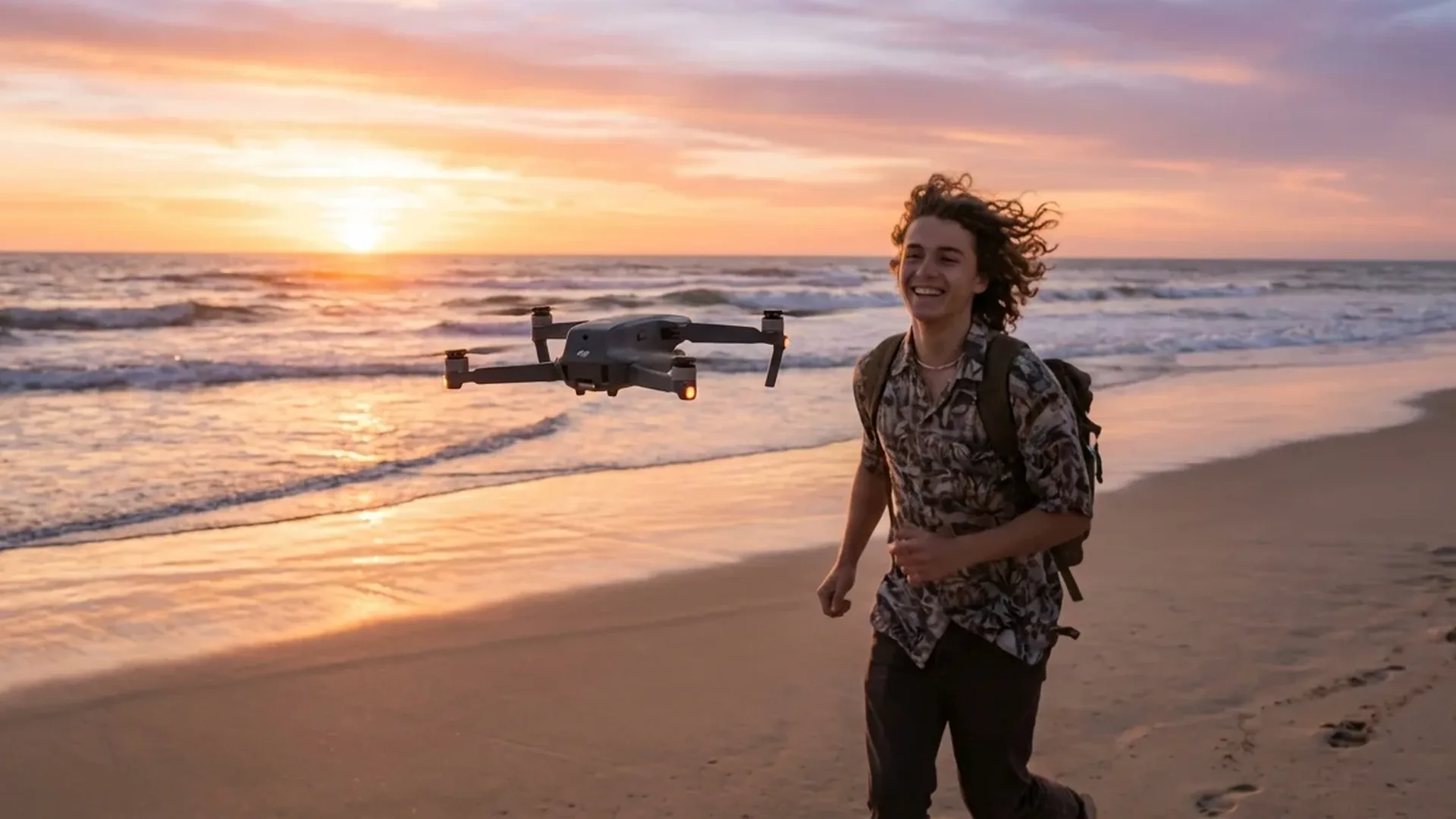
The Next Generation of the Selfie Drone
The original DJI Neo launched in August 2024 and was already impressive: an ultra-small drone with prop guards, palm takeoff, and basic automatic functions. But it had limitations — a small sensor (1/2.3″), electronic stabilization only, 16GB of storage, and critically no obstacle detection except downward.
With the Neo 2, DJI addressed every single one of those points. The result is a drone that doesn't feel like an upgrade — it feels like an entirely new product. Let's breakdown exactly why.
Omnidirectional Obstacle Sensing: The Biggest Upgrade
The most significant upgrade isn't about the camera — it's about safety. The Neo 2 is the smallest drone DJI has ever produced with omnidirectional obstacle sensing. This means it can detect obstacles in front, to the sides, and below — something typically found only in considerably more expensive drones like the Air 3S or the Mavic 4 Pro.
How does it achieve this in 151 grams? With three sensor systems:
- Omnidirectional monocular vision system: Vision sensors around the drone body detecting obstacles in front and to the sides
- Forward-facing LiDAR: A LiDAR sensor pointing forward — rare in a drone of this class. It allows the drone to “see” objects more accurately, even in low light conditions
- Downward infrared sensor: For safe hovering at low altitude, even indoors without GPS
Combined, these three systems create a “safety bubble” around the drone. If you approach a wall, tree, or pole, the Neo 2 automatically slows down or stops before impact. Combined with the integrated full-coverage propeller guards, it becomes one of the safest drones available.
Why this matters: The original Neo had no front or side obstacle detection. It could easily crash into a tree or wall when flying in forests or near buildings. The Neo 2 solves this fundamentally — it has sensors that even the Mini series didn't have until recently.
Camera: A Serious Upgrade in a Tiny Body
The Neo 2 features a 1/2″ CMOS, 12MP, f/2.2 sensor — upgraded from the 1/2.3″ sensor of the original. The difference in sensor size may seem small in numbers, but in practice it means better low-light performance, less noise in images, and more vibrant colors.
Beyond the upgraded sensor, DJI added something crucial: a 2-axis gimbal combined with Electronic Image Stabilization (EIS). The original Neo relied exclusively on EIS — which works, but the cinematic feel is missing. Mechanical stabilization delivers noticeably smoother footage, especially during panning and tracking movements.
What it shoots:
- 4K/60fps: High-resolution video recording with realistic image quality
- 4K/100fps Slow Motion: Slow motion at full 4K resolution — impressive for a drone under €245 (~$265)
- 2.7K Vertical Video: Vertical footage ideal for TikTok, Instagram Reels, YouTube Shorts
- 12MP photos: Good for social media and medium-quality prints
- Portrait Optimization: DJI's portrait optimization technology automatically adjusts brightness, contrast, and skin tones
By comparison, it naturally doesn't match the 1/1.3″ sensor of the DJI Flip or the Mini 5 Pro, nor does it support D-Log M or RAW photos. But for its intended purpose — quick, automatic on-the-go captures — the image quality is impressive. As one user on Skroutz notes: "the videos you capture with this drone are much better than many expected for its size and price."
Control Methods: 6+ Ways to Fly
What makes the Neo 2 truly unique isn't just the camera or safety — it's the number of ways you can control it. DJI designed a drone that can operate completely autonomously, without any accessories, or evolve into a full FPV system.
1. Palm takeoff and landing: Point the drone toward your face, press a button, and it takes off from your hand. The new Return-to-Palm function on the Neo 2 accurately detects your palm, approaches safely, and lands steadily. You need neither a phone nor a controller.
2. Gesture Control: Raise your palm to move the drone up/down/left/right. Use both hands for precise distance control. No remote needed even for adjusting the camera angle.
3. Voice Control: Via smartphone or Bluetooth headset, you give voice commands. Ideal for running, cycling, or other activities where your hands are busy. The app can also record audio and automatically filter out propeller noise.
4. DJI Fly App: Virtual joysticks on your phone, full flight control via Wi-Fi. Range is limited (approximately 50 meters), but sufficient for most use cases.
5. Remote Controller (RC-N3 / RC 2): For full control with physical joysticks, video transmission range up to 10 kilometers. The RC-N3 uses your phone as a display, while the RC 2 has a built-in screen.
6. FPV Mode: By combining DJI Goggles N3 (or Goggles 3) with the RC Motion 3 controller, you fly as if sitting inside the drone. The Manual FPV Mode was added via firmware update v01.00.0400 (November 2025), offering full manual control and Easy ACRO mode.
7. Apple Watch: In December 2025, DJI added remote control support via Apple Watch — you control, capture, monitor, and manage the drone directly from your wrist. A “futuristic touch” that no other drone offers.
Intelligent Flight Features
The Neo 2 carries some of the most advanced automated features we've seen in a drone at this price point:
ActiveTrack: The upgraded tracking version follows subjects at speeds up to 12 m/s (43 km/h) — enough for running, cycling, or skateboarding. Omnidirectional obstacle sensing remains active during tracking, so it avoids obstacles while following you. It supports 8-direction tracking (front, rear, left, right, and 4 diagonals), and can automatically switch to rear tracking in complex environments.
SelfieShot: A new function exclusive to the Neo 2. It captures individual or group moments in three variations: waist-up, full-body, and wide shot. Composition is automatic — ideal for birthday parties, picnics, or travel.
QuickShots, MasterShots, Dolly Zoom: All the classics return — Dronie, Circle, Rocket, Helix, Boomerang. MasterShots automatically create complete cinematic clips, while Dolly Zoom (the Hitchcock effect) delivers a dramatic “vertigo” sensation in footage.
Riding Follow: A special cyclist tracking function. The drone follows smoothly without the jerky movements that normal tracking can cause on complex trails.
Built-in display: Unlike the original, the Neo 2 features a small display on the drone body itself. You can select a shooting mode or start recording without connecting anything. Press a button, choose a mode, and it flies.
Neo 2 vs Neo 1: Is the Upgrade Worth It?
For those who already own the first Neo or are considering picking one up at a lower price (currently €156 (~$170) Drone Only on Skroutz), this comparison is crucial:
| Feature | DJI Neo (2024) | DJI Neo 2 (2025) |
|---|---|---|
| Weight | 135g | 151g |
| Sensor | 1/2.3″ CMOS, 12MP | 1/2″ CMOS, 12MP, f/2.2 |
| Stabilization | EIS only | 2-axis gimbal + EIS |
| Video | 4K/30fps | 4K/60fps, 4K/100fps slo-mo |
| Vertical video | Yes | 2.7K vertical |
| Obstacle sensing | Downward only | Omnidirectional (LiDAR + Vision + IR) |
| Storage | 16 GB | 49 GB |
| Wi-Fi Transfer | Basic | 80 MB/s QuickTransfer |
| Flight time | 18 minutes | 19 minutes |
| Return-to-Palm | ❌ | ✅ |
| Apple Watch | Later (update) | ✅ |
| Manual FPV Mode | ❌ | ✅ (firmware update) |
| Built-in display | ❌ | ✅ |
| Price (Drone Only) | €156 (~$170) | €245 (~$265) |
The €89 difference (€156 vs €245) is fully justified. Omnidirectional obstacle sensing, the 2-axis gimbal, 49GB of storage, 4K/60fps, and Return-to-Palm transform the flight experience. If you're buying today, the Neo 2 is the only choice that makes sense.
If you already own the original Neo and fly primarily in open spaces without obstacles, you could wait. But if you fly near trees, buildings, or in indoor spaces, the upgrade is definitely worth it.
Storage, Battery, and Practical Considerations
One point many don't mention enough: the 49 GB of internal storage without a memory card. That means space for approximately 105 minutes of 4K/60fps video — over 5 full batteries' worth of flight footage. You'll never need a microSD card, which significantly simplifies your life.
File transfer happens via Wi-Fi QuickTransfer at 80 MB/s. A 1GB video transfers to your phone in 12-13 seconds. No cables needed — your footage is on your phone immediately after the flight.
The 1606 mAh battery provides 19 minutes theoretically. In practice, users report 14-15 minutes under normal flight conditions. That's short — but expected for a 151-gram drone. The solution? The Fly More Combo includes 3 batteries, giving you approximately 45 minutes of real-world flight time. The two-way charging hub charges all 3 batteries simultaneously.
Regarding wind resistance, the Neo 2 handles up to Level 5 (10.7 m/s). For a 151g drone, that's notable. However, at a windy beach or on mountain peaks, it will struggle. For calm days and urban environments, it's perfectly fine.
Pricing in Europe (February 2026)
The DJI Neo 2 is available in 4 editions in Greece, all available through Skroutz.gr from 18+ retailers:
Just the drone, without controller or transceiver. Works with phone & automatic modes.
3 batteries + charging hub + accessories. No controller included.
3 batteries + RC-N3 controller (uses your phone as display).
3 batteries + RC Motion 3 + DJI Goggles N3 for FPV experience.
Which edition should you get?
Drone Only — €245 (~$265): The most affordable option — but with an important catch. The Drone Only package does not include the Digital Transceiver (€21 (~$23) separately) required for controller flight. Without it, you can only fly via phone (DJI Fly app) or autonomously. If you don't plan on using a controller, it's perfectly fine.
Fly More Combo — €339 (~$369): The best value. Three batteries transform the experience — instead of a timid 15 minutes, you get approximately 45 minutes of flight time. The charging hub charges all 3 simultaneously. If you're torn between this and the Drone Only, get this one.
FMC + RC-N3 — €409 (~$449): If you want full manual control, 10 km range, and access to camera settings (ISO, WB, etc.), this is the right choice. The RC-N3 uses your phone as a display.
Motion FMC — €589 (~$639): Only if you want the FPV experience. The Goggles N3 put you “inside” the drone, while the RC Motion 3 is controlled with gyroscope movements of your hand. An impressive experience, but the price approaches “standard” drones that are more capable.
What Users Say
On Skroutz.gr, the DJI Neo 2 holds a 4.9/5 rating (13 reviews, February 2026). Nearly all are 5 stars (12 out of 13), with just one 4-star review:
Pros & Cons
Pros
- ✅ Omnidirectional obstacle sensing (LiDAR + Vision + IR)
- ✅ 151g — no license required (C0 EU class)
- ✅ 4K/60fps + 4K/100fps slow-mo
- ✅ 2-axis gimbal + EIS (massive upgrade)
- ✅ 49GB internal storage
- ✅ Palm, gestures, voice, app, RC, FPV, Apple Watch
- ✅ Return-to-Palm — unique feature
- ✅ 8-direction ActiveTrack at 12 m/s
- ✅ Built-in display on the drone
- ✅ Wi-Fi QuickTransfer 80 MB/s
Cons
- ❌ 19 min theoretical, ~14-15 in practice
- ❌ No D-Log M or RAW photos
- ❌ 1/2″ sensor (smaller than Flip/Mini 5 Pro)
- ❌ Drone Only lacks transceiver — needs separate purchase (€21 (~$23))
- ❌ 12MP only — no 48MP mode
- ❌ Not officially available in the USA
- ❌ Low range without controller (~50m)
Who It's For — and Who It's Not
The DJI Neo 2 targets a very specific audience. As one Skroutz user aptly notes: "Before starting the review, it's worth knowing the reason we're buying each drone model so we have the appropriate expectations."
Ideal for:
- Travelers who want aerial footage without lugging around an equipment backpack
- Content creators who need follow-me shots, vertical video, and selfie captures
- Families who want a safe drone for picnics, birthdays, outings
- Athletes (runners, cyclists) — ActiveTrack + voice control = hands-free filming
- FPV newcomers who want to try immersive flying without risk
NOT for:
- Landscape photographers: The 1/2″ sensor can't compete with the 1/1.3″ of the Flip or the 1″ of the Air 3S in detail
- Professional videographers: Without D-Log M, 10-bit, or RAW, post-production capabilities are limited
- Long-range flights: Without a controller, range is approximately 50 meters
- Strong winds: At 151g, even Level 5 resistance isn't always enough
Frequently Asked Questions
Do I need a controller?
Not necessarily. The Neo 2 can fly autonomously with palm takeoff, gestures, voice, or the phone app. If you want full flight control, 10km range, and manual camera settings, then you need the RC-N3. Important: with the Drone Only package, you must separately purchase the Digital Transceiver (€21 (~$23)) for it to work with a controller.
How does it compare to the DJI Flip?
Completely different drones. The Flip (€378 (~$409) with RC-N3) has a 1/1.3″ sensor, 48MP, 3-axis gimbal, D-Log M, RAW — it's clearly superior in image quality. But it doesn't do palm takeoff, doesn't have gesture control, doesn't do FPV, has no built-in display, and is heavier. If you want a “grab-and-go” selfie drone → Neo 2. If you want the best camera in a beginner drone → Flip.
Can it fly indoors?
Yes, and quite well. The full-coverage propeller guards, omnidirectional obstacle sensing, and downward infrared sensor allow stable hovering indoors without GPS. Just be careful with height — in rooms with very low ceilings, it will struggle.
What happens if connection is lost?
The Failsafe RTH (Return to Home) activates automatically. The drone returns to its takeoff point using GPS. During the return, obstacle avoidance remains active.
Final Verdict
The DJI Neo 2 isn't “just another small drone.” It is, in our opinion, the most complete selfie/vlog drone available today. Omnidirectional obstacle sensing in a 151-gram drone is a technological achievement, and the 7+ control methods (palm, gestures, voice, app, RC, FPV, Apple Watch) don't exist on any competitor.
The camera will never compete with drones in the €400+ (~$435+) category, but that's not the point. The point is to follow you, capture you, and create impressive footage without you doing anything — and at that, it excels.
At €245 (~$265) (Drone Only) or €339 (~$369) (Fly More Combo), it represents exceptional value. The 4.9/5 rating on Skroutz doesn't lie — 12 out of 13 reviews are 5 stars. If you're looking for a drone that fits in your jacket pocket and does everything on its own, this is it. Rating: 8.8/10.