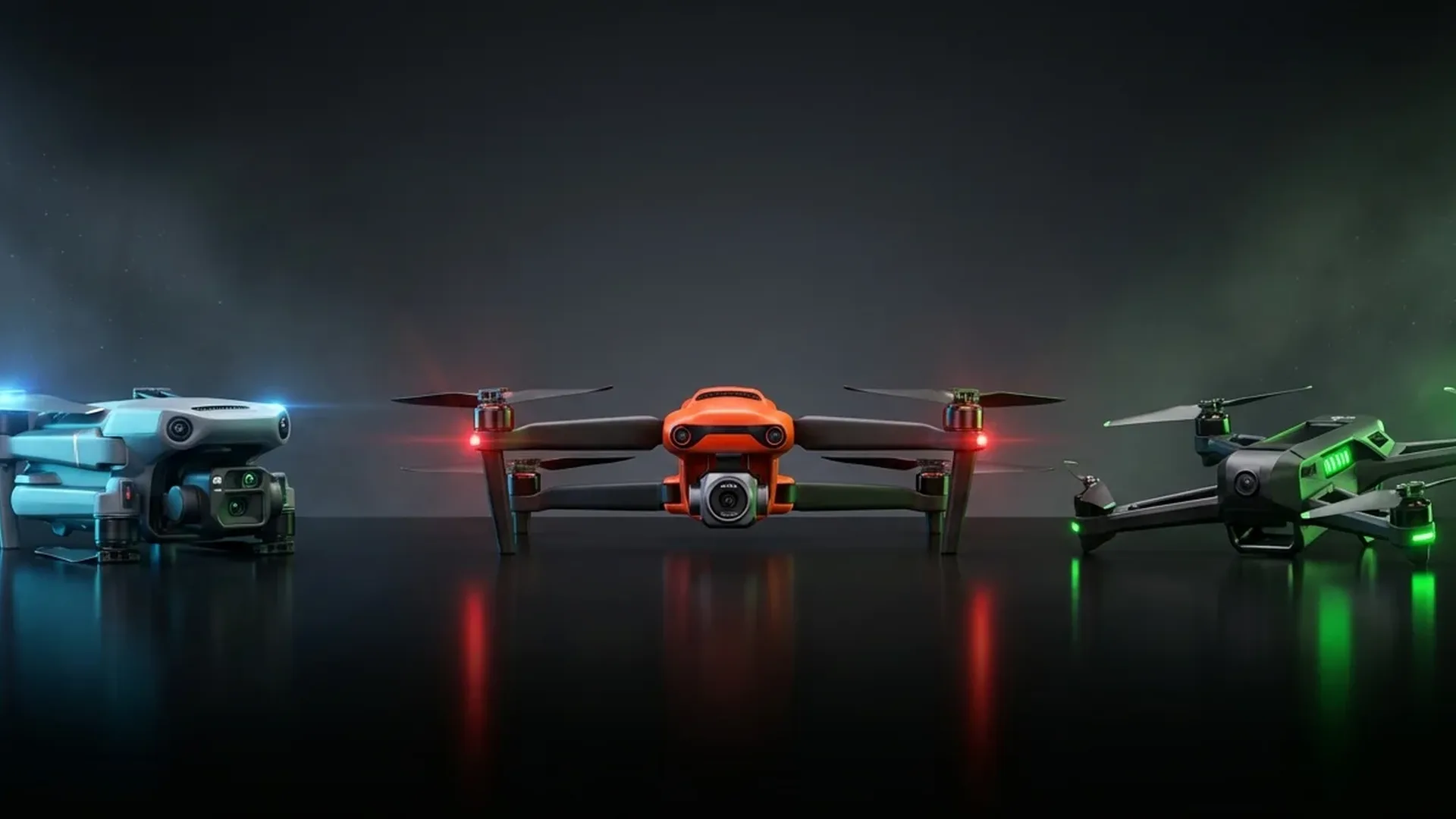
🏢 The Big Three — A Quick Introduction
Until recently, the consumer drone market had three key players. DJI, the Chinese giant headquartered in Shenzhen, was always the dominant force — consistently holding over 70% of the global market share. Autel Robotics, also a Chinese company (with commercial offices in the US), offered competitive alternatives with its EVO lineup. And Skydio, the only American drone company, stood out with its industry-leading autonomous flight technology and AI-powered obstacle avoidance.
Things have changed dramatically. According to PCMag (January 2026), both Autel and Skydio — along with Parrot and Yuneec — now manufacture exclusively unmanned aerial vehicles (UAVs) for enterprise, industry, and agriculture. GoPro (Karma) and Sony (Airpeak S1) have exited the space entirely. This means the “DJI vs Autel vs Skydio” comparison no longer involves three equal competitors — it's one dominant player versus two former contenders.
🔴 DJI — The Undisputed King
Let's start with what everyone already knows: DJI is, and remains, the dominant force in consumer drones. Founded in 2006 by Frank Wang in Shenzhen, China, the company conquered the industry through a combination of top-tier camera quality, reliable aircraft design, an excellent app ecosystem, and — crucially — competitive pricing.
The Complete DJI Lineup (Europe, February 2026)
DJI's strength lies in its breadth of options. From selfie drones at €156 (~$149) to professional cinema machines at €2,159 (~$2,099), there's literally something for everyone:
- DJI Neo (€156 / ~$149) — The cheapest drone. 4K/30fps, palm launch, QuickShots. No controller needed, no obstacle avoidance. 18-minute flight, 135g.
- DJI Neo 2 (€245 / ~$245) — 4K/60fps, LiDAR omnidirectional avoidance, gesture control, palm launch. 19 minutes, 151g. Best value on the market.
- DJI Flip (€378 / ~$369) — 4K/60fps HDR, 3-axis gimbal, 48MP, 10-bit D-Log, prop guards. 31 minutes, 249g. Perfect for vloggers.
- DJI Mini 3 (~€350-400 / ~$419) — 4K/30fps, vertical video, 38-min flight (51 min with extended battery). 249g. Budget classic.
- DJI Mini 5 Pro (€819 / ~$819) — 1-inch sensor, 50MP, 4K/60fps, LiDAR, 225° gimbal. 36 minutes. Top mini drone.
- DJI Mini 4 Pro (~€871 FMC / ~$1,299) — 4K/60fps, 360° obstacle avoidance, dual-aspect camera, D-Log M. 34 minutes, 249g.
- DJI Avata 2 (~€874 FMC / ~$719) — FPV racing drone, motion controller + FPV goggles, 4K/60fps. 23 minutes. Unique experience.
- DJI Air 3S (€1,129 / ~$1,099) — Dual camera (wide 50MP + tele 48MP), 4K/120fps, 3-axis gimbal, 360° avoidance, 45 minutes. The top mid-range pick.
- DJI Mavic 4 Pro (€2,159 / ~$2,099) — Triple camera (100MP Hasselblad + 50MP + 48MP), 6K/60fps, 51 minutes. The ultimate consumer drone.
Why Does DJI Dominate?
According to PCMag's tests, DJI "is a few steps ahead of the competition": even entry-level models support 10-bit color sampling, 4K resolution, and RAW photography. Build quality uses higher-grade plastics, drones are perfectly stable in flight, battery life is impressive, and the DJI Fly app provides excellent camera and aircraft control. Even if future DJI drones don't get FCC clearance in the US due to the foreign drone ban, the existing lineup remains “generations ahead of competitors.”
In Europe — the situation is even clearer: there is no ban, and DJI drones are sold normally in retail stores and e-shops. For European consumers, DJI is the only brand you can easily find in physical stores, with manufacturer's warranty and technical support.
📌 Key takeaway: DJI offers 9+ consumer models, from €156 (~$149) to €2,159 (~$2,099), with full availability in Europe. No competitor comes close to this range.
🟡 Autel Robotics — The Shift from Consumer to Enterprise
Autel Robotics, headquartered in Shenzhen (with commercial offices in Bothell, Washington), was once DJI's most significant competitor in consumer drones. The EVO series was a serious alternative: the EVO Lite+ featured a 1-inch CMOS sensor, 6K video, and excellent image quality, while the EVO Nano+ was a compact 249g drone with 4K/30fps and an RYYB sensor for improved low-light performance.
What Happened to the Consumer Drones?
Autel decided to pivot its strategy exclusively toward enterprise, industry, and public safety. Consumer drones (EVO Lite, EVO Nano, EVO II) are no longer produced as new models. If you find one at an online store, it's remaining inventory — with no guarantee of future firmware updates or replacement parts.
Instead, the company focuses on the EVO Max series — enterprise drones designed for law enforcement, firefighting, industrial inspections, and agriculture. The current flagship, the EVO Max 4N, is a technological powerhouse: a wide-angle 50MP camera with a 1-inch CMOS sensor, a 640×512 uncooled thermal camera, a 2.3MP starlight night vision camera, mmWave radar for obstacle avoidance even in total darkness, A-Mesh networking for multi-drone communication, and 42-minute flight time.
Impressive? Absolutely. But the EVO Max 4N is not a drone you buy for travel footage. Its price exceeds €5,000 (~$5,000+), it weighs over 1.1 kg, and it's designed for professionals who need thermal imaging or missions in extreme conditions.
Autel's Legacy Consumer Drones
If you still want an Autel consumer drone, there are some remaining on shelves — but with significant caveats:
- Autel EVO Lite+ (roughly €800-1,000 / ~$800-1,000): 1-inch CMOS, 6K/30fps video, 5.4K/30fps or 4K/60fps, 40-minute flight, angular obstacle avoidance. It was excellent for its time, but the DJI Air 3S (€1,129 / ~$1,099) now surpasses it in every category.
- Autel EVO Nano+ (roughly €500-700 / ~$500-700): 249g, RYYB 1/1.28-inch sensor, 4K/30fps, 28-minute flight. The “Mini killer” of its era — but it can't compete with the Mini 5 Pro or even the Flip now.
The problem: there's no guarantee that firmware updates will continue, that you'll find replacement batteries long-term, or that Autel will keep supporting the smartphone app. Buying a discontinued product is always a gamble.
"Autel once made excellent consumer drones. Today, however, they exclusively manufacture enterprise UAVs. If you find an EVO Lite+ or Nano+ at a store, you're essentially buying an orphaned product with no future."
🔵 Skydio — The American Powerhouse That Doesn't Serve Consumers
Skydio was founded in 2014 in California with an ambitious vision: drones that fly themselves through AI, avoiding obstacles without human intervention. And it achieved that goal better than anyone. In 2020, the company released the Skydio 2 — a consumer drone with astonishing autonomous flight capability. Through forest trails, between trees, through tight gaps, the Skydio 2 flew on its own without hitting anything.
Why Did They Leave the Consumer Market?
Despite its technological superiority in autonomous flight, Skydio faced serious challenges in the consumer market: camera quality didn't match DJI (the 1/2.3-inch sensor was mediocre), battery life was limited, availability outside the US was minimal, and — critically — pricing was high relative to what it offered as a “camera device.” Ultimately, Skydio officially announced that it was discontinuing consumer drones to focus on enterprise and government solutions.
What Does Skydio Offer Today?
Today's Skydio is entirely enterprise-focused. The flagship X10 is a military-grade aircraft: 64MP narrow camera + 48MP telephoto + thermal, NVIDIA Jetson Orin GPU for on-board AI processing, 360° AI obstacle avoidance, NightSense autonomous night flight, IP55 waterproofing, 40-minute flight time, 45 mph speed, and a 7.5-mile range via Skydio Connect SL. It's NDAA compliant, designed and assembled in the USA, and used by the US military, fire departments, police departments, and industrial operators.
Skydio Autonomy, powered by the NVIDIA Jetson Orin, analyzes footage from multiple cameras in real time, building a 3D model of the environment. No consumer drone — not even DJI's best — comes close to this level of AI autonomy. But with prices starting well above €10,000 (~$10,000+) depending on configuration, Skydio is irrelevant for any hobbyist pilot.
⚠️ Important: Skydio never had a significant presence in Europe. Even when they sold consumer drones, availability was almost exclusively in the US. For European consumers, Skydio was never a realistic option.
⚔️ The Big Comparison — Which Brand for Whom?
Let's put things in order. The 2026 comparison isn't about three equal companies — it's about three entirely different profiles:
DJI — Consumer King
Full lineup €156–€2,159 (~$149–$2,099). Top camera, app, support. Sold everywhere in Europe. The ONLY realistic option for consumers.
Autel — Enterprise Only
Excellent enterprise drones (EVO Max series) with thermal cameras and mmWave radar. Consumer drones discontinued. For companies/organizations only.
Skydio — Military/Enterprise
Best AI autonomy, NDAA compliant, made in USA. Prices €10,000+. No European presence. For governments/military/industry.
Consumer Drone Comparison
The fairest comparison is between each brand's latest consumer drones — even though two of them are discontinued:
🏆 DJI Air 3S (€1,129 / ~$1,099)
- Dual camera 50MP + 48MP
- 4K/120fps, 10-bit, HDR
- 360° obstacle avoidance
- 45-minute flight time
- 48GB internal storage + microSD
- 20km transmission range
- ✅ Active product, full support
📦 Autel EVO Lite+ (~€900 / ~$900)
- 1-inch CMOS, 20MP
- 5.4K/30fps or 4K/60fps
- Front/rear avoidance only
- 40-minute flight time
- microSD only
- 12km range
- ⚠️ Discontinued, uncertain support
What Do the Experts Say?
Tom's Guide consistently ranks DJI drones at the top. The Air 3S received an “Outstanding” rating at 4.5/5, and even budget models (Flip, Neo 2) outperform older Autel models in image quality thanks to their newer image processing pipeline. PCMag emphasizes that “DJI models have earned our highest ratings time and time again” — something no Autel or Skydio consumer drone ever achieved.
Potensic (Atom 2, ~€270 / ~$290) is mentioned as the only noteworthy non-DJI alternative on the market. Antigravity (A1, ~€1,475 / ~$1,599) is interesting for 360° video but remains niche. Real competition simply doesn't exist.
🇪🇺 The European Reality
An important point often lost in the discussion: regulatory developments in the US — the FCC ban on foreign drones — do not apply to Europe at all. In EU countries, you can buy and fly any DJI drone normally, and this is not going to change in the foreseeable future.
The European drone market is dominated almost exclusively by DJI. In retail stores and specialized e-shops, you'll find the full Neo, Flip, Mini, Air, and Mavic lineup — with local warranties and after-sales service. Autel drones can potentially be found through Amazon or imports, but without local support. Skydio has never been available in Europe.
For flight regulations, European countries follow the EASA framework: drones under 250g (Open category A1) have the fewest restrictions, while heavier drones fall into A2/A3 categories with stricter rules. Operator registration is mandatory in most countries. Notably, the DJI Neo, Neo 2, Flip, Mini 3, Mini 4 Pro, and Mini 5 Pro all weigh under 250g — the most “unrestricted” category.
🤔 Buying Scenarios — What Should You Get?
Let's look at some practical scenarios for drone buyers:
🟢 Scenario 1: I want my first drone
Go straight to DJI. If your budget is tight, the DJI Neo (€156 / ~$149) or the DJI Neo 2 (€245 / ~$245) will get you airborne with zero risk. If you want something more capable but still affordable, the DJI Flip (€378 / ~$369) delivers cinematic quality at a budget price.
🟡 Scenario 2: I need professional aerial photography
If your work demands top-tier image quality, the DJI Mavic 4 Pro (€2,159 / ~$2,099) with its 100MP Hasselblad sensor is unquestionably the most capable consumer drone. If you don't need that much firepower, the DJI Air 3S (€1,129 / ~$1,099) delivers impressive dual-camera performance at half the price.
🔴 Scenario 3: I need a drone for industrial use
Here's where Autel gets interesting. If you need thermal imaging, night flight, or mesh networking for multi-drone operations, the Autel EVO Max 4N deserves serious consideration. The Skydio X10 is also top-tier — but procurement in Europe is practically impossible without a local distributor.
🟣 Scenario 4: I don't want DJI
If you categorically refuse DJI (privacy concerns, geopolitical reasons, personal preference), your options in the consumer space are very limited. The Potensic Atom 2 (~€270 / ~$290) is the best non-DJI buy. Beyond that, you might find remaining Autel EVO stock — but with no future support.
📊 Brand Comparison Table
Price Range
DJI: €156–€2,159
Autel: €5,000+ (enterprise)
Skydio: €10,000+ (enterprise)
Camera Quality
DJI: Best in consumer class
Autel: Enterprise-grade thermal
Skydio: Enterprise multi-sensor
AI / Autonomy
DJI: Very good (ActiveTrack, APAS)
Autel: Good (enterprise focus)
Skydio: Best in the world
European Availability
DJI: Everywhere (retail + e-shops)
Autel: Amazon/import only
Skydio: Not available
After-Sales in Europe
DJI: Full warranty + service
Autel: No local support
Skydio: Non-existent
Target Audience
DJI: Beginners → Professionals
Autel: Enterprise/Industry
Skydio: Government/Military
💡 Final Verdict
The “DJI vs Autel vs Skydio” comparison that was valid during 2020–2023 no longer exists. The 2026 consumer drone market has one clear winner — DJI — and that's not due to “fan loyalty” but because literally nobody else manufactures consumer drones worth buying.
🎯 For Consumers
DJI is the only brand worth your money. Pick the DJI Neo 2 (€245 / ~$245) if you want something affordable and reliable, the DJI Flip (€378 / ~$369) if you want top video on a budget, the DJI Air 3S (€1,129 / ~$1,099) if you want the best all-around, or the DJI Mavic 4 Pro (€2,159 / ~$2,099) if you want the ultimate. Don't bother looking for Autel or Skydio — it simply doesn't make sense anymore.
If you work in the enterprise or industrial sector and need thermal cameras or military-grade AI autonomy, then Autel (EVO Max) or Skydio (X10) are worth examining — but with prices running into the thousands and no local support in most European countries, thorough research before purchase is essential.
The truth is simple: we live in the age of DJI. And until a competitor puts consumer drones on the market that are at least equal, brand choice is no longer a “question” — it's a given.