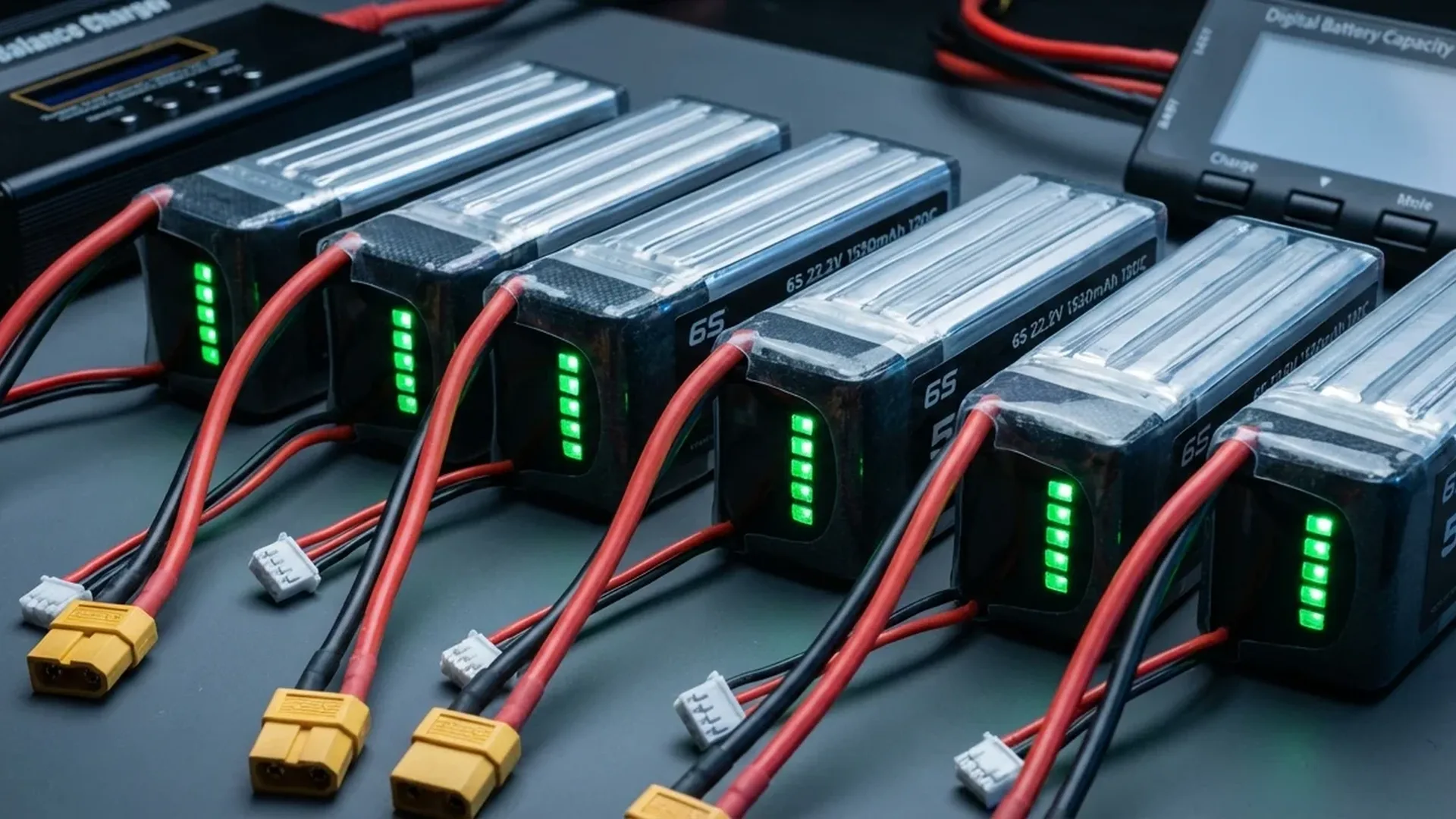
🔋 What Is a LiPo Battery & How It Works
Modern consumer drones — from the DJI Mini 4 Pro to the DJI Air 3S — use LiPo (Lithium Polymer) batteries. This isn't a coincidence: LiPo batteries offer an exceptional energy-to-weight ratio. For a drone that needs to stay airborne, every gram matters, and LiPos deliver more power per unit of weight than virtually any other battery technology available.
Each LiPo battery consists of one or more cells connected in series. Every cell has a nominal voltage of 3.7V, a full charge of 4.2V, and a minimum safe voltage of 3.0V. For example, a "2S" battery (2 cells in series) has a nominal voltage of 7.4V, while a "3S" has 11.1V. DJI's Intelligent Flight Batteries incorporate protection electronics that prevent overcharging and deep discharge — but that doesn't mean you can ignore them.
Why LiPos demand respect
Unlike the disposable AA batteries you pick up at a convenience store, LiPo cells are sensitive to extreme temperatures, overcharging, and deep discharge. Discharging a cell below 3.0V can cause permanent damage — oxidation inside the cells that degrades performance irreversibly. On the other end, charging above 4.2V per cell is dangerous and can theoretically lead to fire. DJI's Intelligent Flight Batteries automatically manage these limits, but your care with storage and temperature is what makes the real difference.
⚠️ Important: Never use a battery that appears deformed, swollen, or physically damaged. A puffy LiPo means gas has been trapped inside the cells — this condition is irreversible. Retire it immediately.
⚡ Real-World Flight Time: What the Numbers Say
Manufacturers always quote maximum flight time under ideal conditions — controlled environment, zero wind, no video recording, at a constant speed. In practice, real-world endurance is typically 20-30% shorter.
The DJI Mini 4 Pro, according to DJI, offers a maximum flight time of 34 minutes with the standard Intelligent Flight Battery, measured in a controlled wind tunnel at a constant speed of 21.6 km/h. Maximum hover time reaches 30 minutes. In reality, with light winds, altitude changes, gimbal movement, and 4K video recording, practical flight time ranges between 23 and 27 minutes.
It's worth noting that DJI also offers the Intelligent Flight Battery Plus, which extends flight time to 45 minutes (or 39 minutes of hover). However, this battery is not sold in Europe because it pushes the aircraft weight above 249 g, changing the EASA category and requiring additional certifications. Maximum flight distance reaches 18 km with the standard battery.
🔌 Proper Charging: The Foundation
Charging is the single most critical process in a LiPo battery's life. Do it right, and your battery will last for years. Do it wrong, and performance will degrade within months.
Always balance charge
DJI Intelligent Flight Batteries automatically perform balance charging, ensuring each cell charges evenly. This is crucial: if cells become imbalanced, some may overcharge while others remain partially charged — a dangerous situation. DJI's Two-Way Charging Hub charges three batteries sequentially, starting with the one that has the highest charge level.
Charging speed
The standard recommendation for LiPo batteries is charging at 1C — meaning a charge current equal to the capacity in Ah. For a 2,590 mAh battery (DJI Mini 4 Pro), that translates to roughly 2.6A. At this rate, a full charge from empty takes approximately one hour. DJI recommends using the DJI 30W USB-C Charger or another USB Power Delivery charger for optimal speed.
💡 Pro Tip: If your battery gets noticeably warm during charging, stop immediately. A healthy LiPo should not feel hot to the touch. If it does, you're either charging too fast or there's a problem with the battery itself.
When to charge
Charge your batteries the day before (or a few hours before) your flight. If you charge batteries and end up not flying for more than 2-3 days, it's good practice to return them to storage voltage. DJI Intelligent Flight Batteries are designed to auto-discharge to storage voltage after a period of inactivity (typically 3-5 days, adjustable through the DJI Fly app), but it's always wise not to leave batteries fully charged without reason.
Don't charge right after flying
After a flight, your battery is warm. Wait at least 15-20 minutes for it to cool down before connecting the charger. Charging a hot battery accelerates wear and increases internal resistance — meaning less power output and lower performance down the road.
🏠 Storage: The 40-60% Rule
If you don't plan to fly for more than 1-2 weeks, your battery should be stored at storage charge voltage — around 3.80-3.85V per cell, which corresponds to roughly 40-50% charge. At this level, the LiPo is in its most chemically stable state: minimal internal stress, minimal self-discharge, maximum lifespan.
The reasons are electrochemical: a fully charged LiPo (4.2V/cell) exists in a high-energy state that gradually stresses the electrodes. Similarly, an empty battery below 3.5V risks oxidation. In both extreme states, internal resistance climbs faster, which translates to lower performance.
"Storing at storage charge is the single most important factor in LiPo battery longevity. If you only do ONE thing right, make it this."
Storage temperature
Store your batteries at room temperature — ideally between 15°C and 25°C (59-77°F). Don't leave them in your car during summer (interior temperatures can exceed 60°C/140°F), don't expose them to direct sunlight, and don't store them in very cold environments (<5°C/41°F). Excessive heat can cause swelling or even thermal runaway. Extreme cold can permanently reduce capacity.
Where to store
The ideal storage spot is a dry, cool area away from flammable materials. For added safety, use a LiPo safety bag or a metal container (like an ammo box). LiPo bags alone won't stop a battery fire, but they can slow it down — a metal box provides more effective containment.
🌡️ Temperature & Flight: The Hidden Enemy
Temperature dramatically affects LiPo battery performance. According to DJI, the Mini 4 Pro's operating range is -10°C to 40°C (14-104°F). But within that range, performance varies significantly.
Cold (<10°C / 50°F)
In cold weather, battery chemistry slows down. Lithium ions move more sluggishly through the electrolyte, increasing internal resistance. This creates more pronounced "voltage sag" — voltage drops under load. In practice, flying at 0°C (32°F) can reduce flight time by 20-30%. If voltage drops sharply during a throttle burst, individual cells might dip below safe limits.
Best practice: keep your batteries warm before flying — in your pocket, in the car with the heater on, or in an insulated battery bag. Start your flight by hovering low for 30-60 seconds, allowing the battery to warm up through operation before demanding full power. If you see a low temperature warning in the DJI Fly app, don't ignore it — wait until readings exceed 15°C (59°F).
Heat (>35°C / 95°F)
Excessive heat is equally problematic. At ambient temperatures above 40°C (104°F), the battery can overheat during flight, especially in Sport mode or with sustained power bursts. Overheating accelerates degradation, increases the risk of swelling, and reduces overall cycle life.
📖 Read more: How to Fly a Drone: Step-by-Step Tutorial
Optimal operating range: LiPo batteries perform best between 20°C and 30°C (68-86°F) — typical spring and autumn conditions. In this range, you'll experience maximum flight time and minimal battery degradation.
🛩️ 10 Tips for Longer Flight Time
Beyond proper battery care, there are several things you can do during flight to squeeze every last second of endurance from your drone.
- Fly in Normal or Cine mode: The DJI Mini 4 Pro's Sport mode (S) reaches 16 m/s but consumes significantly more energy. In N mode (12 m/s) or C mode, power consumption drops dramatically.
- Avoid frequent direction changes: Every abrupt direction change requires braking and re-acceleration, wasting energy. Plan your movements smoothly.
- Maintain a steady altitude: Climbing is the most energy-intensive maneuver — motors work directly against gravity. Once you reach your desired altitude, keep it level.
- Fly in calm conditions: Wind above 5-6 m/s forces the motors to work harder for stabilization. The DJI Mini 4 Pro handles up to 10.7 m/s, but at 8+ m/s the battery drains noticeably faster.
- Don't fly until empty: Land when the battery reaches 20-25%. Discharging below 15% stresses the cells more aggressively — voltage drops much faster below this threshold.
- Minimize hover time: Hovering isn't free — motors consume energy just to maintain altitude. According to DJI, the Mini 4 Pro's hover time is 30 minutes, 4 minutes less than maximum flight time (34 minutes).
- Remove unnecessary weight: Propeller guards, landing pads, or third-party accessories add weight. If you don't need them, remove them. For the Mini 4 Pro (<249 g), even 20-30 grams make a noticeable difference.
- Get extra batteries: If possible, purchase additional batteries and rotate them. A DJI Mini 4 Pro Intelligent Flight Battery costs approximately €55-65 (~$60-70). The Fly More Combo includes 3 batteries — much more cost-effective.
- Keep firmware updated: DJI frequently optimizes power management through firmware updates. Updates may fail if the battery is below 20% — make sure you start with adequate charge.
- Plan your flight path: If you know what shots you need beforehand, you can minimize unnecessary back-and-forth. Use Waypoint Flight for automated, efficient routes.
📊 Cycle Life & Internal Resistance
Every LiPo battery has a limited number of charge-discharge cycles. One "cycle" counts from a full charge to a full discharge. According to testing data, standard LiPo batteries lose approximately 3.8% of their performance per 100 cycles. A well-maintained drone battery can last 200-300 cycles before performance becomes noticeably degraded.
Internal resistance (IR) is the most reliable indicator of LiPo health. Lower IR means more efficient power delivery. Over time and usage, internal resistance gradually increases — an irreversible process. This manifests as "voltage sag": under load (e.g., increased throttle), voltage drops faster, and the drone feels less powerful.
Factors that accelerate degradation — and therefore increase internal resistance — include:
- Deep discharge (voltage below 3.0V per cell)
- Overcharging (above 4.2V per cell)
- Overheating during use or charging
- Storing at full charge or fully depleted for weeks
- Frequent flights in extreme temperatures
⚠️ Signs of Wear: When to Replace Your Battery
There's no "expiration date" on a LiPo battery. With proper care, it can perform satisfactorily for years. However, there are clear signs that replacement time has arrived:
- Swelling (puffing): If the battery appears puffy — even slightly — stop using it immediately. Gas inside the cells indicates chemical failure. The condition is irreversible.
- Noticeable flight time reduction: If you're consistently getting 30-40% less flight time compared to a new battery, capacity has degraded significantly.
- Slow charging or unbalanced cells: If the battery takes unusually long to charge or cells show significant voltage differences after a flight, internal health is poor.
- DJI Fly app errors: If the app displays warnings like "battery abnormal" or "cell error," take them seriously.
- Physical damage: Dents, torn casing, or visible damage from a crash. Never attempt to use a physically damaged battery.
💡 Rule of thumb: Replace your drone batteries every 200-300 cycles or every 2-3 years, whichever comes first. Even without visible signs of wear, internal resistance will have increased enough for measurably lower performance.
✈️ Traveling with Batteries by Air
If you plan to travel with your drone — and you should, because some of the world's most stunning landscapes are waiting — you need to know the rules for transporting LiPo batteries.
- Carry-on only: LiPo batteries must NEVER go in checked luggage. Always keep them in your carry-on bag.
- Storage charge: Bring batteries at storage voltage (~40-50%). If you can't manage that, at least avoid traveling with them fully charged.
- Cover the terminals: Apply tape or use terminal caps to prevent short circuits during transport.
- Use a LiPo bag: Keep batteries inside a LiPo safety bag during transit.
- Check with your airline: Each carrier may have slightly different rules. Most accept batteries up to 100Wh without special permission — a DJI Mini 4 Pro battery is approximately 19.83Wh, well below this limit.
- Never travel with damaged batteries: If a battery is swollen or physically damaged, don't bring it on a flight.
🔥 Safety: What to Do If Something Goes Wrong
The chances of experiencing a LiPo fire with DJI Intelligent Flight Batteries are extremely low, but knowledge saves lives. If a battery starts smoking or emitting heat:
- Stay calm — disconnect all cables if you can do so safely
- Use a fire extinguisher if one is available
- Alternatively, cover with sand — sand effectively smothers LiPo fires
- Do NOT use water
- Avoid breathing the smoke — it contains toxic substances
- Wait until the battery cools completely before handling it
💰 Battery & Charging Accessory Costs
DJI battery pricing in Europe follows standard regional pricing. A standalone DJI Mini 4 Pro Intelligent Flight Battery costs approximately €55-65 (~$60-70). If you don't already have a Fly More Combo, you can purchase the Two-Way Charging Hub (around €40-50 / ~$45-55) and additional batteries separately. However, the Fly More Combo RC 2 (~€1,010 / ~$1,099) or Fly More Combo Plus RC 2 (~€1,065 / ~$1,159) includes 3 batteries, a charging hub, and a carry bag — a better deal overall if you're just getting started.
The DJI 30W USB-C Charger, which is the recommended charger, retails for around €20-25 (~$22-27). You can use any USB Power Delivery charger of equal or greater wattage, but the official one guarantees compatibility. Don't use uncertified third-party chargers — saving a few euros isn't worth the risk.
📋 Quick Reference Cheatsheet
Let's wrap up with a quick reference you can keep handy every time you prepare for a flight:
- ✅ Charge your battery shortly before flying — not days ahead
- ✅ Store at storage charge (~40-50%) if not flying for 1+ week
- ✅ Keep batteries at room temperature (15-25°C / 59-77°F)
- ✅ Wait 15-20 minutes after flying before charging
- ✅ Fly in N or C mode for maximum endurance
- ✅ Land at 20-25% battery
- ✅ Replace batteries every 200-300 cycles or 2-3 years
- ❌ Don't charge a hot battery
- ❌ Don't fly in Sport mode if you want maximum range
- ❌ Don't store at 100% or 0% charge
- ❌ Don't use swollen or damaged batteries
- ❌ Don't put batteries in checked luggage
Your battery isn't just a consumable — it's the technology that keeps your drone in the air. Take care of it, and it will reward you with longer flight times, more consistent performance, and fewer replacement costs. Happy flying!