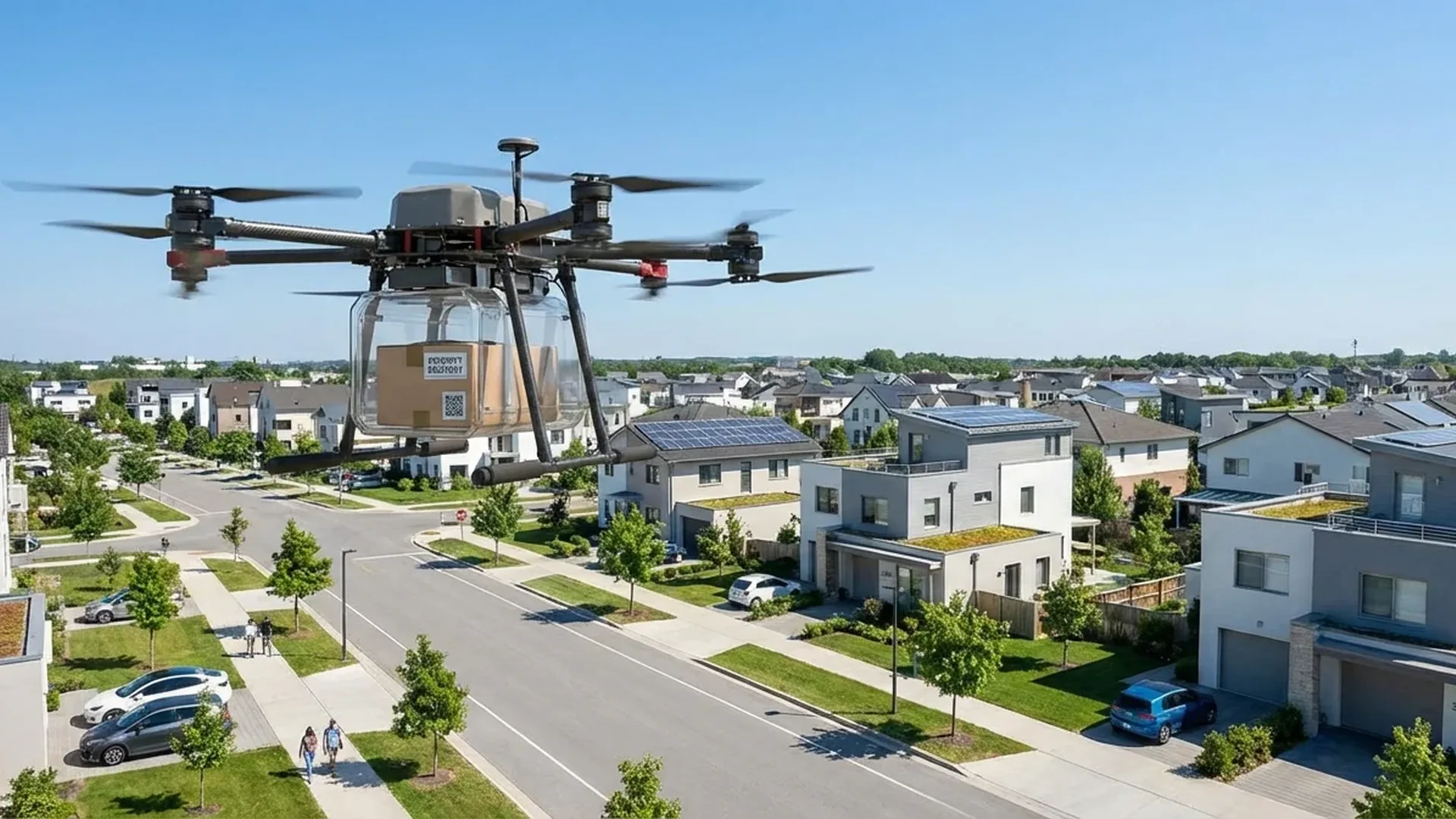
The global commercial drone market is worth approximately $8 billion (2022) and is expected to reach $47 billion by 2030 (ASME, 2023). A major growth driver is deliveries: Walmart in partnership with Wing plans 270+ drone delivery locations by 2027, reaching 40 million customers (DroneLife, January 2026). How does it work, who are the players, and when will drone delivery reach Europe?
What Is Drone Delivery
Drone delivery — or aerial transport via unmanned aircraft — is the use of UAVs (Unmanned Aerial Vehicles) to transport packages, medications, food, postal items, and lightweight goods. According to Wikipedia (2026), major companies like Amazon, DHL, and FedEx have integrated drone delivery services into their operations.
The idea entered the mainstream in December 2013, when Jeff Bezos announced Amazon Prime Air — a rapid delivery service for lightweight items via drone. Despite initial skepticism, 13 years later the industry is no longer an experiment but an operational reality in many countries.
The Major Players of 2026
Wing (Alphabet/Google)
Wing, an Alphabet (Google) subsidiary, is currently the leader in drone delivery in the USA. According to DroneLife (January 2026), Wing in partnership with Walmart has expanded to 20+ stores in the Dallas-Fort Worth area and announced plans for 270+ delivery locations by 2027, in cities including Los Angeles, Miami, St. Louis, Cincinnati, Atlanta, Houston, Tampa, Orlando, and Charlotte.
Wing's drones fly at speeds up to 97 km/h (~60 mph) and deliver packages in less than 30 minutes. Delivery is accomplished via a tether system — the drone slowly lowers the package into the customer's garden or yard without landing. More than half of Walmart's products are now available for drone delivery.
Zipline
Zipline pioneered the transport of medical supplies in Rwanda and Ghana, delivering blood, vaccines, medications, and medical samples to remote areas. During the COVID-19 pandemic, Zipline's drones delivered thousands of vaccine vials in Ghana (2020-2021). The company has expanded to the USA in partnership with Walmart.
Amazon Prime Air
Amazon, despite pioneering the concept, remains behind Wing operationally. Amazon Prime Air's MK30 drone promises delivery within 60 minutes for packages up to 2.3 kg (5 lbs), but the service remains limited to pilot locations. Competition from Wing and Zipline is pressuring Amazon to accelerate its rollout.
European Players
In Europe, Manna (Ireland) pioneered food and medication deliveries in the village of Moneygall during the pandemic. Wingcopter (Germany) delivered COVID-19 test kits in Scotland. DHL tested its “Parcelcopter” as early as 2013. Dronamics (Bulgaria) specializes in long-range fixed-wing cargo drones.
Applications: Where They're Used Today
Drone delivery applications span many sectors (Wikipedia, 2026):
- Healthcare: Transport of blood, vaccines, medications, medical samples. Zipline is credited with saving lives in Rwanda. In Canada, a drone transported lungs for transplant in Toronto.
- Food & Retail: Walmart+Wing delivers groceries, medications, and household items. Foodpanda is testing in Singapore and Pakistan.
- Postal Services: Royal Mail (UK) plans 500 drones for remote communities. ELTA (Greek Postal Service) signed an agreement with Dronamics for postal drone delivery in Greece.
- Ship Resupply: Maersk and the Port of Rotterdam are experimenting with drones instead of auxiliary vessels.
- Military Resupply: The USMC uses TRV-150C drones to transport food, water, and ammunition.
Environmental Benefits
According to a study by the Lawrence Livermore National Laboratory (published in Nature Communications), the delivery of a small package by drone in California produces approximately 0.42 kg of CO₂ emissions — 54% less than delivery trucks (~1 kg CO₂/package). In Virginia, it's estimated that drones could reduce road usage by 294 million miles annually.
However, the benefits depend on package weight, distance, and the carbon intensity of each region's electrical grid. Heavy packages over long distances are transported more efficiently by trucks.
Important: The European Union Aviation Safety Agency (EASA) is developing standardized environmental footprint methodologies for drones, taking into account the full lifecycle — manufacturing, batteries, operation, and disposal.
Advantages & Disadvantages
Advantages
- ✅ Delivery in <30 minutes
- ✅ 54% fewer CO₂ emissions
- ✅ Access to remote areas
- ✅ Saving lives (medical supplies)
- ✅ Reduced traffic congestion
- ✅ 24/7 operation (autonomous)
Disadvantages
- ⚠️ Weight limitation (~2-5 kg / 4.4-11 lbs)
- ⚠️ Range (15-25 km / 9-15 miles)
- ⚠️ Weather restrictions
- ⚠️ Regulatory barriers (BVLOS)
- ⚠️ Noise in residential areas
- ⚠️ Privacy & GDPR
Regulatory Framework
In the European Union, drone delivery operations are regulated by Regulation (EU) 2019/947 from EASA, which uses a risk-based framework (open, specific, certified categories). Typical delivery flights Beyond Visual Line of Sight (BVLOS) in urban areas fall under the Specific Category and require a Specific Operations Risk Assessment (SORA).
In the USA, the FAA certifies drone delivery companies under Part 135 (charter airline rules). The Remote ID regulation (finalized 2020) is now mandatory, requiring real-time identification. Establishing BVLOS (Beyond Visual Line of Sight) rules is critical for scaling — the FAA is working on an NPRM (Notice of Proposed Rulemaking) that will allow routine flights without visual line of sight.
Privacy is a critical issue: delivery drones use cameras for navigation and obstacle avoidance, which can capture personal data. In the EU, this is subject to the GDPR.
Drone Delivery in Greece
Greece, with its thousands of islands and remote mountainous communities, is an ideal candidate for drone delivery. According to Wikipedia (2026), ELTA (Hellenic Post) signed an agreement with the Bulgarian company Dronamics for the first postal transport via cargo drone in Greece. The goal: same-day delivery for all users at lower cost.
Dronamics uses fixed-wing cargo drones called "Black Swan", which can carry packages up to 350 kg (770 lbs) over distances exceeding 2,500 km (1,550 miles) — ideal for connecting Greek islands with the mainland.
Challenges in Greece include:
- Airspace: Many islands and coastal areas are near military zones or airports
- Regulatory framework: The Hellenic Civil Aviation Authority (HCAA) must license large-scale BVLOS flights
- Strong winds: The Aegean Sea is known for its Meltemi winds — a challenge for smaller drones
- Infrastructure: Charging stations/landing pads are needed on islands
- Cost: The initial investment in a cargo drone network is significant
"ELTA and Dronamics signed an agreement for the first postal deliveries by cargo drone in Greece. The goal: same-day delivery for everyone, everywhere, at lower cost."
— DroneLife / Wikipedia, November 2023Walmart & Wing: The Largest Expansion of 2026
According to a DroneLife report (January 2026), Walmart and Wing (Alphabet) announced the largest drone delivery expansion in history:
- September 2023: First partnership in Frisco, Texas
- 2024: Expansion to 20+ stores in Dallas-Fort Worth
- June 2025: Announcement of 100 new locations + 5 new metro areas (Charlotte, Atlanta, Houston, Tampa, Orlando)
- December 2025: 6 new hubs in Atlanta
- January 2026: 150 additional stores, target of 270+ locations by 2027
- Future cities: Los Angeles, Miami, St. Louis, Cincinnati
Orders are placed through the Wing app. At checkout, the customer confirms the delivery location (yard, garden). The drone departs from the local Walmart store, flies at up to 97 km/h (60 mph), and lowers the package via a tether without landing. Afterward, it returns to base.
What Lies Ahead After 2026
The industry is moving toward:
- Full autonomy: Drones without human intervention, 100% AI-driven navigation
- UTM (UAS Traffic Management): NASA is developing a low-altitude air traffic management system for thousands of simultaneous drones
- BVLOS regulations: The EU is expected to establish rules for mass autonomous flights within the next 2-3 years
- New batteries: Solid-state & hydrogen fuel cells will increase range and payload capacity
- Vertiports: Urban air mobility stations will serve both delivery drones and air taxis