The European Framework: EASA (EU) 2019/947 & 2019/945
Since January 1, 2021, all EU member states (including Greece) apply European Regulations (EU) 2019/947 (operational rules) and (EU) 2019/945 (technical requirements) for Unmanned Aircraft Systems (UAS/Drones). EASA (European Union Aviation Safety Agency) defines three main operational categories based on risk level:
Open Category
Low risk. No prior authorization from the authority required. The majority of recreational flights and low-risk commercial activities fall here. Max drone weight: 25 kg. Max altitude: 120 m. Visual Line of Sight (VLOS) mandatory.
Specific Category
Medium risk. Requires authorization from the competent authority (HCAA in Greece) before operation, based on an Operational Risk Assessment. Alternatively: Declaration under Standard Scenario or Light UAS Operator Certificate (LUC).
Certified Category
High risk. Requires UAS certification, a licensed remote pilot, and an approved operator. Applies to large drones, transport of people, transport of dangerous goods over crowds.
💡 Key takeaway: The vast majority of hobby/recreational pilots and small commercial flights fall under the Open Category. If you're flying a DJI Mini 4 Pro, DJI Flip, DJI Air 3S, or anything under 25 kg for photos/video without special risks — this is the category that applies to you.
Open Category Subcategories: A1, A2, A3
The Open Category is divided into 3 subcategories (A1, A2, A3) that determine where you can fly in relation to people:
| Subcategory | Proximity Rule | Drone Classes | Pilot Requirement |
|---|---|---|---|
| A1 | Fly over individual people (not over assemblies) | C0 (<250 g), C1 (<900 g) | C0: Online course + A1/A3 exam C1: Online course + A1/A3 exam |
| A2 | Fly close to people (minimum 30 m or 5 m in low speed mode) | C2 (<4 kg) | A1/A3 first + practical self-assessment + A2 theory exam at test center |
| A3 | Fly far from people (150 m from residential/commercial areas) | C2 (<4 kg), C3 (<25 kg), C4 (<25 kg) | Online course + A1/A3 exam |
Drone Classes (C0 - C4): What Each One Means
Since January 1, 2024, every drone sold in the EU must bear a Class Identification Label per Regulation (EU) 2019/945. Drones purchased before December 31, 2023 without a label can still be used, but with restrictions.
C0 — Under 250 g
The lightest drones. Operator registration not required if they have no camera/sensor. If they do have a camera → registration mandatory. Fly in A1 (over individual people). Example: DJI Mini 4 Pro (<249 g, class C0).
C1 — Under 900 g
Fly in A1 but no intentional flight over uninvolved persons. Low kinetic energy on impact (<80 J). Requires A1/A3 examination.
C2 — Under 4 kg
Fly in A2 (close to people) or A3 (far away). Requires A2 certificate (practical self-assessment + theory exam). Example: DJI Air 3S.
C3 & C4 — Under 25 kg
Fly only in A3 (far from people, 150 m+ from populated areas). C3 has a geo-awareness system. C4 does not — designed for privately built drones.
Operator Registration
UAS Operator Registration is mandatory for every person flying a drone in the EU, unless:
- The drone weighs under 250 g AND has no camera/sensor (per Regulation 2019/947, Article 14).
- The drone qualifies as a toy under Directive 2009/48/EC.
In Greece, registration is done through the HCAA (Hellenic Civil Aviation Authority / YPA) system. After registering, you receive an Operator Registration Number that must be displayed on your drone.
Registration Steps in Greece
- Visit the UAS registration system via HCAA (ypa.gr).
- Fill in your details (tax number, ID, address).
- Receive your registration number.
- Display the number legibly on your drone.
- Keep the registration proof with you at all times during flights.
Pilot Certificates — Which One Do You Need
Depending on your flight subcategory and drone class, you need a different certificate:
| Certificate | Who Needs It | Requirements | Validity |
|---|---|---|---|
| A1/A3 | C0, C1 (A1) and C2, C3, C4 (A3) | Online training course + online exam (40 questions, 75% pass) | 5 years |
| A2 | C2 in subcategory A2 | A1/A3 first + practical self-assessment + theory exam at test center (30 questions, 75%) | 5 years |
| STS | Specific Category (Standard Scenarios) | Theory training + practical at operator + examination | Varies by scenario |
💡 In practice: If you fly a DJI Mini 4 Pro (<249 g, C0), you only need the online A1/A3 certificate. It's a 40-question online exam — free through the HCAA system or recognized entities.
Greek Rules — HCAA (Hellenic Civil Aviation Authority)
Beyond EASA regulations, Greece applies national rules through the HCAA (Hellenic Civil Aviation Authority, known locally as YPA). Based on data from the official ypa.gr website and the DAGR (Drone Aware GR) system:
General Flight Rules in Greece
- Maximum altitude: 120 meters (393 feet) above ground level.
- Visual Line of Sight (VLOS): The pilot must always see the drone with the naked eye.
- Night flying: Drone flights at night are prohibited in Greece (except with special exemption).
- Weight: Maximum takeoff weight 25 kg in the Open category.
- Private property: Flying over private property without the owner's consent is prohibited.
- Crowds: Flying over assemblies of people is prohibited.
Flight Application via HCAA
Unlike many European countries, Greece requires a specific flight application for each area. The process according to the HCAA:
Step 1: Prepare Application
Send an email to [email protected] containing: (1) short description of flight activity, (2) UAS Operator Registration Number, (3) pilot certificates A1/A3 and A2, (4) completed flight table, (5) declaration that the flight will be conducted under Open Category per (EU) 2019/947.
Step 2: Use DAGR (Drone Aware GR)
Go to dagr.hasp.gov.gr — the online UAS information system by HASP. Select drawing mode (pencil icon) → draw a circle or polygon for your flight area (maximum: 1,000 × 1,000 meters) → click “Flight Manager” → copy the coordinates into your application form.
Step 3: Submission Timeline
The application must be submitted at least 3 working days before the flight. If the area includes a military installation (MIL zone in DAGR), the timeline extends to 5 working days.
Step 4: Approval & Police Notification
Once approved by HASP, notify the local police department about your flight plans. Carry with you: operator registration, pilot certificate, flight approval, and government ID/passport.
No-Fly Zones — Where You Cannot Fly
Greece has numerous zones where drone flight is prohibited or strictly restricted. According to HCAA and the DAGR system:
🚫 Fully Restricted Zones
- Airports & helipads — 8+ km radius around every airport (CTR zone)
- Military installations — Bases, radar sites, defense positions
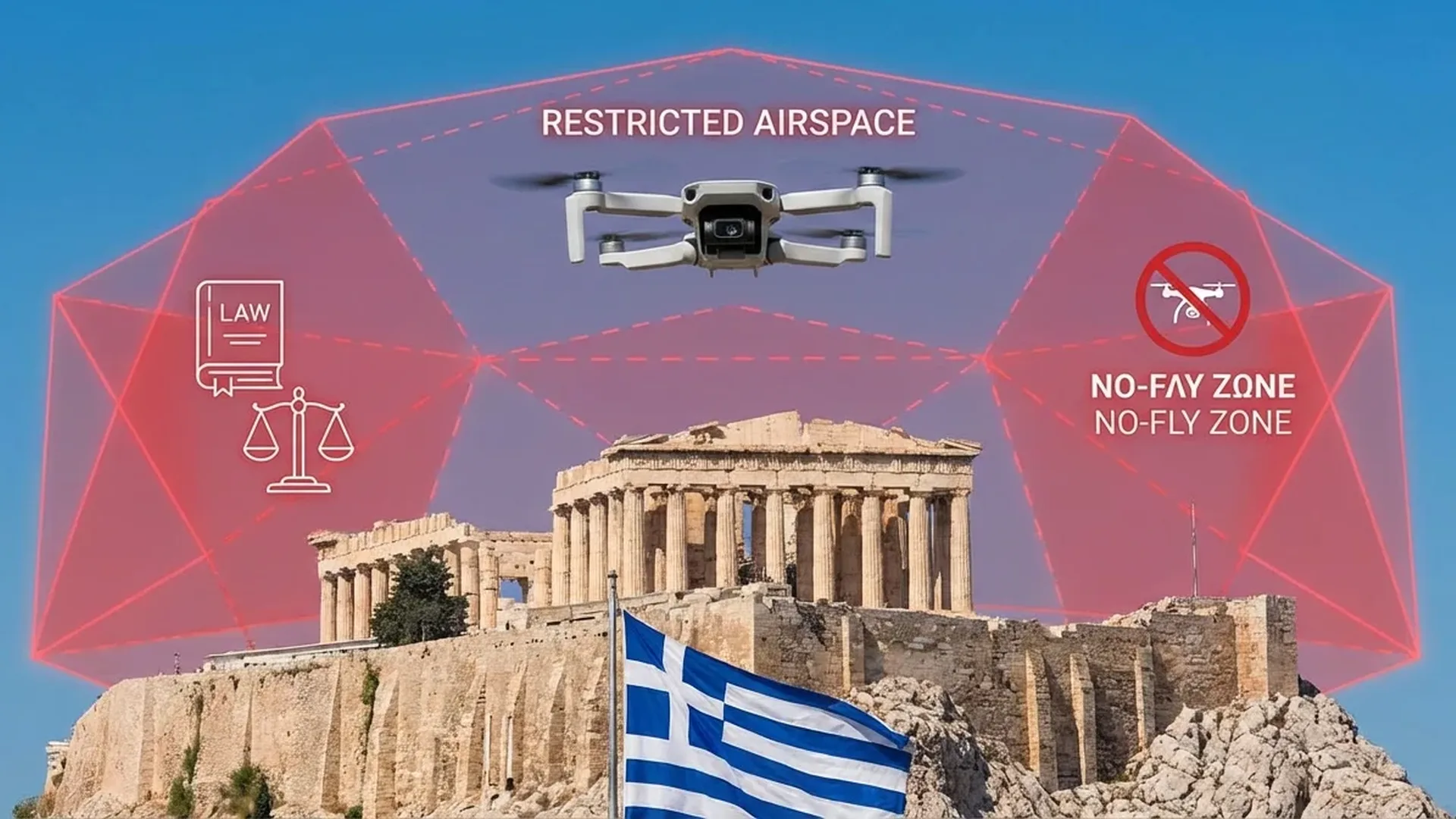
- Archaeological sites — Acropolis, Delphi, Knossos, etc. without a special permit
- Prisons & hospitals
- Government buildings — Parliament, ministries, embassies
⚠️ Restricted Zones
- Densely populated areas — Only A1 (C0/C1) or A2 (C2 with certificate)
- National parks & Natura 2000 — Possible restrictions per area
- Ports & naval installations
- Parks & squares with crowds — A3 category: 150 m minimum distance
- Beaches with swimmers — Avoid flying over crowds
🗺️ DAGR (Drone Aware GR): You must use the system at dagr.hasp.gov.gr before every flight. The map shows real-time no-fly zones (red), restricted zones (yellow), and free zones (green). You can draw your intended flight area and check if it's permitted.
Insurance — When Do You Need It
According to Regulation (EU) 2019/947 and Greek law:
| Usage Category | Insurance | Notes |
|---|---|---|
| Recreational, drone <4 kg | Optional (but recommended) | The EU recommends insurance for all operators |
| Recreational, drone ≥4 kg | Mandatory | A2 category, third-party liability required |
| Commercial use (any weight) | Mandatory | Third-party liability insurance required |
| Specific / Certified category | Mandatory | Full insurance coverage |
Insurance costs in Greece range from ~€60-150/year (~$65-163) depending on the provider, drone weight, and usage (hobby vs commercial). DJI Care Refresh (~€80-120/year / ~$87-130) covers damage/crashes but does not replace third-party liability insurance.
Remote Identification
Since January 1, 2024, all drones in the Open category (with limited exceptions) must be equipped with a Direct Remote Identification system — automatically broadcasting identification data (position, speed, operator registration number) during flight.
EASA has approved several add-on modules (Dronetag, Aerobits, Bluemark, etc.) for drones that didn't have built-in Remote ID. New DJI drones (Mini 4 Pro, Air 3S, Flip, etc.) support Remote ID out of the box via firmware updates.
Fines & Penalties
Violating drone legislation in Greece can result in serious consequences:
Administrative Fines
Fines ranging from €1,000 to €50,000 (~$1,090-$54,500) depending on severity, per the Greek Aeronautical Code. Flying without registration, without certificate, or in a no-fly zone.
Criminal Charges
Flying near an airport or military installation can lead to criminal prosecution. Equipment confiscation, fines, and potentially imprisonment in serious cases (Law 1815/1988).
Privacy Violations
Recording private property without consent → GDPR fines (Hellenic Data Protection Authority). Lawsuits from property owners. Fines of €5,000-20,000 (~$5,450-$21,800) or higher.
Flying Near Airports
Flying within the CTR (airport control zone) without authorization is considered a felony. Dozens of incidents every year, especially in tourist destinations.
⚠️ Real-world example: Tourists flying drones over the Acropolis, Santorini, or military zones on Greek islands have been arrested, had their equipment confiscated, and faced fines of thousands of euros. Greek police actively enforce drone regulations.
Popular Drones & Their Categories
Here's a practical overview of the most popular drones and which category they fall into:
| Drone | Weight | Class | Subcategory | Certificate |
|---|---|---|---|---|
| DJI Mini 4 Pro | <249 g | C0 | A1 | A1/A3 (online) |
| DJI Flip | <249 g | C0 | A1 | A1/A3 (online) |
| DJI Air 3S | ~720 g | C1 | A1 | A1/A3 (online) |
| DJI Mavic 3 Pro | ~958 g | C1/C2 | A1 or A2 | A1/A3 or A2 |
| DJI Avata 2 | ~377 g | C1 | A1 | A1/A3 (online) |
| DJI Inspire 3 | ~3,995 g | C2 | A2 or A3 | A2 (certificate) |
Pre-Flight Checklist
📋 Required Documents
- ✅ Operator registration number (on the drone)
- ✅ A1/A3 pilot certificate (or A2)
- ✅ Government ID / passport
- ✅ HCAA flight approval (when required)
- ✅ Insurance document (if >4 kg or commercial)
📱 Before Every Flight
- ✅ Check DAGR (dagr.hasp.gov.gr)
- ✅ Update drone firmware
- ✅ Calibrate compass
- ✅ Fully charge all batteries
- ✅ Set Return-To-Home (RTH) altitude
- ✅ Verify NOTAMs (Notices to Airmen)
Traveling with a Drone — Airport Rules
If you're traveling with a drone through an airport:
- LiPo batteries: ONLY in carry-on luggage (cabin baggage). NEVER in checked luggage. Max capacity: 100 Wh without approval, 100-160 Wh with airline permission, >160 Wh prohibited.
- The drone itself: Can go in carry-on or checked luggage (without batteries).
- Propellers: Remove them (or use prop guards) — some security staff consider them sharp objects.
- DJI Mini 4 Pro: Battery 47.22 Wh → well within limits. Fly More Combo 3 batteries = 3 × 47.22 = 141.66 Wh → each one individually within limits.
Common Mistakes Pilots Make in Greece
1. Flying Without an Application
Many assume that buying a drone means immediate freedom to fly. In Greece, a flight application via HCAA is required even for Open category operations.
2. Archaeological Sites
The Acropolis, Delphi, Knossos, Ancient Olympia — all strictly prohibit drones. Written consent from the Ministry of Culture is required (rarely granted outside documentaries/films).
3. Islands & Military Zones
Many islands (Crete, Lesbos, Samos, islands near the Turkish border) have extensive military zones invisible in tourist apps but clearly shown on DAGR.
4. Santorini & Mykonos
Popular tourist destinations, but airport proximity makes large areas no-fly zones. Always check DAGR before flying in these locations.
Practical Tips for Legal Flying
- Register as an operator before you even open the box.
- Get your A1/A3 certificate — it's a free online exam that takes ~30 minutes.
- Always check DAGR (dagr.hasp.gov.gr) before every flight.
- Submit your flight application via HCAA at least 3 working days in advance.
- Notify local police after receiving flight approval.
- Never fly at night — it's prohibited in Greece.
- Respect privacy — don't record private properties.
- Maintain VLOS (Visual Line of Sight) at all times.
- Never exceed 120 m altitude — ever.
- Replace damaged batteries — swollen LiPo cells are a fire hazard.
Frequently Asked Questions
Do I need a license for DJI Mini 4 Pro (<249 g)?
Yes. Despite being C0, you need: (1) operator registration (it has a camera), (2) online A1/A3 certificate, (3) flight application submission to HCAA.
Can I fly on Greek islands?
It depends. Each island has its own restrictions. Check DAGR. Many islands (especially near borders) have extensive military zones (MIL). These require a 5-working-day application.
What happens if I fly without registration?
If stopped by police or coast guard, you may face equipment confiscation and an administrative fine (€1,000+ / ~$1,090+). In serious cases (e.g., near an airport) → criminal prosecution.
How much does registration cost?
UAS operator registration via HCAA is free. The online A1/A3 exam is free. The A2 exam (if needed) may cost ~€50-100 (~$55-110) at a test center.
Can I fly at the Acropolis?
No. The Acropolis (and virtually every archaeological site) strictly prohibits drone flights without written permission from the Ministry of Culture — which is rarely granted except for documentaries/films.
"Drone regulations don't exist to stop you — they exist to ensure that EVERYONE can fly safely. Learn the rules, follow the process, and enjoy free flight."
Conclusion
Flying a drone in Greece is legal but regulated. The European EASA framework is fully implemented, the HCAA adds national rules, and the HASP provides the DAGR system for real-time zone information. The essential steps: (1) Operator registration, (2) A1/A3 certificate, (3) Flight application via email to HCAA, (4) Check DAGR, (5) Notify police.
Whether you're flying a DJI Mini 4 Pro (<249 g, C0) over Santorini or a DJI Inspire 3 (C2) for a professional project, compliance isn't optional — it's mandatory. With 2025-2026 bringing new U-space regulations and Remote ID enforcement, staying informed is an ongoing responsibility.