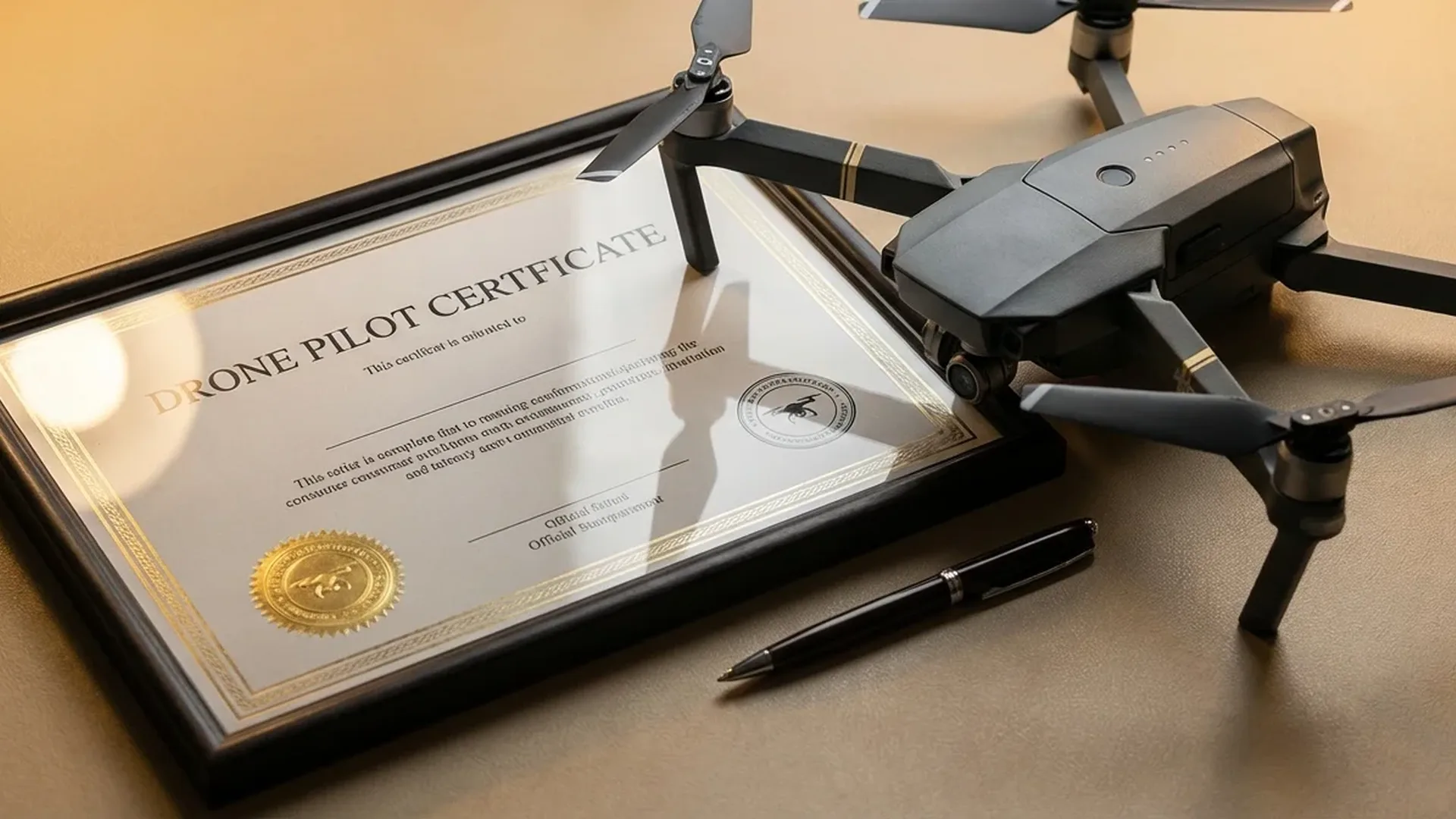
Do I Need a Drone License?
The answer depends on two factors: what drone you fly and where you want to fly it. Under EASA Regulation (EU) 2019/947 — the pan-European regulation that applies across 31 states (27 EU + 4 EFTA) — not everyone needs a license. If you fly a class C0 drone (weighing under 250g, e.g., the DJI Mini 4 Pro) without a camera or as a toy, technically no certificate is required — you just need to read the user manual.
However, in practice, virtually every drone worth buying today has a camera. And if it has a camera, operator registration is required — and by extension, a competency certificate. Particularly in Greece, the HCAA (Hellenic Civil Aviation Authority) is strict: it requires a flight application even for drones under 250g with a camera.
💡 Important: The term “drone license” is informal. EASA uses “Remote Pilot Certificate of Competency.” It's not a professional permit — it's a certification that you understand safe flight rules.
The 3 Certificate Levels
EASA established three certificate levels for the Open and Specific flight categories:
A1/A3 Certificate
For: Hobbyists, travelers, photographers
Drones: C0 (<250g) in A1, C1 (<900g) in A1, C2/C3/C4 in A3
Exam: 40 online multiple-choice questions
Cost: Free (through national authority)
Validity: 5 years
A2 Certificate
For: Pilots flying close to people
Drones: C2 (<4kg) in A2
Exam: 30 questions + self-study + practical training
Cost: ~€50-100 (~$54-108)
Prerequisite: Must already hold A1/A3
STS Certificate
For: Professionals (Specific Category)
Drones: C5/C6 in STS-01, STS-02
Training: Full program at authorized training school
Cost: ~€300-800 (~$326-868)
Requires: Authorized UAS Training Centre
A1/A3 Certificate: Step-by-Step
The A1/A3 certificate is the foundation — the first step for every drone pilot in Europe. Under Regulation (EU) 2019/947, the examination is conducted online through the National Aviation Authority (NAA) or an authorized entity. You can take the exam in any EASA member state — if you sit the exam in Austria, the certificate is valid in Greece, France, Germany, and everywhere else.
Register as a UAS Operator
Register with your national aviation authority (NAA). You'll receive an Operator Registration Number that must be displayed on your drone. Registration is mandatory if your drone weighs over 250g or has a camera.
Online Training
EASA recommends self-study through the online training module. Topics cover aviation safety, regulations, meteorology, airspace characteristics, human limitations, and data privacy/protection.
Online Exam (40 Questions)
The exam consists of 40 multiple-choice questions covering: aviation safety, airspace regulations, human factors/limitations, meteorological conditions, operational procedures, privacy protection, and insurance. You need at least 75% correct (30 out of 40) to pass.
Receive Your Certificate
If you pass, you receive a digital A1/A3 certificate bearing the EASA logo. It's valid across all of Europe (31 states) for 5 years. If you fail, you can retake the exam.
A1/A3 Exam Topics
According to information published by EASA in their Guidelines for UAS operations in the open and specific categories, the A1/A3 exam covers:
Aviation Safety
General flight safety rules, hazard avoidance, protection of third parties on the ground, basic drone aerodynamics principles.
Regulations
EASA flight categories (Open, Specific, Certified), C0-C4 classes, A1/A2/A3 subcategories, operator rights and obligations, registration.
Human Factors
Fatigue, stress, perception, decision-making, alcohol/medication, circadian rhythm, emergency situation response.
Meteorology
Wind, gusts, fog, thunderstorms, temperature, humidity, METAR/TAF, how weather affects drone flight performance.
Privacy & GDPR
Data protection when using cameras, right to privacy, what you're allowed to photograph, where photography is prohibited.
Operational Procedures
Pre-flight checklist, battery transport for air travel, safe charging, malfunction handling, flying near obstacles.
A2 Certificate: For Flying Close to People
The A2 certificate is required if you want to fly a class C2 drone (weighing under 4kg) at close range to people — minimum 30 meters, or 5 meters in low-speed mode (speed under 3 m/s). Under Regulation (EU) 2019/947, obtaining the A2 requires:
A2 Prerequisites
- Hold an A1/A3 certificate
- Self-study using approved materials
- Practical flight training (self-declared)
- Theory exam with 30 questions
- Minimum age 16 years
What A2 Covers
- Advanced meteorology
- Drone technical performance (range, endurance, speed)
- Safety measures near people
- Low-speed mode rules
- Ground Risk Class (GRC) assessment
The A2 exam is not free — it's conducted by authorized entities (NAA or recognized schools) and costs approximately €50-100 (~$54-108). According to EASA, the A2 exam requires deeper knowledge of meteorology, drone technical performance, and ground risk assessment beyond what A1/A3 covers.
STS Certificate: For Professionals
If you're planning professional operations — particularly BVLOS (Beyond Visual Line of Sight), flights over controlled ground areas, or urban flights with drones over 4kg — then you're operating in the Specific Category. Under Regulation (EU) 2019/947, there are four pathways for Specific Category operations:
- Standard Scenario (STS) Declaration: The simplest route. No full risk assessment required — only a compliance declaration. STS-01 (VLOS over controlled ground area) and STS-02 (BVLOS over sparsely populated area) are the two European Standard Scenarios.
- PDRA Authorization: Pre-Defined Risk Assessment — a pre-established risk assessment that simplifies the process.
- Full SORA Authorization: Specific Operations Risk Assessment — the comprehensive risk assessment following JARUS methodology.
- LUC (Light UAS Operator Certificate): Allows self-authorization in certain scenarios.
For STS operations, the pilot must train at an Authorized UAS Training Centre — self-study is not sufficient. STS training includes theory, practical flight exercises, risk assessment, Operations Manual preparation, and examinations. Based on pricing from European training schools, costs range from €300 to €800 (~$326-868).
"Pilot training in the Specific Category is not mere bureaucracy — it's substantive. You learn risk assessment, Operations Manual preparation, SORA methodology, and operational procedures." — EASA Guidelines on Specific Category
How to Take the Exam: Country-by-Country
Each EASA member state designates its own National Aviation Authority to administer exams. Here's how it works in major European countries:
Greece — HCAA (YPA)
Register at ypa.gr → UAS section. Take the A1/A3 exam online (free). After certification, you must submit flight applications via the DAGR system — even for drones <250g with camera.
Germany — LBA
Register at dipul.de. The LBA provides free online training and exam. Germany also requires mandatory liability insurance for every drone flight, regardless of weight.
France — DGAC
Register at AlphaTango platform. Free A1/A3 online training and exam available. Urban flights require special authorization. Use Géoportail for zone checking.
Italy — ENAC
Register at D-Flight system. Online exam available through ENAC-authorized entities. Special restrictions near archaeological sites and historical monuments.
Certificate Costs
A1/A3 — Free
The A1/A3 exam is free in most member states. Some training schools charge €30-50 (~$33-54) for preparation/coaching, but the exam itself costs nothing.
A2 — €50-100 (~$54-108)
Conducted through authorized entities. In Germany approximately €70-150 (~$76-163), in France €50-80 (~$54-87). Includes the theoretical exam.
STS — €300-800 (~$326-868)
Full training program at recognized schools. Includes theory, practical flights, risk assessment training, and Operations Manual preparation.
Valid Across All of Europe?
Yes — and this is one of the greatest advantages of the EASA system. Under Regulation (EU) 2019/947 (Article 4), competency certificates issued in one member state are recognized throughout the EU plus the 4 EFTA countries. If you pass the A1/A3 exam in Greece, you can legally fly in France, Germany, Italy, Spain — everywhere.
Important caveat: while your pilot certificate is valid everywhere, national rules and geographical zones differ by country. For example, Greece requires flight applications via DAGR, France requires AlphaTango registration, Germany mandates liability insurance. Your certificate grants you “flight rights” — but you must follow local regulations.
Renewal & Expiry
Under Regulation (EU) 2019/947:
- A1/A3: Valid for 5 years. Renewed through an online “refresher” exam before expiry.
- A2: Valid for 5 years. Renewed through additional exam or refresher training completion.
- STS: Validity depends on the training program. Typically refresher training is required every 2-3 years.
If you let your certificate expire, you don't lose eligibility — but you must retake the full exam, not just a refresher. Recommendation: set a reminder 2 months before expiry.
Frequently Asked Questions
What's the Minimum Age?
According to EASA, 16 years. Each member state may lower it to 12 — but that reduction only applies within that specific state.
What Language Is the Exam?
Available in each country's national language plus English. In most countries, you can choose English.
If I Fail, When Can I Retake?
No mandatory waiting period — you can retake shortly after. Some entities require a 24-48 hour minimum wait.
Do I Need a License for DJI Mini?
DJI Mini 4 Pro and Mini 3 Pro weigh <250g (class C0) but have cameras. You must register as an operator. Technically, A1 doesn't require an exam for C0, but you must know the rules.
Certified Category: The Full “Pilot License” for Drones
Under Regulation (EU) 2019/947, the Certified Category covers the highest-risk scenarios: transporting people (e.g., air taxis), carrying dangerous cargo, flying over large gatherings. In this category:
- The drone must be type-certified (like a manned aircraft)
- The pilot must hold a full remote pilot license from the NAA
- The operator must be approved (certified operator)
- An approved Operations Manual is required
EASA is currently developing the regulatory framework for certified passenger-carrying drones — expected to be finalized within 2026-2027. This is the true “pilot license” in the strict sense — equivalent to manned aircraft certification.
📋 Summary: For the average drone pilot, the A1/A3 certificate is sufficient — free, online, valid for 5 years across 31 countries. If you fly a C2 drone close to people, you need A2 (~€50-100 / ~$54-108). For professional use, STS at a recognized school (€300-800 / ~$326-868). Whatever you do, always start with A1/A3.