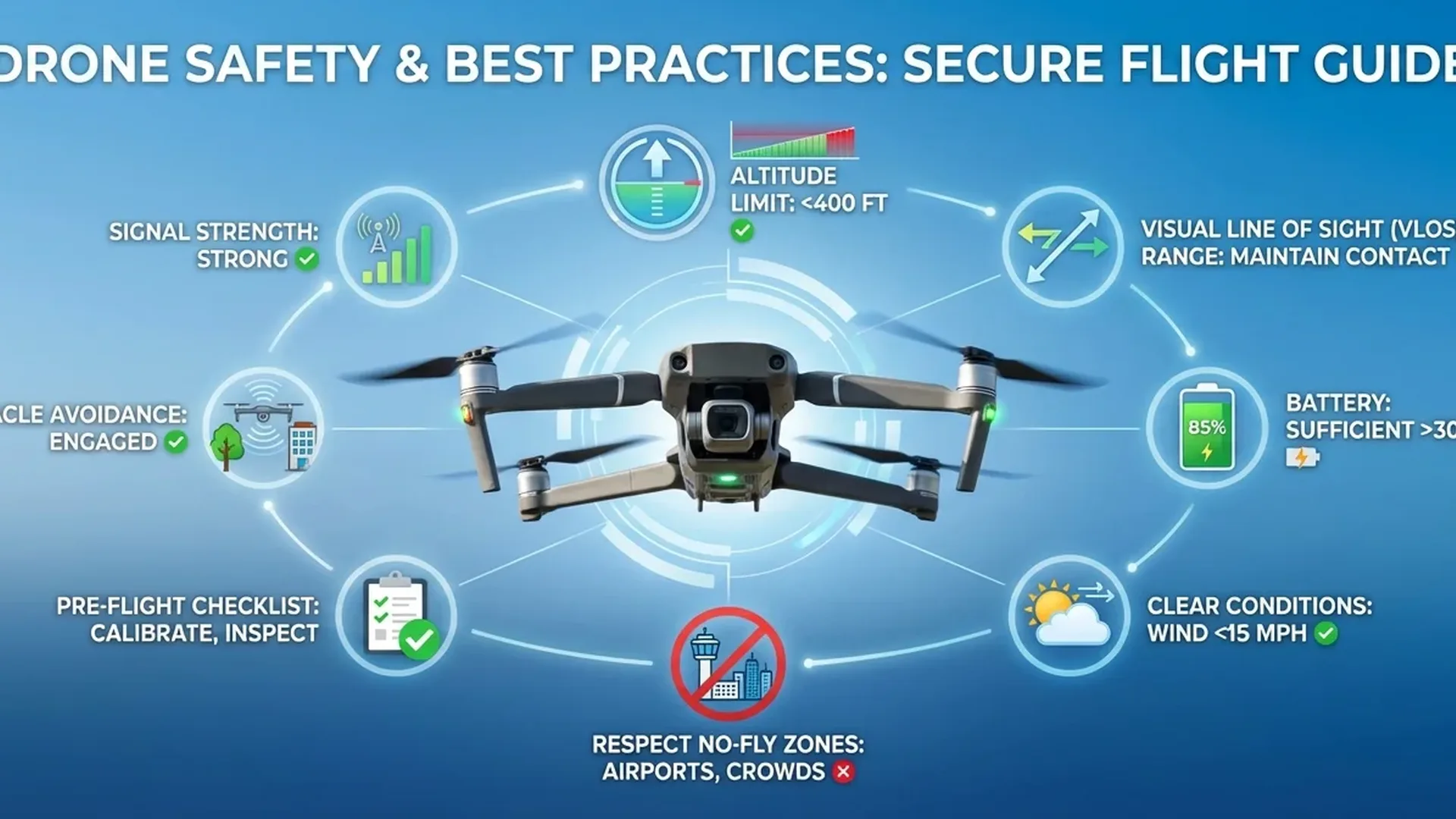
⚡ Key Numbers Every Pilot Should Remember
Before diving into the full ruleset, here are the critical figures that define legal and safe flight in the Open Category:
📋 Pre-Flight Checklist: Before Every Takeoff
A thorough pre-flight checklist is your first line of defense against accidents. Even the most experienced pilots never skip their checks — just like commercial airline pilots. According to EASA guidelines, every drone operator should perform systematic inspections before each flight.
Battery & Power
Check drone charge (at least 80%) and controller battery. Inspect the battery for swelling or physical damage. Never fly with a battery that shows signs of wear.
Propellers & Body
Ensure propellers have no cracks, dents, or warping. Confirm they're properly secured. Inspect the arms, gimbal, and landing gear for any damage.
GPS & Signal
Wait for at least 10+ satellite locks before takeoff. Verify the Home Point is correctly saved. Ensure a strong signal between the controller and drone.
Weather Conditions
Strong wind (>10 m/s for small drones), rain, fog, or snow = NO flight. Check the forecast and local conditions. Beware of thermal currents near buildings.
Firmware & App
Verify the drone firmware and flight app are up to date. Never update right before an important flight — test in a safe environment first.
Airspace & Zones
Confirm your location isn't in a no-fly zone (airports, military areas, archaeological sites). Use apps like DJI Fly, AirMap, or DroneRadar to verify.
🛡️ EASA Flight Rules — Open Category
EU Regulation 2019/947 defines three operational categories: Open, Specific, and Certified. The vast majority of recreational pilots operate in the Open Category, which is subdivided into three subcategories:
A1 — Over People
Flight over individual people is allowed, but never over assemblies of people. Applies to C0 (<250g) and C1 (<900g) drones. No training required for C0; A1/A3 certificate required for C1.
A2 — Close to People
Flight near people with a minimum horizontal distance of 30 meters (or 5 meters in low-speed mode). Applies to C2 drones (<4kg). Requires an A2 certificate after practical training and examination.
A3 — Far from People
Flight away from urban, residential, or industrial areas. Minimum horizontal distance of 150 meters from these zones. Applies to C3 and C4 drones (<25kg). A1/A3 certificate required.
⚠️ Important: Drones without a class identification label (C-mark) sold before January 1, 2024 can still be used, but under stricter limitations. Drones <250g without C-mark follow A1 rules but cannot fly over people. Drones <25kg without C-mark are restricted to A3 rules only.
📏 Rule #1: Maximum Altitude of 120 Meters
The most fundamental rule in the Open Category is the maximum flight altitude: 120 meters (400 ft) above the closest ground surface. This applies across the entire European Economic Area.
According to EASA, manned aircraft normally fly above 150 meters, so the 120m limit provides a 30-meter safety buffer. The only exception is building inspections above 105m, where flight is permitted up to 15m above the obstacle — but never with a C0 drone.
Why 120m Matters
Above 120 meters, the probability of collision with manned aircraft increases dramatically. A drone weighing <250g may seem harmless, but at collision speed it can cause serious damage to airplane engines or helicopters. EASA explicitly warns that even a small drone (<250g) flying at <19 m/s can pose a risk to light aircraft and hot air balloons.
👁️ Rule #2: VLOS — Always Maintain Visual Contact
The VLOS (Visual Line Of Sight) principle means the pilot must be able to see the drone with the unaided eye at all times, without binoculars or other optical aids (corrective glasses excepted).
In practice, this means:
- Distance: A typical drone remains visible at 300-500 meters horizontally — beyond that, it becomes difficult to judge orientation
- Altitude: At 120 meters, a small drone (<250g) is nearly invisible — EASA explicitly warns about this risk
- FPV: If flying with FPV goggles, an observer must be present next to you who maintains visual contact with the drone
- Obstacles: Don't fly behind buildings, hills, or trees that block your view of the drone
🌤️ Weather & Flight Conditions
Weather is one of the most critical factors in safe drone operations. No drone is impervious to the elements, even the most expensive professional models.
Wind
Maximum acceptable wind depends on your drone's size and weight:
- Mini drones (<250g): Maximum wind 8-10 m/s (roughly 29-36 km/h). The DJI Mini 4 Pro handles up to 10.7 m/s per manufacturer specs
- Mid-range (250g–900g): Maximum 10-12 m/s (36-43 km/h). DJI Air 3/3S drones handle approximately 12 m/s
- Pro drones (>900g): Up to 12-15 m/s (43-54 km/h) depending on model. The DJI Mavic 3 Pro handles up to 12 m/s
⚠️ Rule of thumb: If wind exceeds 60% of your drone's maximum speed, don't fly. Remember that wind at altitude is often significantly stronger than at ground level. Gusts can be 50% stronger than sustained wind speed.
Rain, Fog & Snow
Most consumer drones are not waterproof. Even a few raindrops can short-circuit electronics or fog up the camera lens. Exceptions include specialized enterprise drones (e.g., DJI Matrice 350 RTK with IP55 certification) designed for harsh conditions.
Fog completely eliminates VLOS capability — if you can't see your drone, it needs to land immediately. Snow can interfere with obstacle sensors and freeze propellers.
🔋 Battery Management During Flight
Proper battery management is critical for safety. The LiPo batteries used in drones can behave unpredictably in extreme temperatures.
- Return-to-Home (RTH): Set RTH at 25-30% battery — no lower. Return time increases significantly when flying against the wind
- Cold weather: Below 5°C (41°F), capacity drops dramatically (up to 30%). Warm batteries before flight — keep them in a pocket close to your body
- Hot weather: Above 40°C (104°F), performance is also affected. Avoid charging immediately after flight — let the battery cool down first
- Landing buffer: Always land with at least 15-20% battery remaining. Don't risk it — a forced landing can destroy your drone
✅ DO vs ❌ DON'T: Safe Flight Rules
Best Practices
- ✅ Always perform a pre-flight check
- ✅ Maintain VLOS at all times
- ✅ Respect the 120m altitude limit
- ✅ Check airspace before every flight
- ✅ Inform people nearby about your flight
- ✅ Monitor battery levels continuously
- ✅ Fly only in suitable weather conditions
- ✅ Always give way to manned aircraft
Common Mistakes to Avoid
- ❌ Flying over crowds or public events
- ❌ Flying near airports without authorization
- ❌ Night flying without lights/authorization
- ❌ Flying under the influence of alcohol or substances
- ❌ Ignoring app warnings and alerts
- ❌ Flying with damaged propellers
- ❌ Flying in strong wind “because I need the shot”
- ❌ Relying solely on GPS — always verify manually
🚨 What to Do in an Emergency
Even with perfect preparation, things can go wrong. Here are the most common emergency scenarios and how to handle them:
Signal Loss
If the controller-drone connection is lost, most modern drones will automatically activate RTH (Return-to-Home). Make sure before flying that the RTH altitude is set high enough to clear any obstacles along the return path.
Low Battery
If you receive a critical battery warning, don't panic — find the nearest safe landing spot. If there's no safe area nearby, it's better to let the automatic RTH handle the return rather than attempting a manual flight back in a state of panic.
Flyaway
Rare but possible: the drone stops responding to commands. If this happens, hit Emergency Stop immediately (always know where this button is). On DJI drones, hold both sticks down and inward simultaneously for emergency motor shutdown.
💡 Safety Tip: Before every flight, mentally plan an emergency procedure. Where will the drone land if signal is lost? Where will it fall if motors stop? This mental preparation can save equipment worth hundreds of euros (~$) — but more importantly, it can prevent injuries.
🌍 Country-Specific Rules
While Regulation 2019/947 applies across the entire EU, each member state can establish additional rules through geographical zones (Article 15). A few examples:
- Greece: The Hellenic CAA (YPA) designates no-fly zones around airports, military installations, archaeological sites, and national parks. Registration through the DAGR system is mandatory
- Germany: Additional altitude restrictions of 100m in certain zones. Strict rules for flying near residential properties
- France: No night flying permitted in the Open Category. Special zones near Paris and major airports
- Italy: No flying over historic city centers without special authorization. Dedicated ENAC regulations apply
🔑 10 Golden Rules for Safe Drone Flight
Here's everything distilled into 10 essential rules:
- Always perform a pre-flight check — never skip the checklist
- Maximum altitude 120m — no exceptions in the Open Category
- VLOS at all times — if you can't see it, don't fly it
- Check the airspace — no-fly zones, NOTAMs, local rules
- Respect others — don't fly over or near people without authorization
- Monitor the weather — when in doubt, stay grounded
- Manage battery wisely — RTH at 25-30%, land at 15-20%
- Give way to aircraft — always move aside if you spot a helicopter or plane
- Know your emergency controls — where's the Emergency Stop button?
- Stay informed — regulations evolve, check for updates regularly
🟢 Final thought: Safe flying doesn't mean boring flying. It means you can enjoy countless flights without ever having to explain to authorities how your drone ended up crashing into a playground. By following these rules, you protect yourself, others — and the hobby we all love.