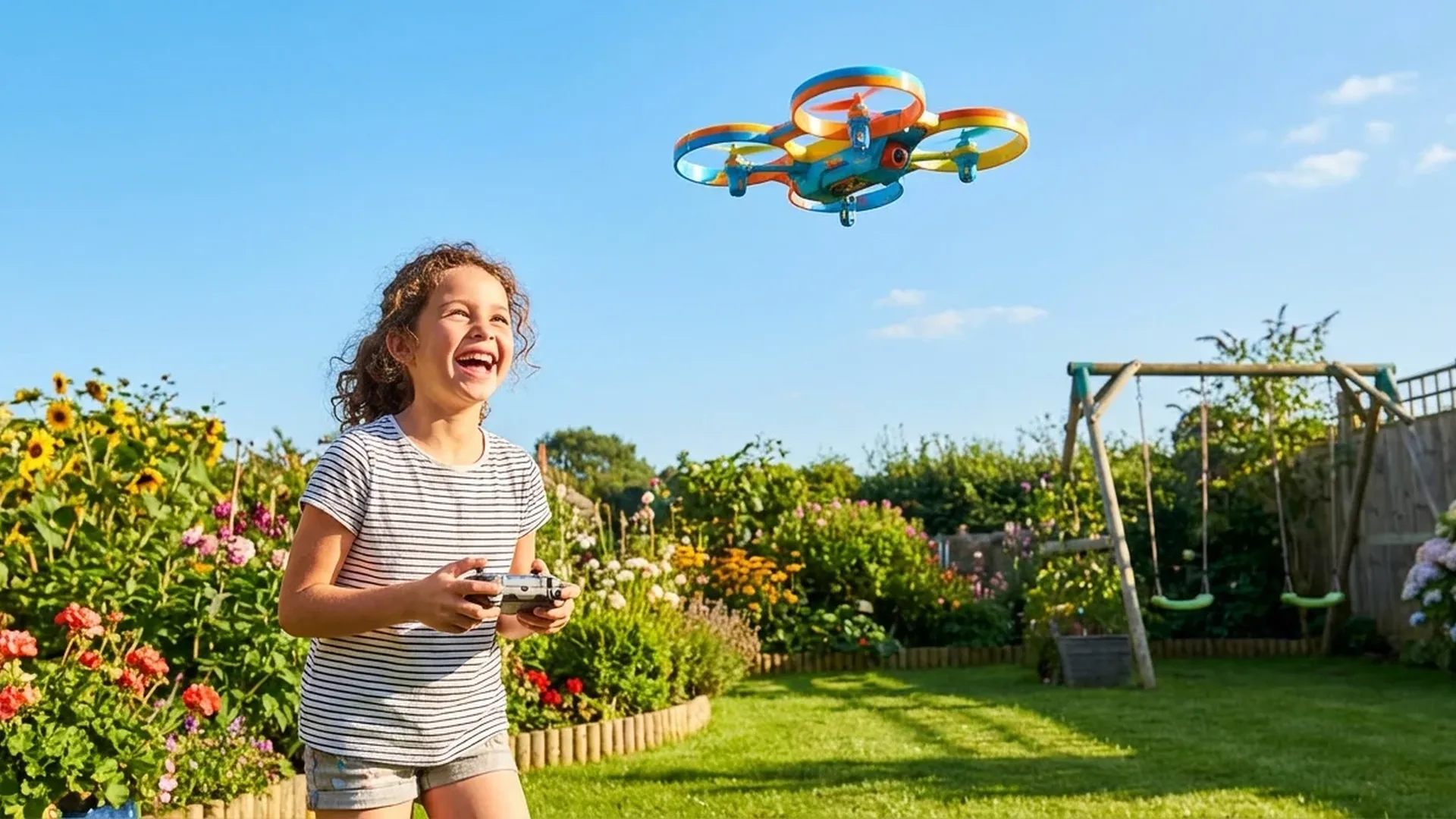
Why Drones Make an Excellent Gift for Kids
Drones aren't just toys — they're educational tools that develop spatial awareness, hand-eye coordination, and basic physics principles. A child learning to fly a drone develops skills transferable to robotics, programming, and engineering. At the same time, today's models are designed with so many protections that the risk of injury is minimal, especially with kids' models under 250 grams.
Safety Features: What to Look For
Before looking at models and prices, it's critical to understand which safety features make a drone suitable for kids. The “kids' drone” label alone isn't enough — you need specific technologies.
🛡️ Propeller Guards (360°)
Full propeller coverage that prevents fingers from contacting the blades. Essential for ages under 12.
📏 Altitude Hold
Automatic altitude maintenance via barometric sensor. The drone stabilizes on its own, even if the child releases the sticks.
🔴 Emergency Stop
A panic button that instantly kills all motors. Vital if the drone heads in the wrong direction.
🧭 Headless Mode
Simplifies control: regardless of the drone's orientation, controls always work relative to the pilot's position.
📡 Range Limitation
Kids' drones have a 30-50m range, enough for fun but without the risk of getting lost. “Adult” drones reach kilometers.
⚖️ Low Weight (<100g)
Lightweight toy drones under 100g can't cause serious injury even if they fall on someone.
Age Groups: Which Drone for Which Age
🎈 Ages 6-8: Toy Drones
Small, lightweight, indoor-only. Full propeller guards, headless mode, simple controller. Prices: €18-€50 (~$20-$54). Flight time 5-7 minutes. Ideal for first experiences.
🚀 Ages 8-12: Mini Drones
Greater stability, 720p-4K camera, outdoor flight capability. GPS or visual positioning. Prices: €100-€250 (~$109-$272). Flight time 10-18 minutes.
🎯 Ages 12+: Advanced Mini
Obstacle avoidance, 4K camera, intelligent flight modes. Suitable for teens with parental oversight. Prices: €250-€400 (~$272-$435). Flight time 18-34 minutes.
Category 1: Toy Drones (Ages 6-8) — From €18 (~$20)
Toy drones are a child's first introduction to the world of remote-controlled aircraft. Designed exclusively for indoor use, they're small enough to fit in a palm and light enough not to break objects if they hit a wall. Battery life is 5-7 minutes, but most packages include 2-3 batteries.
HC616 — Classic Kids' Indoor Drone
The HC616 is one of the most popular kids' drones on Skroutz (Greek price comparison site) with 52 reviews and an average rating of 4.0/5. It's a no-frills indoor drone without a camera, featuring full 360° propeller protection and headless mode. Ideal as a first gift: if it breaks or gets lost, your wallet won't suffer. The build quality is surprisingly resilient for the price — it survives drops on tiles and walls. Available in blue.
Silverlit Flybotic Neon — Quality Brand
Silverlit (Flybotic) is a French company with decades of experience in remote-controlled toys. The Neon stands out with impressive LEDs that glow in neon colors during flight — perfect for nighttime flying in a room. Build quality is noticeably better than generic Chinese models, with smoother control response and more stable hovering. Without a camera, it focuses purely on the joy of flying.
💡 Parent tip: For ages 6-8, don't focus on the camera. Cheap drones with “4K camera” labels actually shoot at much lower resolution. Choose a drone without a camera but with good stability and propeller guards.
Category 2: Mini Drones (Ages 8-12) — €100 to €250 (~$109 to $272)
In this age group, things get much more interesting. Drones in this category can fly outdoors, feature decent cameras, and some models offer educational programming. The key here is flight stability — a drone that stabilizes itself allows the child to learn without constant crashes.
Ryze Tello — The Educational Drone (powered by DJI)
The Ryze Tello remains the favorite educational drone after years on the market, and that's no accident. It uses a flight controller and visual positioning designed in collaboration with DJI, which means remarkable stability for an 80-gram drone. Its biggest selling point? It can be programmed via Scratch (block coding for kids) or Python, turning flight into a robotics lesson.
The 720p camera is basic but sufficient for a child aged 8-12. It lacks GPS (using downward-facing camera visual positioning instead), so outdoor use requires caution in wind. Indoors or in the garden, it flies brilliantly. Full propeller guards are included in the box.
✅ Pros
- Scratch/Python programming
- DJI flight technology
- Lightweight (80g) — very safe
- Excellent hover stability
- Propeller guards included
⚠️ Cons
- Camera only 720p
- No GPS
- Wi-Fi connection (100m max)
- Sensitive to wind
- Battery not easily swappable
DJI Neo — Palm Launch with 4K Camera
The DJI Neo is the real game-changer this year. It weighs just 135 grams, fits in your palm, and can literally take off from your hand without a controller — palm launch. This means a 10-year-old can use it even without knowing remote control basics, simply using hand gestures or the mobile app.
The 4K camera (3840×2880@30fps) with a 1/2″ sensor and single-axis mechanical gimbal delivers stable video with RockSteady electronic image stabilization. For a drone in this category, the quality is stunning. While it lacks obstacle avoidance (only downward visual positioning), its low weight and C0 classification mean no license or registration is required in the EU.
At €156 (~$170) drone-only on Skroutz, it's arguably the best value-for-money in the category. The Fly More Combo at €265 (~$288) adds a controller and extra batteries — worth it if they'll use it frequently.
Category 3: Advanced Mini (Ages 12+) — €245 to €400 (~$267 to $435)
Drones in this category are essentially “real” drones in mini size. They offer obstacle avoidance, GPS, 4K video, and intelligent flight modes. Suitable for teens who want real aerial photography or simply a drone that won't crash every 5 minutes thanks to obstacle avoidance sensors.
DJI Neo 2 — Omnidirectional Obstacle Avoidance
If your teen wants a truly serious drone but safety remains a priority, the DJI Neo 2 is the answer. The biggest upgrade over the original Neo: omnidirectional obstacle avoidance — sensors in every direction that prevent collisions. This means even if the pilot makes a mistake, the drone avoids walls, trees, and other obstacles on its own.
With a 1/1.3″ CMOS sensor, 4K camera, and 28 minutes of flight time, it's a drone that would satisfy even an adult. DJI O4 connectivity with 13-kilometer range means you'll never lose connection during normal use. At €245 (~$267) drone-only on Skroutz, it's an excellent purchase. We recommend the Fly More Combo at €409 (~$445) for extra batteries.
DJI Flip — Built-in Propeller Guards
Here we find something unique: the DJI Flip is the first mini drone with built-in foldable propeller guards. You don't need to attach and remove them — they fold together with the arms. This means every flight is protected, making it ideal for teens just getting started.
Technically, it's exceptional: 3-axis gimbal for buttery smooth video, 4K at 60fps, 1/1.3″ CMOS sensor, omnidirectional obstacle avoidance, and 31 minutes of flight time. At exactly 249g, it stays in the C0 category. At €378 (~$411) standard on Skroutz, it's a premium purchase but justifies every euro if you're seeking safety without compromising image quality.
DJI Mini 4K — Budget Outdoor Drone
An excellent value alternative. The DJI Mini 4K sits at €247 (~$269) on Skroutz with an impressive 4.9/5 score from 132 reviews. It doesn't have obstacle avoidance like the Neo 2 or Flip, but offers a 3-axis gimbal, 4K video, and 31 minutes of flight time at a price just €2 above the Neo 2 drone-only. Ideal for teens more interested in aerial photography than acrobatic flying. No built-in propeller guards — they need to be purchased separately.
Comparison Table: All Options at a Glance
Regulations: What Applies in Europe for Kids
European legislation (EU Drone Regulation 2019/947) sets clear rules that also apply to kids' drones. Here's what you need to know:
⚖️ C0 Category (<250g)
Drones under 250g (C0 category) don't require a pilot license or EASA registration. This means a child can legally operate them under parental supervision. All drones we recommend are under 250g.
🔞 Age Requirement
The EU hasn't set a strict age limit for toy drones under 250g, but aviation authorities recommend parental supervision for ages under 14. In the open category A1, the minimum supervised age for operation is around 12 years.
🚫 Restrictions
Regardless of weight, flying is prohibited near airports, over crowds, over military installations, and above 120m altitude. This applies even to 30-gram toy drones.
⚠️ Important: Indoor drones are fully exempt from aviation regulations. If your child only flies inside the house, no restrictions apply whatsoever. The rules concern outdoor airspace only.
Common Parent Mistakes (and How to Avoid Them)
After experience with dozens of models, these are the most common mistakes parents make:
- Buying a drone without propeller guards: Never buy a drone without full propeller protection for a child under 12. Even if it costs €5 more, it's absolutely worth it.
- First flight outdoors: Always start in a large indoor space or a windless garden. The first flight in a park will end with a drone lost in the trees.
- Too expensive as a first drone: Don't start with a €300+ drone. Begin with €20-50, learn the basics, then upgrade. The first 10 crashes will happen regardless.
- Trusting “4K” Chinese drones: A €25 drone labeled “4K” doesn't shoot 4K. The real resolution is VGA or 720p. For genuine 4K, you need at least the DJI Neo (€156 / ~$170).
- Neglecting extra batteries: 5 minutes of flight + 40 minutes of charging = one frustrated child. Always buy a package with 2-3 batteries or a Fly More Combo.
Our Recommendation by Budget
💰 Up to €50 (~$54) — First Introduction
HC616 (€17.90 / ~$19) if you just want a test drone, or Silverlit Flybotic Neon (€36.23 / ~$39) if you want better build quality. Ideal for ages 6-8. Indoor use only.
💰 €100-€150 (~$109-$163) — Education + Flight
Ryze Tello (~€100 / ~$109) if you want Scratch programming. DJI Neo (€156 / ~$170) if you want a 4K camera and palm launch. Both excellent for ages 8-12.
💰 €245-€400 (~$267-$435) — Long-term Investment
DJI Neo 2 (€245 / ~$267) for obstacle avoidance, or DJI Flip (€378 / ~$411) for built-in propeller guards + 4K/60fps. For teens 12+ who'll use it for years.
Final Verdict
Buying a drone for a child doesn't need to be complicated. The golden rule: start cheap, learn together, upgrade later. An HC616 at €18 (~$20) can bring more joy than a DJI Flip at €378 (~$411) if the age and experience level aren't right.
If pushed for a single recommendation: DJI Neo at €156 (~$170). It's affordable enough not to hurt the wallet, safe enough at 135g with C0 classification, capable enough with a 4K camera, and easy enough with palm launch for a 10+ year old to use immediately. If you want an educational gift, get the Tello (~€100 / ~$109). If you want maximum safety without compromises, get the Flip (€378 / ~$411).
Whatever you choose, remember: parental supervision replaces every safety technology. Fly together, learn together, and make drone flying a shared family experience.