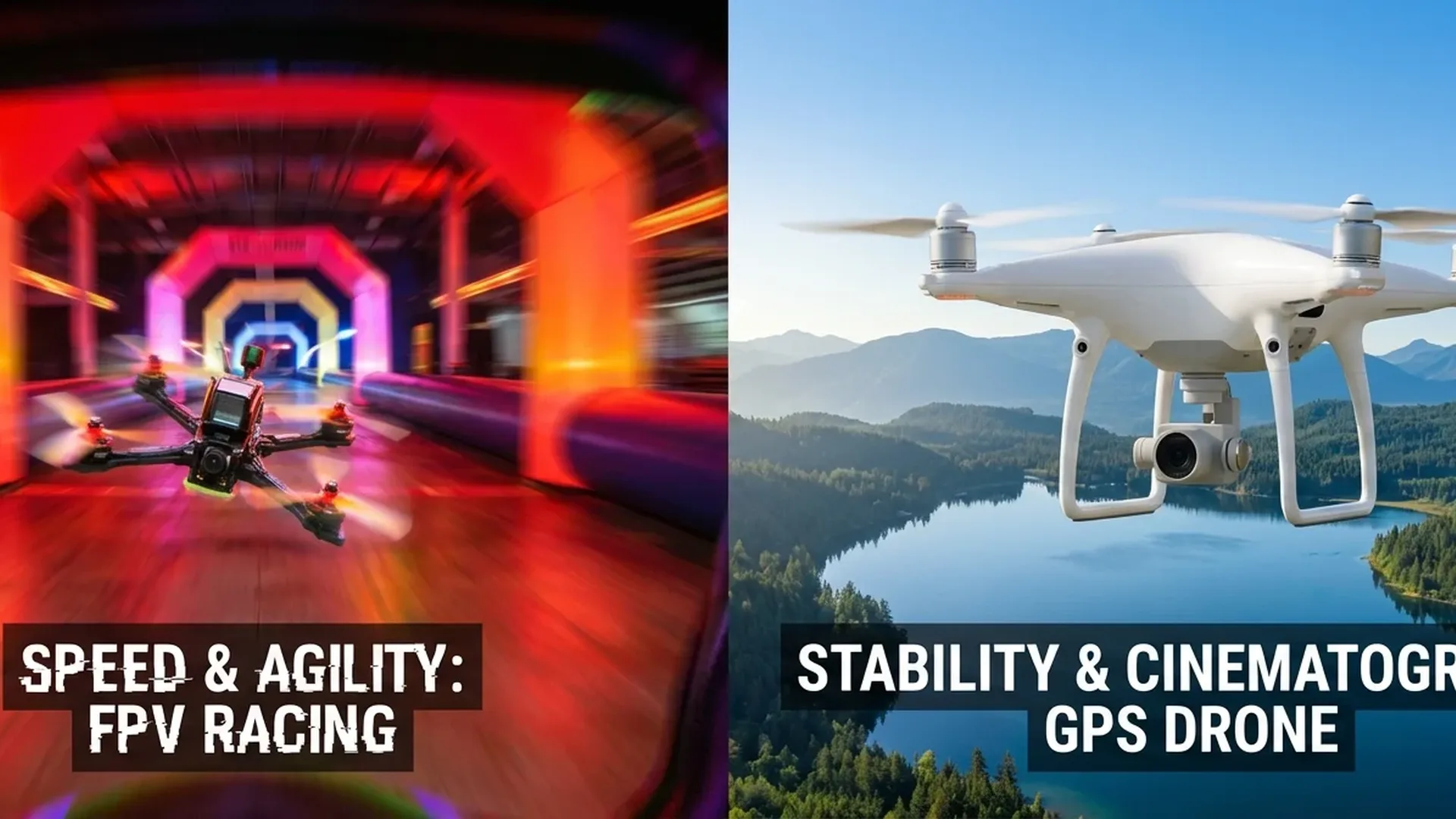
What Does “FPV” and “GPS” Drone Mean?
Let's clarify the terminology first, because that's where the confusion starts. The term “GPS drone” refers to classic photography/videography drones (e.g., DJI Mini, Air, Mavic) that rely on satellite positioning systems (GPS + Galileo + BeiDou) for stable, autonomous flight. Even if you release the sticks, the drone stays locked in place — maintaining position, altitude, and can return home on its own (Return to Home).
The term “FPV drone” (First Person View) refers to drones that fly manually, without GPS stabilization in control, giving the pilot full, unfiltered control. You wear goggles that show the camera feed in real time, and you control every movement — throttle, yaw, pitch, roll — without software assistance.
Note: Some modern FPV drones (e.g., DJI Avata 2) DO have GPS — but its use is different. In a GPS drone, GPS is the core of the flight. In an FPV drone, it's supplementary (for RTH, hover). The fundamental difference lies in the WAY you fly, not in the presence or absence of a GPS module.
Key Technical Differences
To truly understand the difference, let's look at a head-to-head comparison based on two popular models: the DJI Air 3S (classic GPS drone) and the DJI Avata 2 (FPV drone).
| Feature | 🏎️ DJI Avata 2 (FPV) | 📸 DJI Air 3S (GPS) |
|---|---|---|
| Weight | 377 g | 724 g |
| Max Speed | 27 m/s (19 m/s EU) | 21 m/s (19 m/s EU) |
| Flight Time | ~23 minutes | ~45 minutes |
| Max Range | 13 km | 32 km |
| Camera Sensor | 1/1.3" (12 MP) | 1" (50 MP) + 1/1.3" (48 MP) |
| Camera FOV | 155° (ultra-wide) | 84° (wide) + 35° (tele) |
| Gimbal | 1-axis (tilt) | 3-axis (tilt, roll, pan) |
| Obstacle Avoidance | Downward + backward only | Omnidirectional (360°) + forward LiDAR |
| Video Latency | 24 ms (1080p/100fps) | ~120 ms |
| Internal Storage | 46 GB | 42 GB |
| Flight Mode | Manual / Acro + Normal | GPS-assisted (stabilized) |
| Price | from €417 (~$450) Drone Only | from €1,129 (~$1,099) Standard |
The Flight Experience
This is where the truly significant difference lies — and the reason these two categories exist separately.
GPS Drone: Calm & Precision
Flying a GPS drone feels like driving a luxury car. You take it out, GPS locks on, it takes off automatically, and hovers as if suspended by an invisible wire. You see the image on your phone or controller with ~120 ms delay — fast enough for photography/video, but not for rapid maneuvers.
The 3-axis gimbal keeps the camera perfectly smooth — no vibrations, no jolts. If you need to release the sticks, nothing happens — it just hovers. If it loses signal, it returns home automatically. If it approaches an obstacle, it stops — thanks to the Air 3S's omnidirectional obstacle avoidance (binocular vision + forward LiDAR + downward IR). Essentially, you can't crash it unless you do it on purpose.
FPV Drone: Adrenaline & Freedom
The FPV experience feels like driving a Formula 1 car through a forest trail. You put on goggles — the world disappears, you see only what the camera sees. Latency drops to 24 ms (on DJI Goggles 3 with Avata 2), meaning you react in near real-time. Every stick movement translates instantly.
If you release the sticks in Acro mode, the drone doesn't self-level — it falls, spins, does whatever the sticks last commanded. YOU are the only one in control. There's no omnidirectional obstacle avoidance (the Avata 2 only has backward and downward sensors), no automatic return if you lose orientation. This sounds terrifying, but in practice it's the most liberating thing: you fly through trees, under bridges, do flips and rolls, and feel every movement in your bones.
Camera & Image Quality
If image quality is your priority, the choice becomes crystal clear: GPS drones win by a landslide. The DJI Air 3S features two cameras — a wide-angle with a 1″ sensor (50 MP) and a medium tele with 1/1.3" (48 MP) — delivering professional-quality footage. The 3-axis gimbal eliminates all vibration, even in strong winds. D-Log M, 4K/120fps slow motion, and RAW photography are all supported.
FPV drones weren't designed for this. The DJI Avata 2 has a 1/1.3″ sensor (12 MP) — decent but clearly behind. However, it has something no GPS drone can offer: a 155° FOV (nearly fisheye) that creates the stunning cinematic speed shots you see in YouTube videos. Electronic image stabilization via RockSteady 3.0+ and HorizonSteady partially compensates for the lack of a 3-axis gimbal, but doesn't match the butter-smooth footage of an Air 3S.
Where does the FPV camera excel? In cinematic “in-the-action” shots — flying through doorways, proximity flying alongside buildings, chase sequences. These shots are impossible with a GPS drone due to obstacle avoidance (it stops) and narrow FOV. That's why film productions use BOTH FPV drones and GPS drones equally.
Safety & Error Tolerance
This is the area with the biggest difference — and the one that should matter most if you're a beginner.
GPS Drone — “Nearly Impossible to Crash”
Omnidirectional obstacle avoidance, GPS hovering, automatic Return-to-Home, geofencing, altitude limits, failsafe protocols — all designed so that even if you make a mistake, the drone won't crash. DJI estimates that the majority of GPS drone crashes result from pilot error in Manual/Sport mode or flying in restricted zones.
FPV Drone — “You Will Crash”
Crashes in FPV aren't a matter of “if” but “when.” Especially at the beginning, you'll hit trees, walls, and the ground. That's why repairability is just as important as the drone itself. Custom 5″ quads break and fix easily (cheap props, replaceable parts). The Avata 2 has prop guards, but if the frame or camera breaks, repair costs add up.
Purchase & Maintenance Costs
Let's see what each category costs:
Entry-Level GPS Drone
- DJI Mini 4K: from €247 (~$269) — ideal for beginners, 4K but no obstacle avoidance.
- DJI Flip (Standard RC-N3): from €378 (~$409) — foldable, with 1/1.3″ sensor, 3-directional obstacle avoidance.
- DJI Mini 5 Pro: from €752 (~$813) — dual cameras, omnidirectional sensing, 4K/60fps, C0 class.
Mid-Range GPS Drone
- DJI Air 3S (Standard): €1,129 (~$1,099) — dual camera (1" + 1/1.3″), omnidirectional + LiDAR, 45 min flight, C1.
- DJI Air 3S FMC Lite RC2: €1,412 (~$1,527) — with built-in screen controller.
Entry-Level FPV Drone
- BetaFPV Cetus Pro Kit: approximately €150-180 (~$162-195) — all-in-one (drone + goggles + controller), ideal for indoor flying.
- DJI Avata 2 (Drone Only): €417 (~$450) — requires separate goggles + controller.
- DJI Avata 2 FMC Single Battery: €874 (~$944) — with DJI Goggles 3 + RC Motion 3.
Serious FPV Build
- Custom 5″ Freestyle + goggles + TX: approximately €500-800 (~$540-865) total (RadioMaster Boxer ~€100-130, analog goggles ~€50-120, BNF drone ~€150-250, batteries + charger ~€100-150).
- Emax Speed (Standard): €762 (~$823) — ready-to-fly whoop kit with goggles.
"The real comparison isn't FPV vs GPS. It's: what do I want to do with my drone? If I want perfect photos — GPS. If I want adrenaline — FPV. If I want cinematic videos — probably both."
Who Should Get What?
This depends 100% on your purpose. Let's look at the most common scenarios:
Get a GPS Drone if…
- 📸 You want perfect photos/videos
- 🏖️ You want travel/vacation footage
- 🏠 You want real estate property shots
- 🌄 You need long battery life (30-45 min)
- 🛡️ You want safety and obstacle avoidance
- 📱 You want easy operation via smartphone
- 🗺️ You need waypoint missions / mapping
Get an FPV Drone if…
- 🏎️ You want adrenaline and speed
- 🎬 You want cinematic action shots
- 🤸 You want freestyle (flips, rolls, dives)
- 🏁 You're interested in drone racing
- 🔧 You enjoy building/tinkering
- 🎮 You want a “first person” experience
- 🎥 You want unique proximity/chase shots
Can I Get Both?
That's what many drone enthusiasts do — and it's actually the ideal solution. A GPS drone like the DJI Air 3S or Mini 5 Pro for photography/videography, and an FPV drone for adrenaline and creative shots. The two don't compete — they complement each other.
In fact, DJI is increasingly moving toward convergence. The DJI Avata 2 is essentially a “bridge” — an FPV drone with GPS assist, Turtle Mode, and Easy Acro mode that make the transition smoother. And GPS drones are starting to offer “FPV-like” features (e.g., follow me at speed, creative flight paths). The line is getting increasingly blurred.
Regulations: Same Rules?
In Europe, both FPV and GPS drones fall under the same EASA regulations (Open Category). Classification is based on weight:
- Under 250g: Category A1. You can fly over people (if there's no gathering). No registration required if it DOESN'T have a camera.
- 250g - 900g (C1): Category A1. Flight near people but not over gatherings. The DJI Avata 2 (377g, C1) and DJI Air 3S (724g, C1) fall here.
- 900g - 4kg (C2): Category A2. Must maintain 30m+ distance from people (5m at low speed).
The most important difference involves the Visual Observer rule: under EASA regulations, during FPV flight (where you wear goggles and can't see your surroundings), there must be a second person — a “spotter” — watching the drone with the naked eye. This rule doesn't apply to GPS drones, since the pilot can see the surrounding area normally while flying.
The Learning Curve
The difficulty gap is enormous:
GPS Drone: 1-2 Hours
Unbox, download DJI Fly app, calibrate, take off. In 1-2 hours you can capture impressive footage. Within a week you'll feel confident. No simulator needed — you can learn directly in the field thanks to obstacle avoidance.
FPV Drone: 20-50+ Hours
You'll need at least 10-20 hours in a simulator before flying a real drone. After that, another 20-30 real flights to feel comfortable in Acro mode. For freestyle aerobatics, we're talking months of regular practice. The reward? The most satisfying flight experience there is.
Final Recommendation
There's no “better” — there's “right for you.” If you want perfect travel photos, cinematic landscape footage, and safe risk-free flying, get a GPS drone. The DJI Air 3S (€1,129 / ~$1,099 Standard) or DJI Mini 5 Pro (from €752 / ~$813) are excellent choices. If you want adrenaline, immersive flight, speed, and creative action shots, get an FPV drone. The DJI Avata 2 FMC (€874 / ~$944) is the easiest entry point, while a custom 5″ build (approximately €500-800 / ~$540-865) puts you into the real FPV community.
And if you decide you want the best of both worlds? Get a small GPS drone for everyday use and an FPV drone for adrenaline moments. That's the world of drones — there's room for everything!
Frequently Asked Questions (FAQ)
Can an FPV drone take good photos?
Decent ones, yes — but not at the level of a GPS drone. FPV drones were designed for video, especially cinematic in-motion shots. If photography is your top priority, get a GPS drone.
Can GPS drones do flips and aerobatics?
Some budget GPS drones have a “flip” function, but it doesn't compare to real FPV freestyle. Professional GPS drones (DJI Mini, Air, Mavic) don't do aerobatics — they weren't designed for it.
What happens if signal is lost during FPV flight?
If your FPV drone has GPS (e.g., DJI Avata 2), Return-to-Home activates automatically. If it doesn't (custom quads), the drone triggers failsafe — depending on settings, it will hover or descend. That's why proper failsafe configuration in Betaflight is critical.
Which drone is more crash-resistant?
FPV drones, especially custom 5″ builds. They're designed to break and be repaired. A motor costs €10-25 (~$11-27), a frame €20-40 (~$22-43). GPS drones are more fragile — a gimbal or sensor crash can cost €100-300+ (~$108-325+) to repair.
Is there a drone that does both?
The DJI Avata 2 is perhaps the closest to a “hybrid” — FPV experience with GPS assist, prop guards, and Turtle Mode. It's not as good at photography as an Air 3S nor as acrobatic as a custom 5″ quad, but it does both reasonably well.