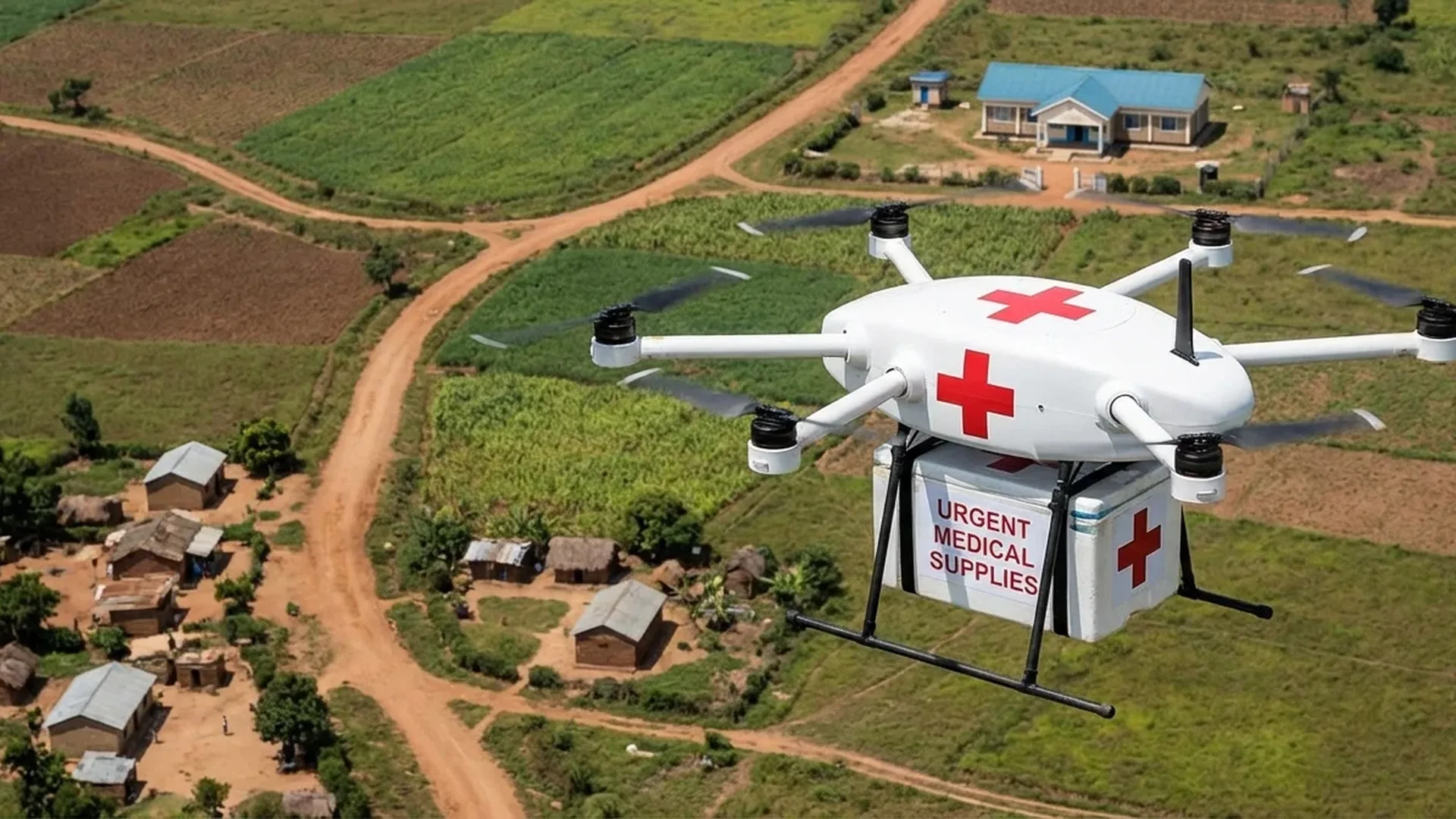
🩺 Why Medical Drones Are a Game-Changer
The concept is simple yet revolutionary: instead of waiting for a truck or ambulance to navigate dozens of kilometers over poor roads, an autonomous drone reaches its destination in minutes, flying a straight path above every obstacle. This isn't just faster — it's a matter of life and death when dealing with hemorrhaging, anaphylaxis, or the urgent need for a specific blood type that isn't available locally.
The advantages are clear: drones aren't affected by damaged roads or floods, they fly day and night, don't require a driver, and can operate at scale — dozens of flights per day from a single distribution center. Studies also show that drone delivery reduces greenhouse gas emissions by 54% compared to traditional delivery vehicles, according to research from Lawrence Livermore National Laboratory.
🚀 Zipline: The Company That Started It All
Zipline, an American company headquartered in South San Francisco, California, is undeniably the pioneer in medical drone delivery. Founded in 2014 by Keller Rinaudo Cliffton, Ryan Oksenhorn, William Hetzler, and Keenan Wyrobek, it launched operations in Rwanda in October 2016 — a time when the idea of delivering blood by drone still sounded like science fiction.
Platform 1: The fixed-wing that changed everything
Zipline's Platform 1 is a fixed-wing drone weighing 20 kg with a wingspan of 3.4 meters (11 ft). It carries payloads up to 1.8 kg (4 lb) — enough for blood bags, vaccines, or medications. The drone launches from a supercapacitor-powered electric catapult, accelerating to 108 km/h (67 mph) in just 0.33 seconds.
During flight, it cruises at 80–120 meters altitude and 101 km/h (63 mph). A single operator at the distribution center monitors multiple drones simultaneously. For delivery, the drone descends to 20–35 meters and drops its package under a paper parachute, landing the payload within a 5-meter diameter. It then returns and lands using a tail-hook arresting gear system — similar to aircraft landing on carriers.
With a 300 km flight range but an operational radius of 80 km, each distribution center reliably covers entire regions — even across mountainous terrain and severe weather. Battery swaps take seconds, enabling rapid turnaround between flights.
Platform 2: The evolution for urban deliveries
In March 2023, Zipline unveiled Platform 2, a VTOL drone designed for shorter-range deliveries in denser areas. It carries up to 3.6 kg (8 lb) within a 16 km (10 mi) radius, flying at up to 110 km/h (70 mph). The key innovation: rather than dropping packages, it hovers at 100 meters and slowly lowers items on a wire via a sensor-equipped “droid,” achieving placement accuracy within 1 meter (3.3 ft). It recharges autonomously without human intervention.
🌍 Zipline: Countries of Operation & Results
Rwanda — Where it all began
Rwanda was the first country where blood delivery drones operated commercially. Its mountainous geography and poor road conditions made blood transport exceptionally slow and unreliable. Zipline operates two distribution centers — one in Muhanga (2016) and one in Kayonza (2018) — serving clinics across the country.
A 2022 study published in The Lancet Global Health revealed striking results: blood delivery time was reduced by 61%, blood unit expirations at hospitals dropped by 67%, and 43% of orders were emergency cases — demonstrating how critical rapid delivery truly is.
"Zipline's drone delivery service in Rwanda shortened blood product delivery times by 61% and reduced blood unit expirations by 67%."
— The Lancet Global Health, 2022 studyGhana — Scaling nationwide
Ghana is arguably the most ambitious example. Since April 2019, Zipline has operated there under a government contract. By 2022, it had 6 distribution centers serving over 2,300 health facilities. The goal: covering 85% of the population through at least 3,200 health centers.
During the COVID-19 pandemic, Zipline delivered over 1 million vaccine doses by March 2022. An independent study found that the service reduced vaccine stock-outs by 60%, decreased missed vaccination opportunities by 42%, and increased the variety of medicines available at health facilities by 10%.
However, the story isn't all success. By 2025, Ghana's government had accumulated roughly $22 million (~€20 million) in unpaid bills to Zipline, compounded by steep local currency depreciation. A new administration deemed many deliveries non-essential, and Zipline shut down half its distribution centers — a stark reminder that even the most innovative technologies depend on political will and sustainable funding.
Japan, Kenya, Nigeria, Côte d'Ivoire
Zipline's reach extends well beyond Africa. In Japan, through a partnership with Toyota Tsusho, it launched medication deliveries to the Gotō Islands in Nagasaki (April 2022) — cutting transport time from hours (by sea or air) to 30 minutes. In Kenya (Chemelil, 2022), it serves over 1,012 health facilities. In Nigeria, centers in Kaduna, Cross River, and Bayelsa deliver COVID-19 vaccines and medications. In Côte d'Ivoire, operations began in January 2023 with four planned distribution centers.
United States — From hospital to home
In the US, Zipline partnered with Novant Health in North Carolina during the pandemic (2020) to deliver medical equipment and PPE. In June 2022, it received FAA Part 135 certification, legalizing commercial delivery flights. Partnerships with Intermountain Healthcare in Salt Lake City (October 2022) for medical deliveries, and with Walmart in Arkansas (2021) and the Dallas–Fort Worth metroplex (early 2025) for retail deliveries, signal the transition from medical applications into broader logistics.
🇩🇪 Wingcopter: German Engineering for Global Health
Wingcopter, a German company based in Darmstadt (founded in 2017 by Jonathan Hesselbarth, Tom Plümmer, and Ansgar Kadura), took a different technical approach: eVTOL drones with a tiltrotor mechanism that combines vertical takeoff/landing with fixed-wing flight for maximum efficiency.
The Wingcopter 178 HL holds a Guinness World Record as the fastest remote-controlled tiltrotor, reaching average speeds of 240.6 km/h (150 mph). It carries payloads up to 6 kg (13 lb) with a range of 120 km (75 mi). The newer Wingcopter 198 (April 2021) introduced a world first: triple-drop delivery — it can carry 3 separate packages (up to 5 kg total) and deliver them to 3 different locations in a single flight using a winch mechanism. A single operator can monitor up to 10 drones simultaneously.
Global missions
Wingcopter has conducted humanitarian missions across multiple continents. In Tanzania (2018), partnering with DHL, it delivered medicine to Ukerewe Island on Lake Victoria. In Vanuatu (2019), with UNICEF, it established a vaccination network for 19 remote villages on Pentecost Island. In Malawi (2019/20), it delivered medicine to areas cut off by flooding. And in Scotland, partnering with the NHS and Thales, it transported COVID-19 test samples to remote hospitals.
Future plans are ambitious: in May 2022, Wingcopter announced a partnership with Continental Drones to deploy 12,000 drones across 49 countries in Sub-Saharan Africa over 5 years. The European Investment Bank backed this initiative with a €40 million (~$43 million) investment in May 2023.
📖 Read more: Autonomous Drones: They Fly on Their Own 2026
🏥 Beyond Companies: Cases That Saved Lives
AED delivery by drone — The Swedish breakthrough
One of the most compelling examples: in December 2021 in Gothenburg, Sweden, the company Everdrone carried out the world's first autonomous AED (defibrillator) delivery by drone during a real cardiac arrest event. A 71-year-old man went into cardiac arrest while shoveling snow outside his home. A neighbor called emergency services, and simultaneously a drone carrying an AED was dispatched. The defibrillator arrived before the ambulance, the neighbor used it, and the patient survived.
Studies from Sweden's Karolinska Institutet show that AED drones can reduce response times from 20+ minutes (in rural areas) to under 5 minutes — a difference that literally determines life or death, given that each minute of delay reduces survival chances by 7–10%.
Lung transplant delivered by drone
In September 2021 in Toronto, Canada, a historic delivery was made: lungs for transplantation were delivered by drone for the first time ever. The transport, which would normally take longer through conventional means, was completed successfully, paving the way for drone-based organ transport — where every minute counts.
Uganda — HIV medication to remote islands
In Uganda, drones have been used since 2021 to deliver antiretroviral HIV medication to remote islands on Lake Victoria. Access to these communities was extremely difficult by boat, particularly in bad weather — drones eliminate that barrier entirely.
Greece on the Map: Dronamics & ELTA
In November 2023, the Hellenic Post (ELTA) signed an agreement with Bulgarian company Dronamics for the first postal cargo drone deliveries in Greece. The goal: same-day delivery nationwide — particularly significant for island communities and remote villages. While this primarily covers postal services, it opens the door for equivalent medical applications across Greece's vast island network.
🔬 COVID-19: The Pandemic as Catalyst
The COVID-19 pandemic served as a powerful accelerator for medical drones. Suddenly, the need to transport samples, PPE, and vaccines to remote areas without physical contact was no longer a luxury — it was an urgent necessity. Zipline delivered COVID-19 test samples in Ghana, Wingcopter transported test kits in Scotland, Ireland's Manna pivoted in just one week to deliver prescription medication in the village of Moneygall, and Windracers drones carried medical supplies from Cornwall to the Isles of Scilly in the UK.
In Nigeria, Zipline's distribution centers featured ultra-cold storage for COVID-19 vaccines, allowing small health facilities to order on demand without needing their own cooling infrastructure. In the UK's NHS, trial deliveries of chemotherapy drugs by drone were conducted at St. Mary's Hospital on the Isle of Wight (2022), with medications flown in from the mainland pharmacy in Portsmouth.
📊 The Market & What Lies Ahead
The global commercial drone market was valued at approximately $8 billion (~€7.4 billion) in 2022 and is projected to reach $47 billion (~€43 billion) by 2030, according to the American Society of Mechanical Engineers (ASME). A significant portion of this growth stems from the healthcare sector, which represents the most widely tested type of drone delivery — with trials and pilot programs running in dozens of countries including Australia, Canada, Botswana, Uganda, the UK, and the US.
Key technological trends shaping the coming years:
- Larger payloads: From Zipline P1's 1.8 kg, we're already seeing P2's 3.6 kg and Wingcopter's 6 kg — with organ transport and larger medical supply drones on the horizon.
- Level 4+ autonomy: Fully autonomous flight without pilot oversight under normal conditions — Zipline already operates at this level.
- Cold chain capability: Temperature-controlled payload systems for vaccines requiring storage below -20°C.
- Regulatory frameworks: FAA Part 135 certification, EU Regulation 2019/947, and Remote ID technology are gradually clearing the path for full commercial operations.
- AI integration: Machine learning for dynamic route planning, obstacle avoidance, and inventory optimization at distribution centers.
"Medical drones don't replace ambulances — they supplement the healthcare system where traditional transport falls short."
— World Economic Forum, 2020⚖️ Challenges & Realism
Despite impressive successes, medical drones face serious challenges. Ghana's experience demonstrates that even the most innovative solutions depend on political will and sustainable funding. In many countries, regulatory frameworks remain unclear — BVLOS (Beyond Visual Line of Sight) flights are still restricted in Europe, requiring specialized SORA (Specific Operations Risk Assessment) approvals through EASA.
Privacy is a concern, as drones use cameras and sensors that may collect personal data — subject to GDPR in the European Union. Noise pollution also worries communities near distribution centers. And in extreme weather conditions (strong winds, thunderstorms), drones simply cannot fly.
Finally, this market relies heavily on government contracts — particularly in Africa. This means long-term viability depends on funding stability and political shifts, as the Ghana case vividly illustrated.
🔮 What 2026 and Beyond Will Bring
The outlook for 2026 is optimistic yet realistic. Zipline, with over 1 million deliveries, is now a proven model — not an experiment. Wingcopter is planning to scale 12,000 drones across Africa. Growing pressure from pandemics and climate change (floods, earthquakes) will push more countries toward aerial delivery solutions.
Greece, with its 6,000+ islands and mountainous terrain, represents an ideal deployment scenario. The ELTA–Dronamics agreement shows the thinking is there — what's needed is expansion into the medical sector: blood transport from major hospitals to island health centers, anti-venom delivery to remote mountain communities, and emergency vaccine shipments during crises.
Medical drones don't replace ambulances. But where the road ends, the sky begins.