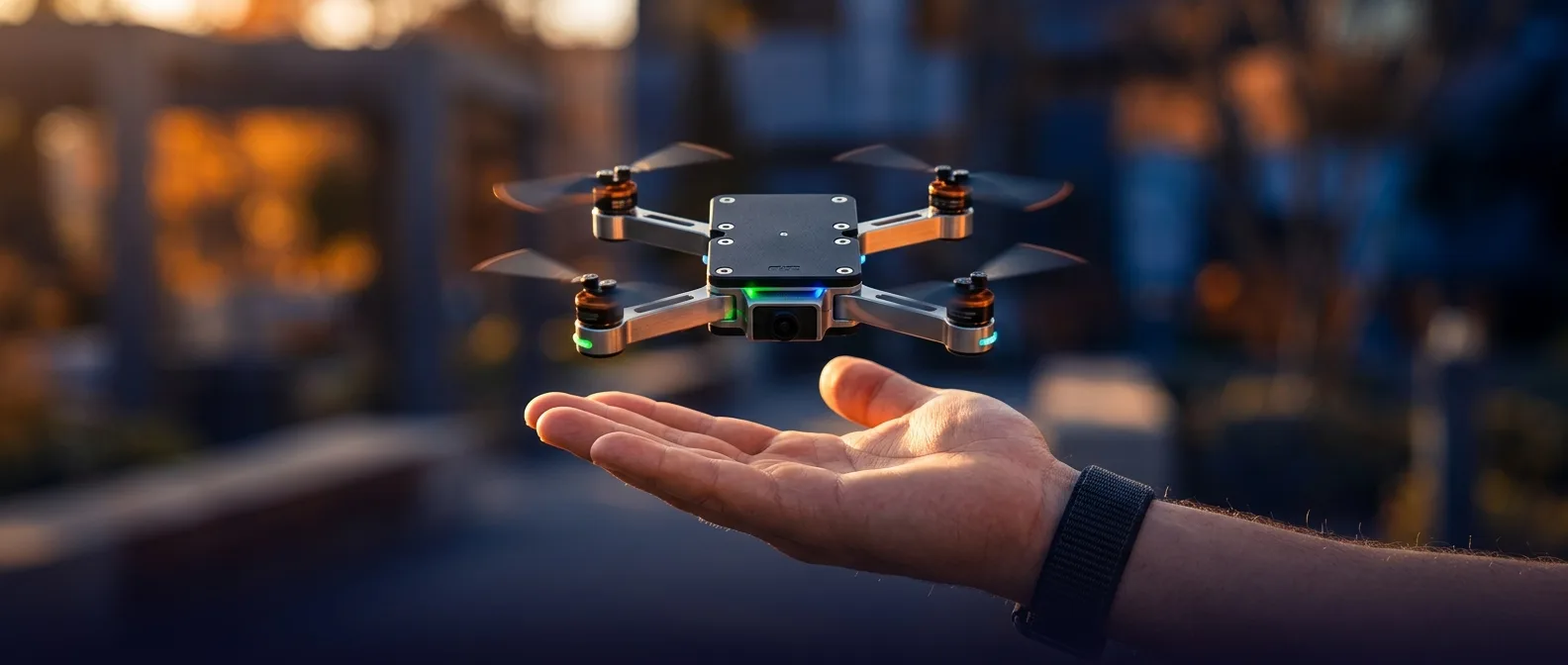
At this year's Photography Show in the UK, the company unveiled a micro drone targeting photographers and videographers who want to learn flight without going bankrupt. As Vernon Kersell, the company's director, puts it: "Some people buy expensive DJI drones and crash them immediately. This one's cheap with replaceable parts."
2026 brings a clear shift in the drone market. Instead of increasingly complex models, we're seeing a focus on accessibility. The Neo 3.0 weighs under 100 grams — meaning no licensing required in Europe or most countries worldwide.
🔬 Crash-Proof Architecture
The Neo 3.0's magnetic top allows module swapping without tools. Just lift the top section and swap cameras, sensors, or whatever else you want to experiment with. The stainless steel arms handle hard impacts, while nylon landing feet absorb the shock.
The 120mm x 120mm dimensions mean it can take off from your palm — perfect for indoor spaces and tight corridors.
Here's where it gets interesting. The modular design isn't just marketing speak. The central PCB board supports anything you can imagine — from thermal cameras to chemical sensors. Extreme Fliers is targeting the hacker and experimenter community, which could make the difference in a saturated market.
Real-World Durability Testing
In durability tests, the Neo 3.0 survived three-meter drops onto concrete. Not once — repeatedly. Users report that most crashes end in prop replacement, not total drone loss.
Why does this matter? Because the learning cost drops dramatically. Instead of sweating every maneuver, you can experiment without financial consequences.
📊 Technical Specifications
The 1080p camera with built-in Wi-Fi enables live streaming to smartphones. There's also an SD card slot for local photo and video storage — something many budget drones skip.
Battery Life and Repeatability
The 5-6 minute flight time sounds short, but the Li-Po battery swaps in seconds. With 2-3 backup batteries you get 20+ minutes of continuous flight — enough for a serious training session.
The self-hovering autonomous hold lets pilots release the controls. Useful when you want to focus on capturing footage instead of stabilizing the drone.
⚡ FPV Experience for Beginners
Let's be realistic here. The Neo 3.0 offers FPV through smartphone app, not goggles. It's not the classic immersive FPV experience — but for a beginner learning the basics, it's sufficient.
Wi-Fi Streaming
Live transmission to your phone without delays. Works indoors and at close distances.
Visual Line of Sight
For beginners, seeing the drone with your eyes is as important as the FPV feed.
The goal isn't to replace a DJI FPV or racing drone. It's to prepare you for those levels without bankrupting you in the process.
Indoor vs Outdoor Flight
The Neo 3.0 can fly both indoors and outdoors, but Extreme Fliers recommends avoiding strong winds. After personal testing, I agree — above 10-15 km/h wind and the drone struggles to maintain position.
For indoor spaces though, it's excellent. Stable hovering, smooth movements, and quiet enough not to annoy the neighbors.
🧬 Modular Ecosystem
Here's where the Neo 3.0 differentiates from competitors. The magnetic mounting system allows custom modules through the central PCB board. Thermal imaging, gas sensors, or even small LED arrays for night photography.
"We're targeting hackers and experimenters. We want to see what they can build on top of the Neo 3.0"
Vernon Kersell, Extreme Fliers
The strategy is smart. Instead of selling a closed system, they're creating a platform. If the community embraces the concept, we'll see third-party accessories that enrich the ecosystem.
DIY Capabilities
For those with basic electronics knowledge, the Neo 3.0 becomes a testbed. Micro sensors, custom lighting setups, or even experimental propeller configurations.
Of course, if you don't know what you're doing, you can destroy the drone. But at $90-95, the cost of mistakes is manageable.
💰 Pricing and Availability
Extreme Fliers targets a price under $99 — roughly $90-95 with current exchange rates. Scheduled release in the UK, US, and globally at the end of March 2026.
At this price it directly competes with BETAFPV Cetus RTF kits and other entry-level FPV drones. The difference? Most competitive products are racing-oriented. The Neo 3.0 targets photographers and content creators.
Early Access: The company accepts registrations for early access on the official Micro Drone 3.0 Neo website.
Hidden Costs
Beyond the initial cost, you need backup batteries (expect $15-20 each), spare props ($3-5 per set), and maybe a carrying case. Total budget: $130-150 for a complete setup.
Compared to a DJI Mini starting at $400+, it's still excellent value.
🎯 Who Should Buy This
The Neo 3.0 isn't for everyone. If you need cinematic 4K footage or professional-grade gimbal stabilization, look elsewhere. It's for:
- Photographers wanting to learn drone basics without major investment
- Content creators needing basic aerial shots for social media
- Beginner FPV pilots planning to move to racing drones later
- Tech enthusiasts wanting to experiment with modular hardware
It's not for advanced pilots seeking acrobatic performance or long-range capabilities. It's a learning tool, not a professional workhorse.
Realistic Expectations
With 5-6 minutes flight per battery and 1080p camera, the Neo 3.0 won't win awards. But it will teach you to fly without the fear of expensive replacement costs.
For someone starting from zero, this is invaluable. The confidence you build flying a robust, cheap drone transfers when you upgrade to something more expensive.
📈 Market Context
In 2026, the micro drone market splits two ways: ultra-premium (DJI, Autel) and ultra-budget (Chinese toys). The Neo 3.0 tries to bridge this gap.
Extreme Fliers isn't DJI — they don't have the R&D budget or global distribution. But they have the advantage of agility. They can experiment with concepts the big players would reject as unprofitable.
The modular concept, if successful, could influence the entire industry. Imagine DJI drones with swappable camera modules or modular sensor arrays. The Neo 3.0 is a testing ground for these ideas.
The question isn't whether the Neo 3.0 will replace premium drones. It's whether it will create a new category: affordable, educational, expandable drones that prepare users for the next levels. And in that, it has real chances of success.
Sources: