📖 Read more: FPV Drones at the 2026 Winter Olympics
⚔️ The Unmanned Combat Aerial Vehicle Revolution
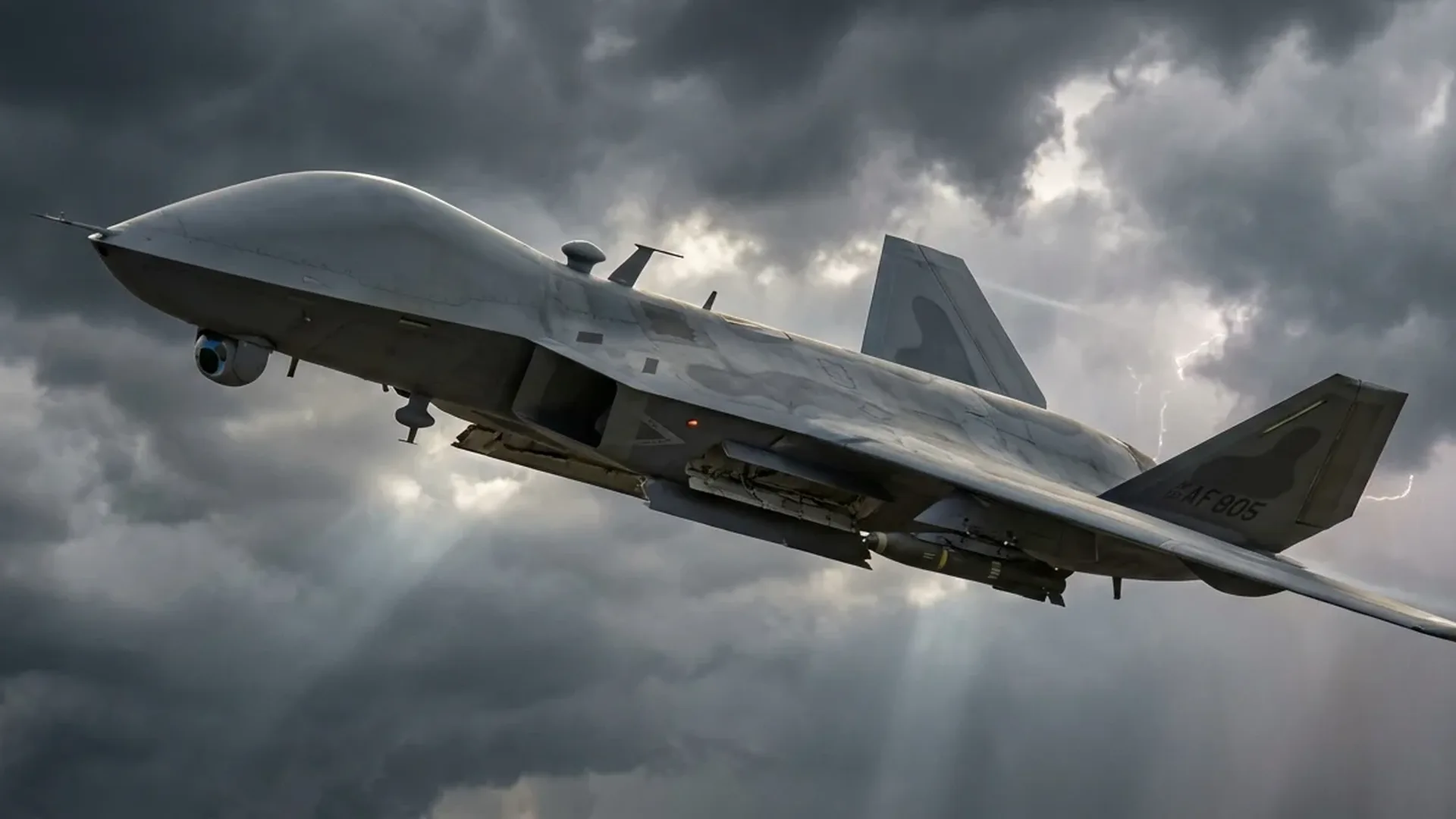
Unmanned Combat Aerial Vehicles (UCAVs) have become a central pillar of every modern military. Unlike traditional reconnaissance drones, UCAVs carry air-to-surface missiles, anti-tank guided missiles, laser-guided bombs, and — in some cases — even air-to-air missiles. Over 40 countries now operate armed drones, while the military UAV market is projected to exceed $26 billion by 2030.
Their history dates back to the 1940s, but the real turning point came after 2000 when the United States deployed the first armed Predators in Afghanistan. Today, the technology has evolved dramatically: artificial intelligence, autonomous navigation in GPS-denied environments, AESA radar, electronic warfare, and even the capability to conduct Beyond Visual Range (BVR) air-to-air engagements.
🇹🇷 Bayraktar TB2 — The Game-Changing Drone
No military drone has become as widely known as Turkey's Bayraktar TB2, manufactured by Baykar. With its maiden flight in August 2014 and over 800 units built, the TB2 is the most produced and export-successful UCAV in the world. Its price — approximately €4.6–5 million (~$5–5.5 million) per unit — is roughly one-sixth of the competing MQ-9 Reaper, making it attractive to dozens of countries.
The TB2 falls into the MALE (Medium-Altitude Long-Endurance) category, capable of flying at altitudes up to 25,000 feet with an endurance exceeding 24 hours. It carries MAM-C and MAM-L laser-guided munitions, L-UMTAS anti-tank missiles, Cirit 70mm rockets, and the Kemankeş cruise missile. Production capacity reaches 250 aircraft per year.
Its operational record is remarkable. In Syria, it destroyed Pantsir-S1 air defense systems, main battle tanks, and BMP infantry fighting vehicles. In Azerbaijan during the 2020 Nagorno-Karabakh war, it proved decisive, devastating Armenian armor and air defenses. In Ukraine, from February 2022, it struck Russian forces — contributing to the sinking of the cruiser Moskva and attacks on Snake Island — though by mid-2023 its role had shifted primarily to reconnaissance as Russia significantly improved its electronic warfare and air defense capabilities. By February 2025, at least 26 TB2s had been confirmed lost in Ukraine.
In February 2025, the new TB2T-AI variant was announced, featuring a turbine engine instead of the original piston powerplant, a redesigned aerodynamic profile, three AI computers, a top speed of 300 km/h, and improved payload capacity. Over 30 countries operate the TB2, including Poland (first NATO/EU buyer, 24 drones), Romania ($321 million contract), Croatia (€67 million (~$73M)), Albania, Kuwait (2025), Bosnia (donated by Turkey, 2025), and Japan (on order).
🇺🇸 MQ-9 Reaper — America's “Hunter-Killer”
The General Atomics MQ-9 Reaper has been the backbone of American unmanned strategy for nearly two decades. In service since May 2007, with over 300 aircraft built, the Reaper is the first hunter-killer UAV designed for long-endurance, high-altitude operations.
Powered by a 950-horsepower turboprop engine, with a 20-meter wingspan and a maximum takeoff weight of 4,760 kg, the MQ-9 can carry 1,700 kg of payload. Endurance reaches 27 hours (up to 42 hours in the Extended Range version), while its speed tops out at 480 km/h. It carries up to 8 AGM-114 Hellfire missiles, GBU-12 Paveway II laser-guided bombs, GBU-38 JDAM munitions, and AIM-9 Sidewinder air-to-air missiles. The average unit cost is estimated at ~€28–30 million (~$30–34 million) — roughly six times more expensive than a TB2.
The Reaper is operated by a ground crew (pilot and sensor operator) at a Ground Control Station, often thousands of kilometers from the aircraft. Commands reach the drone via satellite link in just 1.2 seconds. Its onboard camera can reportedly read a license plate from 3.2 kilometers away.
🔑 Key Fact: The USAF operates over 300 MQ-9 Reapers, with plans for gradual retirement by 2035. Other Reaper operators include the UK (replaced in September 2025 by Protector), France (16 units), Italy, the Netherlands, Spain, Poland, and India (31 MQ-9B contract worth $3.4 billion, signed October 2024).
However, the Reaper has proven vulnerable in contested airspace. In Yemen, the Houthis shot down at least 6 MQ-9 Reapers between March 2024 and April 2025 — each loss representing ~€28 million (~$30M). Another Reaper was lost over the Black Sea in March 2023 after a collision with a Russian Su-27 fighter. These losses are fueling debate over the viability of non-stealth drones in contested environments.
🦅 Bayraktar Akıncı — Turkey's Heavy UCAV Answer
While the TB2 dominates the medium-tier, Baykar developed the Akıncı ("Raider") for more demanding missions. With its maiden flight in December 2019 and entering Turkish Armed Forces service in August 2021, the Akıncı is a HALE (High-Altitude Long-Endurance) multirole UCAV with a maximum takeoff weight of 6 tons and over 1,500 kg of payload capacity.
Powered by twin turboprop engines (450, 750, or 850 HP depending on the A, B, or C variant), it features a 20-meter wingspan, 24+ hours of endurance, and a service ceiling of 45,000 feet. Its 8 hardpoints can carry cruise missiles (SOM), anti-ship weapons, anti-tank munitions, Mark 82/83/84 bombs with guidance kits, and even loitering munitions (Alpagut, Eren). It is the first UAV capable of launching a cruise missile.
The Akıncı is equipped with the MURAD AESA radar (domestically built, first flight with radar in March 2025), electronic warfare suite, SIGINT module, and ASELFLIR-500/600 electro-optical systems with a 200 km detection range. By January 2026, over 110 Akıncı units had been delivered, with a target of 120+ by the end of 2026. Turkey, Azerbaijan, Pakistan, Libya, Ethiopia, Morocco, Somalia, the UAE, Sudan, Burkina Faso, and Mali already operate the Akıncı, while Indonesia signed an agreement for 9 units in February 2025.
In the field, the Akıncı has seen action in Pençe-Kilit operations against PKK positions in northern Iraq, while 9 Akıncı drones flew over 1,551 hours in the Turkey–Syria earthquake zone in February 2023. It also helped locate Iranian President Raisi's crashed helicopter in May 2024. However, it's not invulnerable: the PKK announced shooting down an Akıncı in the Qandil region in March 2025, and the Algerian air defense downed a Malian Akıncı near the Algerian border in April 2025.
📖 Read more: DJI Neo 2: The Next-Gen Selfie Drone
🎮 FPV Drones — The “People's Revolution” of the Battlefield
If UCAVs like the Reaper and Akıncı represent the “heavy weapons” of aerial warfare, FPV (First-Person View) drones are the polar opposite: cheap, mass-produced, and lethal. The war in Ukraine (2022–2026) became the first full-scale conflict featuring the massive use of commercial and modified small UAVs, marking a radical shift in ground-level tactics.
FPV drones are typically quadcopters modified with explosives — costing just a few hundred dollars each, yet capable of destroying armored vehicles worth millions. A single FPV drone costs €400–€1,000 (~$430–$1,100), but can take out a tank worth €3–5 million (~$3.3–5.5M). The cost-to-effectiveness ratio is staggering: 1 to 5,000 or more.
Both sides in Ukraine produce tens of thousands of FPV drones monthly. Ukraine announced a production target of one million drones within 2024. The operator wears FPV goggles and pilots the drone in first-person, guiding it like a missile toward the target — often through building windows or armored vehicle hatches. This form of combat simply didn't exist three years ago.
🤖 Loyal Wingman & Next-Gen Programs
The next major evolution in military drones is the “loyal wingman” concept: autonomous drones flying alongside manned fighters, functioning as AI-controlled companions that can carry weapons, sensors, or decoys. The most significant programs currently include:
- Boeing MQ-28 Ghost Bat (Australia): Developed in partnership with the RAAF, this is a stealth-capable autonomous drone designed to fly alongside F-35s and F/A-18s. First flight in February 2021.
- Kratos XQ-58 Valkyrie (USA): A low-cost stealth UCAV designed as a loyal wingman for the US military. Estimated cost of just ~$2 million per unit.
- Bayraktar Kızılelma (Turkey): Perhaps the most ambitious program — the world's first unmanned fighter to validate BVR (Beyond Visual Range) air-to-air engagement. Features jet propulsion and air-to-air capability, with serial deliveries expected from mid-2026.
- TAI Anka-3 (Turkey): A stealth UCAV in a flying wing configuration, being developed by Turkish Aerospace Industries.
- Sukhoi S-70 Okhotnik-B (Russia): A heavy stealth UCAV in a flying wing design, in service since 2024, designed to operate alongside the Su-57.
The philosophy behind the loyal wingman is straightforward: a single human pilot with 2–4 autonomous drones multiplies combat power without multiplying the risk of human casualties. AI handles the most dangerous missions (SEAD, deep reconnaissance in hostile territory, decoy roles), while the pilot remains the strategic brain.
🛡️ Counter-Drone Technology: The Endless Arms Race
With the explosive growth of military drones, counter-drone technology is evolving just as rapidly. The key tools include:
- Electronic Warfare (EW): Jamming GPS and control signals, forcing drones to lose orientation or crash. In Ukraine, improved Russian EW capability was the primary reason the TB2 became less effective after mid-2022.
- Directed Energy (DE): High-power lasers and microwaves. Lasers can shoot down small drones for just a few dollars per “shot,” compared to missiles costing hundreds of thousands. The Pentagon is already considering integrating DE weapons onto the MQ-9 Reaper itself.
- Anti-Drone Missile Systems: Systems like the Pantsir-S1 and mobile anti-aircraft guns have proven effective against slow-moving UCAVs. The Houthis in Yemen shot down at least 6 MQ-9 Reapers using modified anti-aircraft missile systems.
- Anti-FPV Nets & Counter-Drone Drones: Specialized protective nets on vehicles and dedicated interceptor micro-drones are being developed as countermeasures against FPV threats.
🇬🇷 Greece Enters the Military Drone Arena
Greece is not sitting on the sidelines. The Hellenic Air Force is in discussions to acquire at least 3 MQ-9B SeaGuardian drones (the maritime variant of the Reaper), with parliamentary approval granted in July 2022. Notably, the USAF already operates MQ-9s from Larissa Air Base in Greece, giving the country hands-on experience through joint exercises.
The SeaGuardian offers 360° maritime surveillance radar, over 40 hours of endurance, 11,000 km range, and anti-submarine warfare capability — ideal for monitoring the Aegean and Eastern Mediterranean. The system cost (aircraft + ground stations + support) is expected to run into the hundreds of millions of euros.
📊 Top Military Drones Compared — 2026
To better understand the differences, here is a comparison of key specifications:
- Bayraktar TB2: MALE UCAV, speed ~220 km/h, endurance 24+ hours, payload ~150 kg, price ~€4.6–5M (~$5–5.5M), 800+ built, 30+ operator countries.
- MQ-9A Reaper: MALE UCAV, speed ~480 km/h, endurance 27 hrs (42 ER), payload 1,700 kg, price ~€28–30M (~$30–34M), 300+ built, 10+ operator countries.
- Bayraktar Akıncı: HALE UCAV, speed ~360 km/h, endurance 24+ hrs, payload 1,500 kg, price undisclosed, 110+ delivered, 12+ countries.
- Wing Loong II (China): MALE UCAV, speed ~370 km/h, endurance 20 hrs, Chinese export drone with customers across the Middle East, Africa, and Pakistan.
🔮 What's Coming: The Age of AI Warfare
The trajectory through 2030 is clear: increasing autonomy, swarming tactics (dozens or hundreds of coordinated drones), AI-powered target recognition, and full integration with C4ISR networks (Command, Control, Communications, Computers, Intelligence, Surveillance, Reconnaissance).
The ethical and legal debate surrounding autonomous weapons is intensifying. The EU, the US, and the UN are discussing regulation — or outright bans — on fully autonomous lethal systems (Lethal Autonomous Weapon Systems, LAWS). Yet technology is outpacing legislation: countries like the US, China, Turkey, and Russia are investing billions in AI warfare development.
The reality of 2026 is that no modern military can afford to ignore drones — neither as an offensive tool nor as a threat. The arms race isn't just about the drones themselves, but the entire ecosystem: AI software, secure communications, counter-drone systems, operator training, and strategic doctrine. Those who adapt fastest will hold the advantage on tomorrow's battlefields.