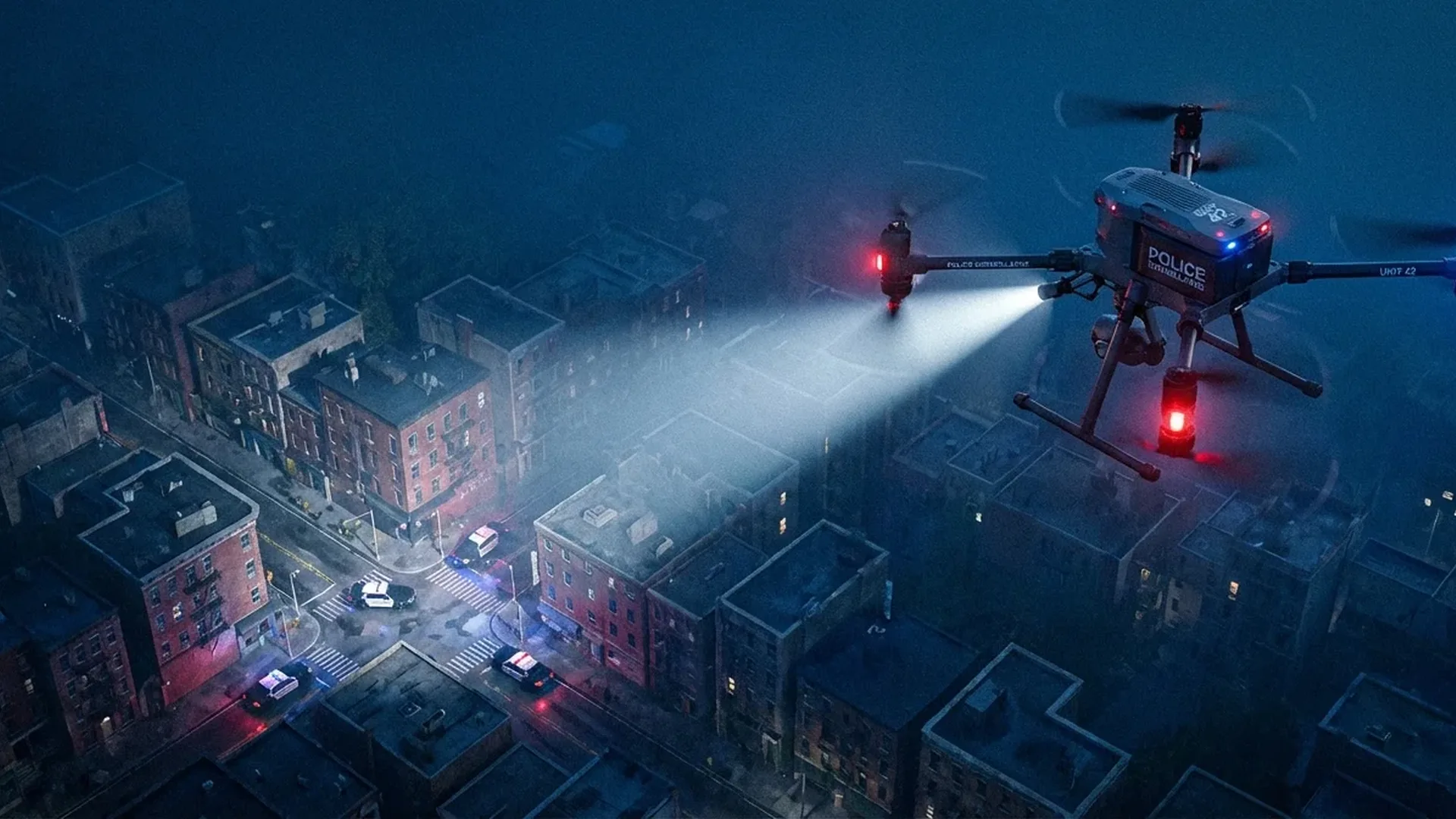
\U0001f6a8 How Police Use Drones
Police drones are not simply flying cameras. According to Wikipedia (Use of UAVs in law enforcement), UAVs can carry camera systems capable of license plate scanning and thermal imaging, as well as radio equipment and other sensors. Key applications include:
- Surveillance and patrol: Real-time aerial monitoring, ideal for large gatherings, sporting events, and demonstrations
- Traffic control: Monitoring traffic flow, detecting violations, and managing incidents
- Search and rescue (SAR): Locating missing persons in difficult terrain using thermal sensors
- Drone as First Responder (DFR): According to DJI Enterprise, drones reduce response time by arriving at the scene before patrol cars
- Collision reconstruction: DJI Enterprise specifically mentions the use of drones for “Collision Reconstruction and Forensics” \u2014 faster road clearing and digitized forensic investigation
- Border patrol: The U.S. Customs and Border Protection has used drones for border patrol since 2005 (Wikipedia)
"Drones offer police departments enhanced situational insight, safer operations for officers and bystanders, cost savings, and better-informed decisions, serving communities more effectively." \u2014 DJI Enterprise, Law Enforcement
\U0001f1ec\U0001f1f7 The Hellenic Police and Drones
The Hellenic Police (EL.AS.) officially introduced drones into its operations in October 2019, following Presidential Decree 98/2019 which enabled the development of the Service of Non-Staffed Aircraft (Y.M.S.A.) (Wikipedia). This service operates under the Aviation Directorate of EL.AS.
Equipment and Procurement
According to Wikipedia, EL.AS. uses drones from BlueBird Aero Systems: 3 ThunderB, 1 Spylite and multicopters from the same company, which were added to the fleet in 2014 following a procurement of \u20ac800,000 (~$870,000). In August 2024, the Heraklion UAV Office acquired a drone team of 6 officers (CretaLive), while overall procurements worth \u20ac300,000 (~$327,000) or more include drones for border surveillance in the Evros region (Wikipedia).
Drones in Traffic Enforcement
In February 2024, EL.AS. announced the use of drones for traffic control through the Traffic Control Monitoring Operations Room. As the Hellenic Police itself stated on X (formerly Twitter): "In the battle for traffic management and driver facilitation, EL.AS. drones are also deployed." The drone footage is transmitted to the operations room and the traffic police intervene immediately and in a targeted manner wherever a problem is identified (Proto Thema, February 2024). The Thessaloniki Traffic Police also uses drones (Parapolitika, October 2023).
Border Surveillance and Emergencies
Y.M.S.A. drones are also deployed for border surveillance in the Evros region (Greek-Turkish border) and for supporting Hellenic Fire Service operations during wildfires, natural disasters, earthquakes, and other emergencies (Wikipedia). According to Kathimerini (January 2020), EL.AS. is also evaluating anti-drone technology for the protection of critical infrastructure.
\U0001f30d International Experience: Who Leads the Way
The use of drones by police has evolved rapidly worldwide. According to Wikipedia:
USA: The first known use of a drone by police occurred in 2005 in Irwin County, Georgia, during the search for Tara Grinstead. In 2011, an MQ-1 Predator was used in North Dakota for the first arrest assisted by a drone in the US \u2014 during a 16-hour armed standoff with a rancher. The FBI officially admitted using drones for surveillance in June 2013, while in 2016 the number of law enforcement agencies that purchased drones doubled to 167.
United Kingdom: Merseyside Police began tests in 2007 and caught a car thief with a drone in 2010 \u2014 but stopped a week later because the drone was unlicensed. Later, the drone was lost in the River Mersey during an exercise. By 2014, five English police forces had acquired or were operating UAVs.
United Arab Emirates: In Dubai, police recorded 4,400 violations using drones in just the first quarter of 2021, employing them for crime detection, traffic control, and Covid restriction enforcement (Wikipedia).
South Africa: In Cape Town in 2025, drones combined with an extensive CCTV camera network proved successful in assisting arrests and prosecutions (MyBroadband, 2025).
\U0001f512 Privacy and Citizens\' Rights
The use of drones by police triggers strong reactions from civil rights organizations. According to Wikipedia, organizations such as the Electronic Frontier Foundation, the American Civil Liberties Union (ACLU), and the Electronic Privacy Information Center (EPIC) have expressed serious concerns about privacy.
Specifically, the ACLU warned of a "nightmare scenario": police, using computing technology, could combine cell phone tracking with drone video and build a database of citizens\' daily movements (National Geographic, 2013).
In the case of Florida v. Riley, the US Supreme Court ruled that citizens have no right to privacy against police surveillance from public airspace \u2014 a decision that makes drone flights legally permissible (Wikipedia). However, in 2014 the California Senate passed regulations requiring a warrant before police use of drones, except in emergencies.
In Europe, EASA regulations set the framework for drone use, while GDPR protects personal data collected by aerial systems. In 2013, Seattle\'s mayor ordered the abandonment of the police drone program after intense citizen backlash (Wikipedia).
\u26a0\ufe0f Critical issue: In 2012, the Electronic Frontier Foundation filed a Freedom of Information Act request with the FAA and revealed the list of all public and private entities that had applied for UAV flight permits within the US. EPIC emphasized that "transparency and accountability must be built into the FAA\'s UAV regulatory system" (Wikipedia).
\U0001f4b0 Equipment and Cost
DJI, with a market share reaching 80% globally (Wikipedia, 2025), offers specialized models for law enforcement use through its Enterprise line. However, in January 2020 the US Department of the Interior grounded approximately 800 DJI drones over security concerns, while in October 2020 the DOJ banned the use of federal funds to purchase drones from “foreign entities considered threats,” including DJI (Wikipedia).
| Model | Type | Suitable For | Approximate Price |
|---|---|---|---|
| DJI Mavic 3T | Compact thermal | Patrol, reconnaissance | ~\u20ac4,600 (~$5,000) |
| DJI Matrice 30T | Enterprise medium | Surveillance, SAR, DFR | ~\u20ac9,200 (~$10,000) |
| DJI Matrice 350 RTK | Heavy enterprise | Borders, forensics | \u20ac11,000-\u20ac18,400 (~$12K-$20K) |
| Autel EVO II Dual 640T | Thermal enterprise | Night surveillance | ~\u20ac7,500 (~$8,200) |
For comparison, a police helicopter costs \u20ac3,000-\u20ac10,000 (~$3,270-$10,900) per hour of operation, requires crew, and dedicated facilities. A drone like the DJI Mavic 3T operates at minimal cost per hour, requires only one trained operator (training ~\u20ac300-\u20ac800 / ~$327-$870 for STS certification) and can be flight-ready in minutes.
\U0001f6e1\ufe0f Anti-Drone Technology and New Threats
Alongside the use of drones by police, threats from illegal drones are also increasing. According to Wikipedia:
- In 2017, drones were used to smuggle contraband into prisons
- In December 2018, London\'s Gatwick Airport was shut down due to drone sightings \u2014 the British military was deployed for counter-drone operations
- Counter-UAS (C-UAS) technologies are being developed: radar, electro-optical systems, RF detection and jamming
- The Israeli company Elbit Systems offers the ReDrone system, while the Iron Dome was enhanced with anti-drone capabilities
Police find themselves in a dual role: using drones for surveillance while simultaneously needing to protect critical infrastructure (airports, border points, public buildings) from illegal UAVs. In Greece, fines for unauthorized flights range from \u20ac1,000 to \u20ac50,000 (~$1,090 to ~$54,500), with possible imprisonment of up to 3 years.
\U0001f52e The Future of Police Drones
Police drone technology is evolving rapidly. The Drone as First Responder (DFR) model, promoted by DJI Enterprise, envisions drones that launch automatically on every emergency call, arriving at the scene before patrol cars and providing real-time video to officers before they even arrive.
Artificial intelligence also plays a central role: according to Wikipedia (UAV article), automatic tracking via deep learning allows drones to detect and follow targets autonomously. Additionally, Remote ID regulations (mandatory from the FAA since 2021 and from EASA in Europe) will allow police to identify every drone in flight in real time.
\U0001f4a1 Remote ID regulation: According to Wikipedia, in the US there were 873,576 UAVs registered with the FAA as of May 2021 \u2014 42% commercial and 58% recreational. Remote ID compliance allows authorities to remotely identify the owner of any drone in flight. In Greece, the cost of a Remote ID module ranges from \u20ac90-\u20ac275 (~$100-$300).
\U0001f4cb Conclusions
Police drones are now an everyday tool in law enforcement agencies worldwide \u2014 from traffic control in Athens to border surveillance on the Evros and collision reconstruction in the US. The benefits are significant: lower cost than helicopters, faster response times, and officer safety.
However, the balance between security and privacy remains the big question. As law professor Ryan Calo wrote in the Stanford Law Review: "Drones could help restore our cognitive model of privacy violation. They could be precisely the catalyst society needs to bring privacy law into the 21st century." For Greece, with Presidential Decree 98/2019 and continued expansions, the future of police drones is already here.