📖 Read more: Drone Fines in Greece: What You Risk
☀️ What Are Solar Drones?
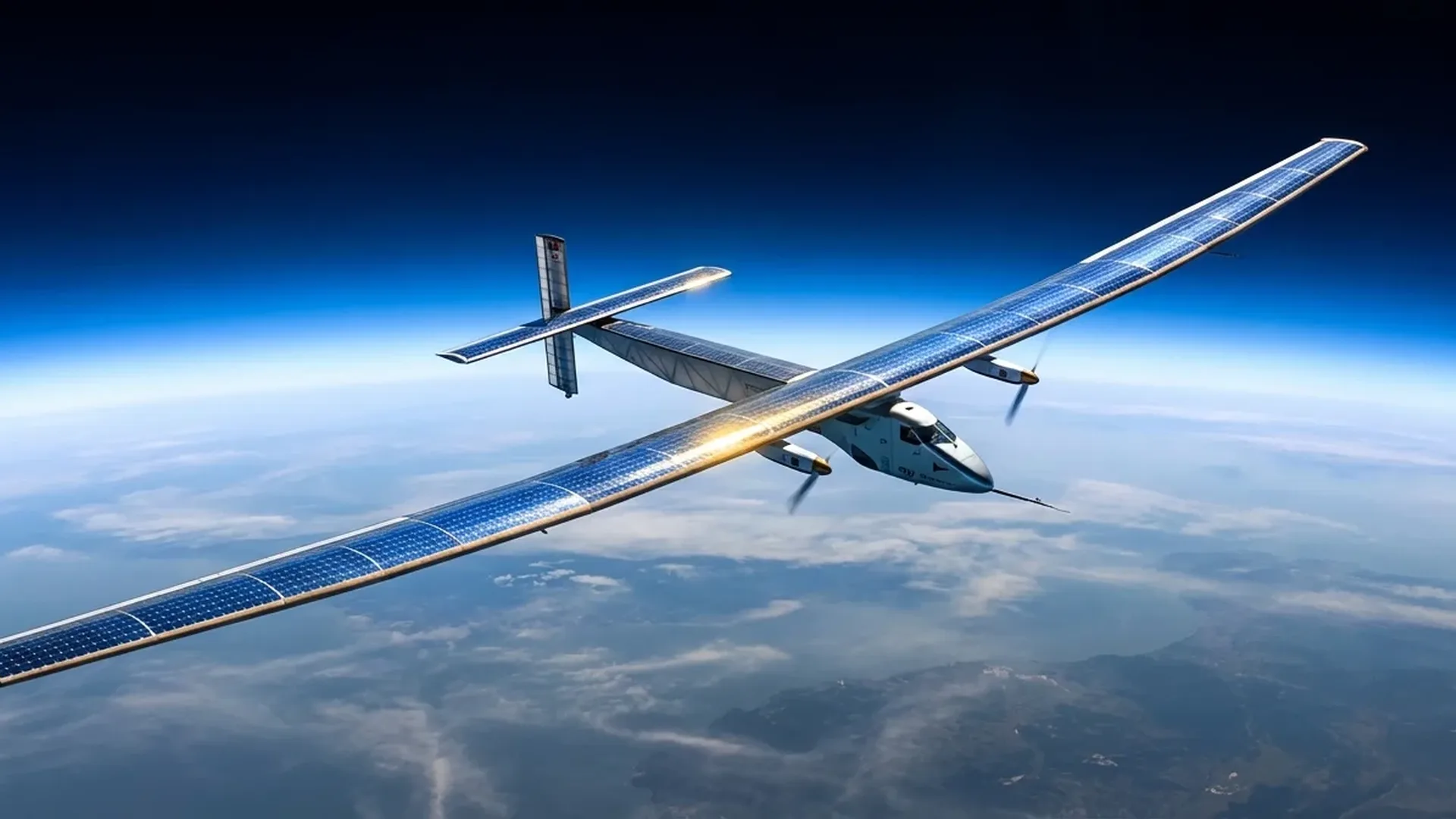
Solar drones are unmanned aerial vehicles (UAVs) that rely on photovoltaic cells as their primary energy source. During the day, the solar cells power the electric motors and charge the onboard batteries — which then take over for nighttime flight. The theoretical goal: uninterrupted presence in the sky, at least at latitudes near the equator where sunshine is abundant year-round.
The category drawing the most attention today is HAPS (High-Altitude Platform Stations) — aircraft that hover at 18 to 23 kilometres altitude, above the clouds and commercial air traffic. Up there, solar radiation is nearly continuous, winds are mild, and the vantage point is ideal for both telecommunications and earth observation. HAPS essentially function as “pseudo-satellites” — according to Airbus, a single Zephyr can replace 250 cell phone towers.
🕰️ The History — From Sunrise to Zephyr
The idea of solar-powered flight began earlier than most people realise. In 1974, the AstroFlight Sunrise completed the first unmanned solar-powered flight in history. It was a small prototype, but it proved that solar energy could actually keep an aircraft airborne.
NASA picked up the baton with its ERAST (Environmental Research Aircraft and Sensor Technology) programme, developing a series of progressively larger aircraft through AeroVironment: the Pathfinder (first flight 1983, 29.5 m wingspan, altitude record of 21,802 m), the Pathfinder Plus (36.3 m, record 24,445 m), the Centurion (61.8 m), and finally the Helios Prototype — a colossal flying wing with a 75-metre wingspan, larger than a Boeing 747.
🏆 Helios Record: On August 13, 2001, the Helios Prototype reached 96,863 feet (29,524 m) — a world record for sustained horizontal flight by a winged aircraft. It carried over 62,000 SunPower photovoltaic cells and 14 electric motors. Tragically, on June 26, 2003, the aircraft broke apart over the Pacific Ocean due to structural instability in turbulent conditions.
Meanwhile, in the United Kingdom, QinetiQ (a commercial offshoot of the Ministry of Defence) had been developing the Zephyr series since 2003. The Zephyr 3, with a 12 m wingspan, weighed just 12 kg. Each version improved on endurance: the Zephyr 6 flew for 82 hours in 2008, and the Zephyr 7 broke the FAI duration record in July 2010 with 336 hours (14 days) of continuous flight, reaching 21,562 m altitude.
📖 Read more: Drone Hyperlapse: Step-by-Step Guide
🚀 Today's Major Programmes
Airbus Zephyr 8/S — King of the Stratosphere
After Airbus Defence and Space acquired Zephyr in 2013, development accelerated. The Zephyr 8/S is currently the most ambitious solar drone in the world: a 25-metre wingspan, weighing just 60–65 kg, with a cruise altitude of 23,200 m (76,100 ft). Batteries account for 40% of its weight (24 kg) — Amprius lithium-ion cells with silicon nanowire anodes delivering a specific energy of 435 Wh/kg, well above the typical 300–320 Wh/kg.
In the summer of 2022, a Zephyr S took off from Arizona and flew for 64 days, covering 56,000 km over the southern United States, the Gulf of Mexico, and South America. The flight ended when an engine component failed during unusual storm turbulence at 17 km altitude. Nevertheless, Airbus's long-term target is flights lasting 200 to 300 days.
In January 2023, AALTO HAPS was established as Airbus's subsidiary for commercial HAPS services. In June 2024, a Japanese consortium led by NTT Docomo and Space Compass committed to a $100 million (~€92 million) investment, targeting commercial operations in Asia by 2026. The long-term vision: a constellation of 1,000 aircraft by 2034 serving 2.9 billion people.
BAE Systems PHASA-35
Designed by engineers who originally worked on the Zephyr at QinetiQ, PHASA-35 was developed in less than two years. With a 35-metre wingspan and a weight of 150 kg, it aims for up to 12 months of continuous flight. Its maiden flight took place on February 17, 2020, at the Woomera Test Range in Australia. By December 2024, it had flown for 24 hours reaching 66,000 feet (20,000 m) from Spaceport America in New Mexico, targeting operational readiness by 2026.
SoftBank Sunglider (HAPSMobile Hawk30)
SoftBank, partnering with AeroVironment (the original Helios manufacturer), developed the Hawk30/Sunglider — an enormous 78-metre flying wing with 10 electric propellers. Its first flight took place on September 11, 2019. On September 21–22, 2020, it flew for 20 hours reaching 62,500 feet (19,100 m) from Spaceport America, successfully testing LTE telecommunications to smartphones on the ground. The target: just 40 aircraft could blanket the entire Japanese archipelago with 4G/5G coverage.
📖 Read more: Drone License: How to Get Your Pilot Certificate
Skydweller Aero — The Solar Impulse Reborn
In 2016, Solar Impulse 2 — boasting a 71.9-metre wingspan, 17,248 photovoltaic cells, and weighing just 2,300 kg — completed a circumnavigation of the globe on solar power alone: 42,000 km in 17 legs. On the most remarkable leg (Nagoya to Hawaii), pilot André Borschberg flew for 117 hours and 52 minutes without stopping — a solo flight duration record for any type of aircraft.
In 2019, Solar Impulse 2 was sold to Skydweller Aero, a Spanish-American company converting it into an autonomous unmanned aircraft. In February 2023, it completed its first autonomous flight in Spain, and in April 2024 conducted the world's first uncrewed autonomous flight of a large solar aircraft in Mississippi. The goal: perpetual autonomous flight around the world.
"A solar drone in the stratosphere costs a fraction of a satellite, can be upgraded, recovered and repositioned. It's the poor man's satellite — and perhaps the satellite of the future."
⚙️ The Technology Behind Perpetual Flight
How does a 60 kg aircraft fly for months without fuel? The answer lies in three technological pillars:
Photovoltaic Cells
The Zephyr 8/S uses multi-junction GaAs (gallium arsenide) cells from MicroLink Devices, with a specific power exceeding 1,500 W/kg and output over 350 W/m². They are exceptionally thin, lightweight, and flexible — ideal for integration into drone wings.
Next-Gen Batteries
Amprius batteries with silicon nanowire anodes deliver 435 Wh/kg — 35–45% more energy than standard Li-ion. Earlier models even used lithium-sulphur (Li-S) batteries with double the energy density of LiPo.
📖 Read more: Drone Light Shows 2026: Spectacular Sky Displays
Ultra-Light Airframe
The airframe uses carbon fibre, epoxy resin, Kevlar and Nomex for an extreme weight-to-strength ratio. The Zephyr 3 weighed just 12 kg across a 12 m wingspan. The skin consists of an ultra-thin transparent membrane.
A fourth pillar, still experimental, is hydrogen fuel cells. NASA tested a combination of photovoltaics, lithium batteries, and an H₂-air fuel cell on the Helios HP03, enabling over 14 hours of nighttime flight. Although that effort ended with the 2003 crash, the technology continues to evolve: Euro Airship is designing the Solar Airship One, a solar airship that will store hydrogen via electrolysis for night operations and fly around the world in 20 days.
📡 Applications — Why This Matters
Stratospheric solar drones are not technological curiosities — they solve real-world problems:
- Telecoms for remote areas: A single Zephyr with an 8 kg payload can deliver 4G/5G to 100,000 people within a 200 km diameter. Perfect for regions lacking tower infrastructure or island archipelagos.
- Disaster response: After an earthquake, hurricane, or flood that destroys cell towers, a HAPS can be deployed within hours providing emergency 4G/5G coverage.
- ISR (Intelligence, Surveillance, Reconnaissance): Using the Airbus Opaz optical sensor, imagery at 18 cm resolution from over 20 km altitude. Also radar, LIDAR and infrared capabilities.
- Environmental monitoring: Pollution measurement, wildfire tracking, ocean current mapping — with weeks of continuous presence above the area of interest.
- Maritime & border surveillance: The larger PHASA-35 and the Zephyr T variant (32 m wingspan, 145 kg, 20 kg payload) target military applications.
⚡ Challenges & Limitations
Despite impressive performance, solar drones face serious hurdles:
📖 Read more: Drone Maintenance: A Complete Care Guide
Weather: Even in the stratosphere, unusual storms can prove fatal. As of February 2026, the Zephyr programme has logged at least four hull losses — including an incident in April 2025 over the Indian Ocean (430 nautical miles northwest of the Seychelles) and a crash in September 2025 at a game reserve in Kenya.
Geographic limits: HAPS work best between 40° north and south. At higher latitudes, winter sunlight is insufficient. Japan (35°N) sits right at the edge, which is why SoftBank is planning a future Hawk50 variant for operations up to 50° N/S.
Tiny payloads: The 5–15 kg useful payload severely limits what a HAPS can carry. Mostly sensors, cameras, and telecoms equipment — cargo delivery is out of the question.
Development costs: A HAPS programme requires extensive R&D. AeroVironment invested $129 million (~€119 million) in design development for the Hawk30 alone. However, compared to satellite launches ($50–400 million per mission), the long-term savings are substantial.
🔮 The Future: Perpetual Flight, Global Coverage
The solar drone industry is no longer experimental — it stands on the threshold of commercial deployment. AALTO (Airbus) targets commercial service launch in 2026 with around 18 aircraft, scaling to a constellation of 1,000 Zephyrs by 2034 serving 2.9 billion people with telecoms and earth observation. BAE Systems also targets 2026 for PHASA-35 operational readiness.
Meanwhile, third-generation photovoltaics (perovskite/multi-junction tandems) promise efficiencies above 40%, delivering more power from smaller surfaces. Solid-state batteries being developed for electric vehicles will find applications here too — dramatically extending nighttime endurance. And artificial intelligence will play a critical role in flight optimisation, weather avoidance, and autonomous decision-making.
In a world that demands connectivity everywhere, always, without massive ground infrastructure, stratospheric solar drones may prove to be the most elegant solution: invisible aircraft powered by sunlight, silently cruising above the clouds, delivering internet, imagery, and data to millions of people.