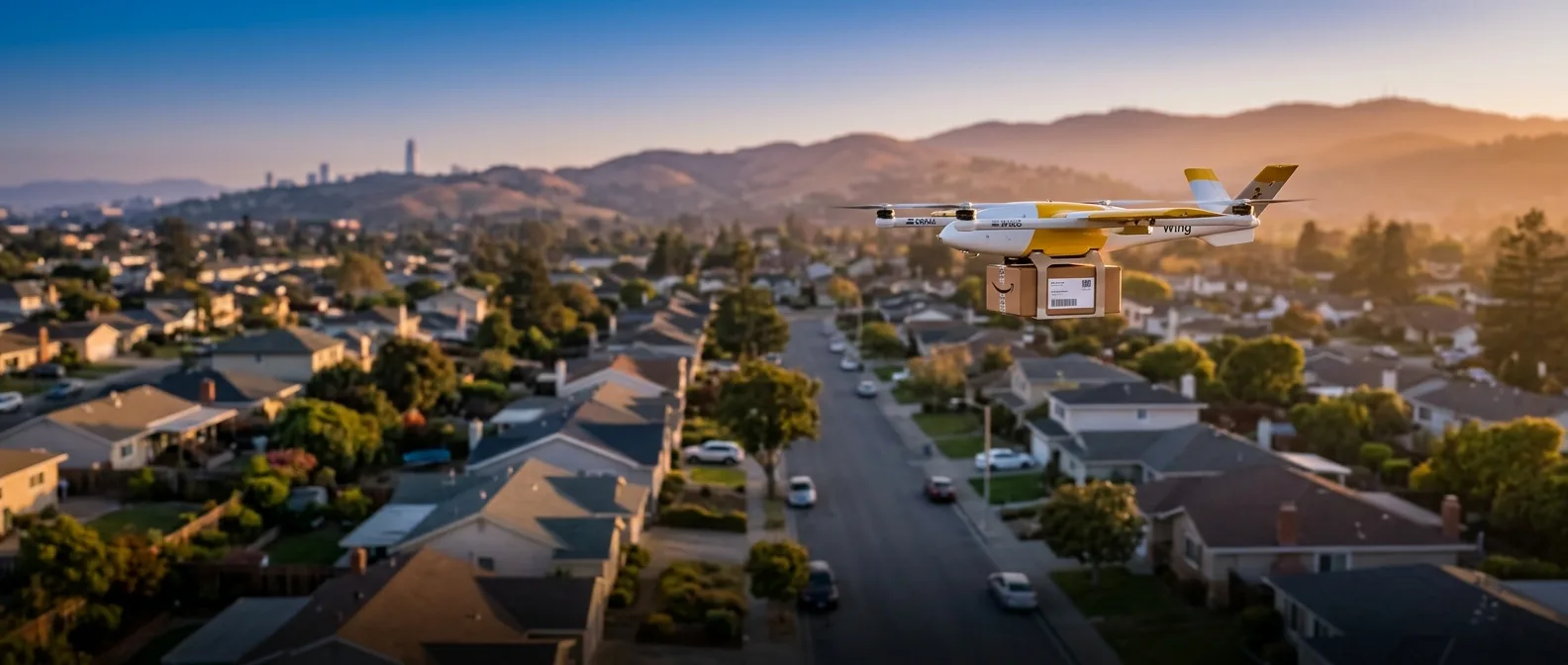
A yellow drone with white trim hovers above Mountain View rooftops. This isn't another tech demo — this is Wing coming home. In 2026, after fourteen years of development and 750,000 deliveries across the US, Alphabet's subsidiary returns to San Francisco Bay Area with a promise: drone delivery in minutes, not hours.
Call it a family reunion. Wing was born in 2012 at Google X — the "Moonshot Factory" that's produced everything from self-driving cars to stratospheric balloons. Their first experiments happened on Mountain View's campus, where Google employees ordered office supplies and received them via drone within minutes. The question they heard constantly? "When can I get this at home?"
📖 Read more: US Drone Exceptions: New Models Added to Import Whitelist
🚁 From Campus to Streets
Today, that vision takes flight. Wing is expanding into the Bay Area, targeting regions where millions live. The plan is simple in theory, complex in execution: lightweight drones carrying small packages to residential areas, delivering them in under 30 minutes.
How fast? Their quickest recorded delivery clocked in under three minutes. What takes an hour by car in traffic, drones accomplish by flying straight.
📦 What They Deliver and How
Wing partners with Walmart and DoorDash for food, pharmacy, and household deliveries. The drones handle packages up to roughly 4.4 pounds — enough for emergency ingredients, snacks, or small tools you forgot to grab.
The process runs through an app. You order from a partner store, the drone loads your package, flies to your area and descends to a safe spot — usually a yard or balcony. You don't need to be there when it arrives.
Technical Specs That Matter
Wing drones are highly automated — no remote pilot controls them. They use AI for navigation, obstacle avoidance and safe landing. The system has backup protocols for bad weather or technical problems.
Each drone can fly several miles from its distribution center. Battery life limits them based on payload weight and weather conditions, but for urban deliveries, range isn't the bottleneck.
🗺️ National Network with 270 Locations
The Bay Area is just one stop in a bigger plan. Wing aims to reach 40+ million Americans by decade's end. Partnering with Walmart, they're planning a network of 270+ drone delivery locations by 2027.
On the expansion list: Los Angeles, Miami, and other major metropolitan areas. The strategy is clear — cover urban centers where last-mile delivery costs more and traffic creates delays.
Partner stores in other cities include Walmart SuperCenters, local pharmacies, and restaurants. For the Bay Area, they haven't announced partners yet — but expect major chains to be involved.
💰 Cost and Economics
Walmart offers drone delivery free to members of its subscription service. For everyone else, it costs about $18 per delivery. Expensive for a bottle of milk, reasonable for an emergency.
The economic logic behind Wing? Drones don't get stuck in traffic, don't need drivers who take breaks, and can make multiple deliveries per hour. Long-term, the model could cost less than traditional delivery — if it achieves scale.
Competition from Amazon
Wing isn't alone in this space. Amazon is testing its own Prime Air service for packages up to 5 pounds. Last week it announced one-hour deliveries in the Los Angeles metropolitan area — without drones for now, but targeting speed.
The difference? Amazon has massive inventory and logistics networks, but Wing has more completed flights and more experience in residential areas.
⚖️ Regulations and Safety
The biggest obstacle for delivery drones isn't technological — it's regulatory. In the US, the FAA (Federal Aviation Administration) has strict rules for commercial drone operations, especially in densely populated areas.
Wing has received permits for operations in specific zones, but each expansion requires new approvals. The Bay Area, with its many airports and dense traffic, will be a challenging test case.
Flight Safety
Automated collision avoidance, backup systems, and controlled airspace management
Designated Zones
Limited operating areas, away from airports and sensitive locations
Privacy Protection
Limited cameras, specific flight paths, data protection protocols
🤔 Will It Actually Work?
Wing has 750,000 successful deliveries under its belt. This isn't a lab experiment — it's an operational service running daily in Dallas, Houston, Atlanta. Residents there use it for convenience, not novelty.
But the Bay Area is different. More density, more regulations, more traffic — and a more skeptical public that's seen plenty of tech promises fail to materialize.
The question isn't whether the technology works — that's been proven. The question is whether people actually want drones flying over their homes for an order they could get by driving ten minutes.
The return to the Bay Area is symbolic — where the vision was born, we'll see if it can live in the real world.
Internal analysis
Residents can already sign up for updates at wing.com. If everything goes well, the next time you run out of milk at 9 PM, you might not need to leave the house. You'll just hear a low hum and see a yellow drone descending into your yard.