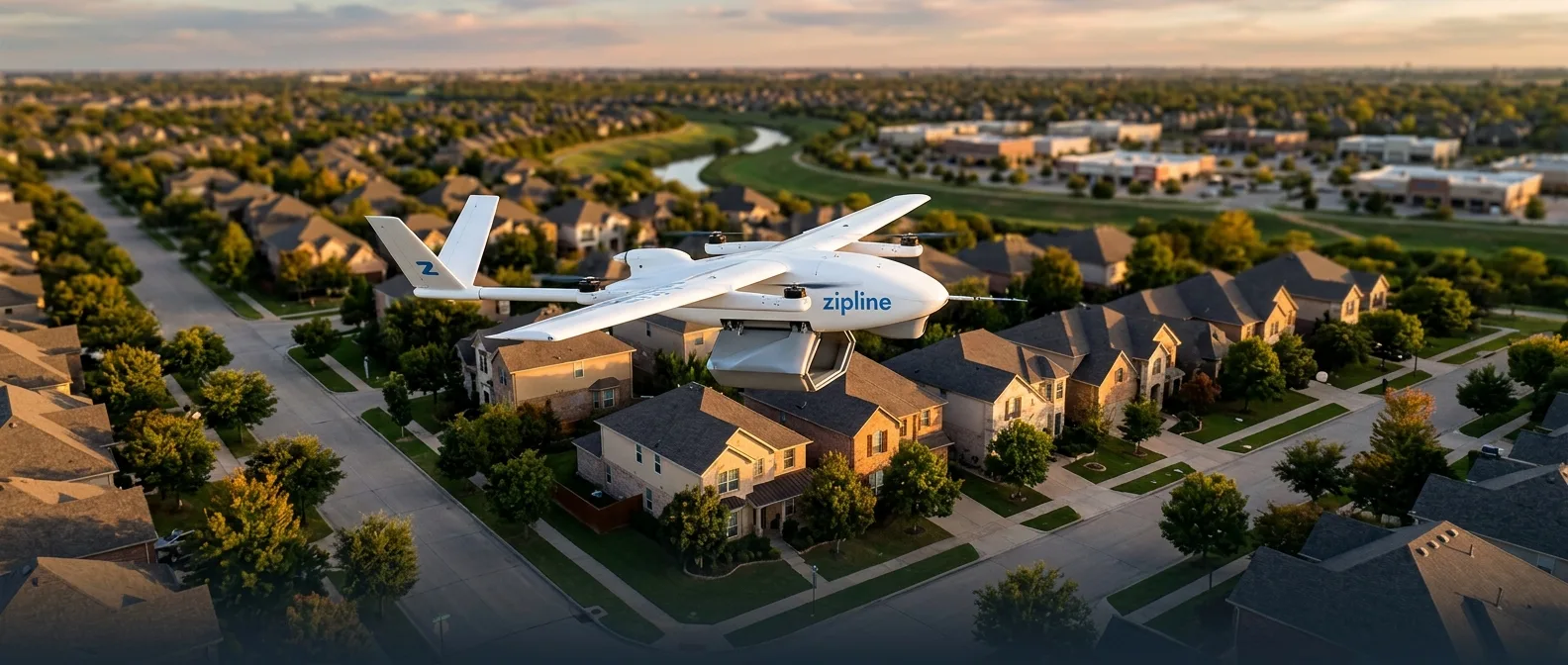
$800 million in funding. 5 million deliveries completed. One startup that's making the sci-fi dream of flying packages real. Zipline just closed another $200 million round — the biggest drone delivery funding of 2026 — and the numbers tell a story that would make Amazon's logistics team sweat.
This isn't some moonshot anymore. The company has raised nearly a billion dollars in three months, with a valuation touching $7.6 billion. Why? Their drone fleet delivers everything from blood bags in Rwanda to Sweetgreen salads in Houston, and they're planning to hit four new US states this year.
The twist? Zipline started in 2014 with a simple mission: deliver blood via drones to rural Africa. Twelve years later, their "Zips" have flown 64 million kilometers and become the undisputed leader in drone logistics worldwide.
🚀 From Rwanda to Houston: The Expansion Numbers
CEO and founder Keller Cliffton isn't hiding his excitement in a video posted to X. "Things are moving a little faster than we expected," he said, announcing the additional funding that included participation from Paradigm — better known for crypto investments.
The numbers speak volumes, but the speed of growth is what's remarkable. In the US, where they've only operated since last year, delivery volumes exceeded projections in January and February. Customers are using the drones multiple times daily for larger orders — and average basket size jumped 20% in three weeks.
The strategy is ambitious: expand to at least four American states in 2026, with confirmed markets in Houston, Phoenix, and Seattle. Meanwhile, the company plans to double the brands on their platform in the next 30 days.
⚡ Platform 2: The New Generation of Silent Drones
At the heart of this revolution sits Platform 2 — known as "Zips." These aren't your typical quadcopters. They fly at 100 meters, have a 16-kilometer range, and generate noise described as "rustling leaves."
The delivery process is remarkably simple — and impressively effective. The drone hovers at 100 meters, lowers the payload (up to 3.6 kg) on a cable, and deposits the package "on a patio table or front steps." The entire process is tracked real-time through an app.
Technical Arsenal
The list of technologies each Zip incorporates is impressive:
- Aerospace Sensing: 360-degree airspace detection
- Fleet Deconfliction: Autonomous fleet management to avoid congestion
- Localization: Centimeter-accurate navigation
- Integrated Maps: Built-in mapping for complex terrain navigation
The key innovation: Autonomous charging. The drones return to docking stations that can attach to any building, recharge, and take on the next mission. They can travel 38.6 kilometers before needing a recharge — meaning multiple stops for long-distance routes.
🏥 From Prescriptions to Salads: The Practical Side
Theoretically it sounds fantastic. But practically, what do these drones actually deliver? The answer might surprise you: everything from prescription medications to fresh Sweetgreen salads.
Zipline's key partnerships: Michigan Medicine, Intermountain Health, MultiCare Health System for pharmaceuticals • Sweetgreen for food • Walmart for general deliveries
During the pandemic, the need for contactless deliveries gave the technology a major boost. Now, Zipline completes a delivery every 90 seconds — a pace that resembles a production line more than drone deliveries.
The larger Platform 1 drones handle long distances (120 miles round trip) and corporate deliveries. P2 focuses on consumers: in the Dallas-Fort Worth Metroplex and Pea Ridge, Arkansas, they partner with Walmart and twelve restaurants.
The African Foundation
Zipline hasn't forgotten its roots. They just closed a new national-scale contract in Rwanda for Platform 2 services in major cities. They're also opening a third distribution center that will serve every hospital and health facility in the country.
What does this mean for Africa? A continent that traditionally struggled with transport infrastructure can now leap-frog into the age of autonomous logistics. Just as mobile phones replaced landlines in Africa, drones might replace roads for last-mile deliveries.
📊 The Battle of Efficiency
Zipline addresses a fundamental inefficiency: 95% of deliveries weigh under 5 kg, but we use trucks that can carry tons. It's like taking a taxi to the corner store.
"Over the last decade, global demand for instant delivery has skyrocketed, but the technology we use is 100 years old. We still use the same internal combustion vehicles for billions of deliveries."
Keller Rinaudo Cliffton, CEO Zipline
The statistics Zipline shares are impressive: deliveries 7 times faster than cars. A 16-kilometer route completes in 10 minutes instead of the traditional process that could take an hour — if you factor in traffic, parking, waiting.
These performance claims need context: Zipline operates under ideal conditions — scheduled routes, known destinations, controlled environment. In the real world, factors like weather, air traffic, urban congestion could change the equation.
🎯 Regulatory Environment and Challenges
One area where Zipline has excelled is regulatory approval. They received FAA approvals for integrated autonomous detect-and-avoid systems and Part 135 certification — giving them clearance for long-range commercial flights in America.
What does this mean for competition? Amazon has had its Prime Air program for years, but still hasn't reached Zipline's scale. Google (Wing), UPS, FedEx — all are testing drone deliveries, but none have combined practical fleets with sustainable business models.
Regulatory Protection
FAA Part 135 certification for commercial flights
Autonomous Detection
Integrated detect-and-avoid system for safety
The big question remains: how will the technology scale? The 1000+ test flights Zipline plans with 100 drones might be impressive, but what happens when thousands of drones fly simultaneously over cities?
The answer lies in the Fleet Deconfliction technology the company developed. Essentially, it's distributed air traffic control that allows drones to communicate with each other and avoid collisions autonomously. If it works in practice like it promises in theory, it could change everything about urban mobility.
🌍 The Future of Autonomous Deliveries
What exactly do these $800 million hide? A look at the investment funds gives us clues: Fidelity, Baillie Gifford, Valor Equity Partners, Tiger Global — all institutional funds that invest in large-scale infrastructure plays. They're not betting on a cool gadget. They're betting on replacing the logistics backbone of the 21st century.
Paradigm's participation is particularly interesting. The company is known for crypto investments, but their involvement with autonomous systems suggests something bigger: blockchain-powered logistics networks. Imagine drones that transact autonomously, pay for fuel, buy parts — a fully decentralized logistics ecosystem.
Zipline's goal is 1 million deliveries by end of 2023 — a number that by their standards represents the technology's infancy. If it spreads as promised, it will change fundamental things: urban planning (fewer delivery trucks), employment (drivers vs. drone operators), even architecture (buildings with drone landing pads).
There's also the energy question. Zipline claims their drones are significantly more energy-efficient than trucks. But what happens when you need thousands of flights per day? The charging infrastructure, electrical consumption, drone manufacturing — all have carbon footprints that need evaluation at scale.
Zipline's track record spans African valleys and American suburbs. The same drones dropping blood supplies in Rwanda now deliver lunch in Texas — proof that the technology translates across vastly different markets.
The question isn't whether we'll see drones in the sky anymore. The question is how quickly we'll get used to not hearing the delivery truck's engine in the neighborhood. And if Zipline is right, that change is coming faster than we imagine — with noise that sounds more like rustling leaves than technological revolution.