⚡ Where Do We Stand Today?
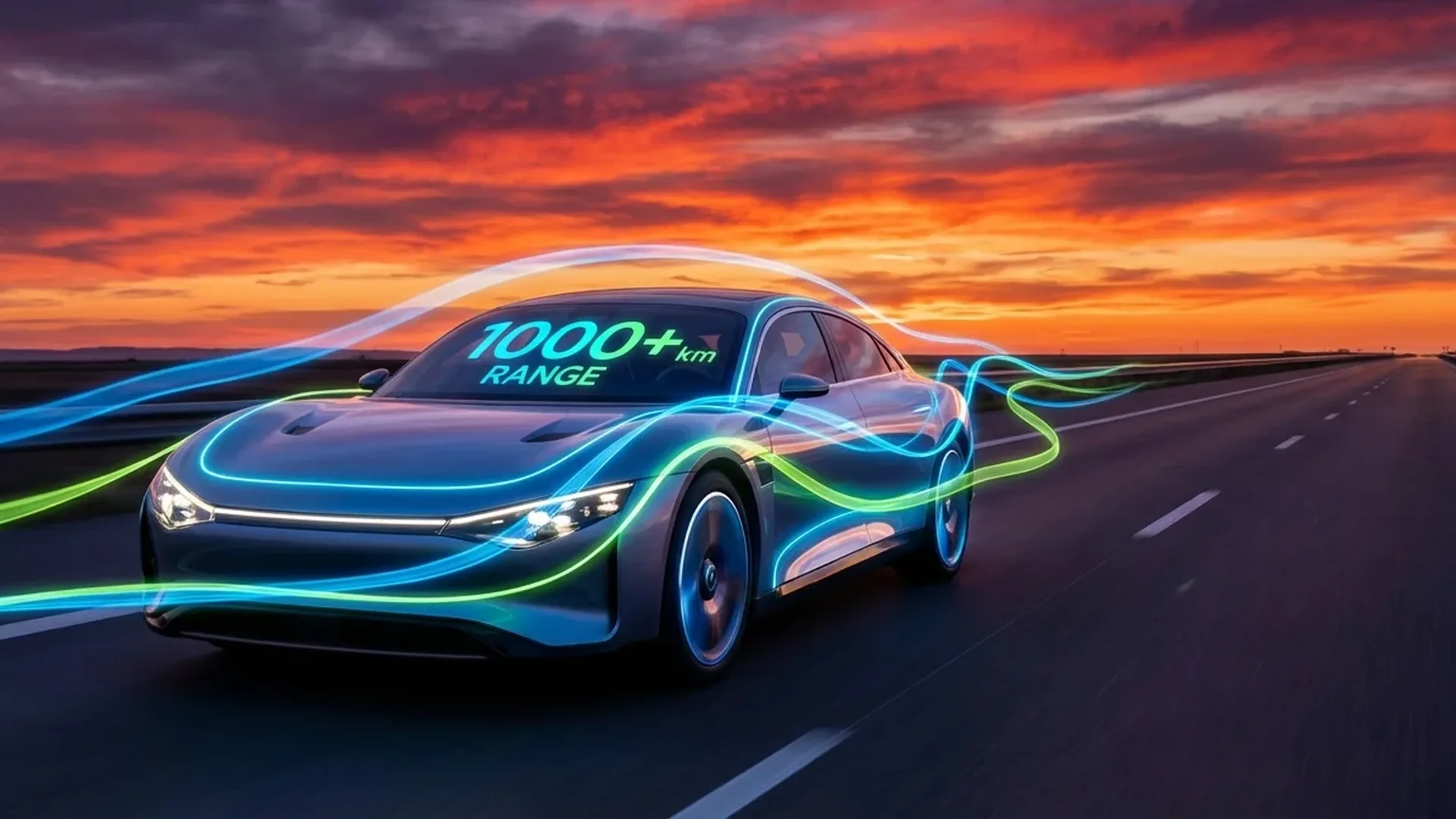
As of February 2026, the best production electric vehicles offer a range between 500 and 760 kilometers under WLTP standards. The Mercedes-Benz Vision EQXX, a prototype not yet in production, managed to cover 1,202 km in real-world conditions — from Stuttgart to Silverstone — with an average consumption of just 8.3 kWh per 100 km. This proves the technology exists, but it hasn't yet reached cars that everyone can buy.
In mass production, CATL — the world's largest battery manufacturer with approximately 38% global market share — unveiled the Shenxing Pro battery in September 2025. It's the world's first LFP (lithium iron phosphate) battery to exceed 758 km of WLTP range, with the ability to charge in just 10 minutes thanks to 12C charging rates.
🔋 The Technologies Paving the Way
To reach 1,000 km of range in production vehicles, there are three main technological paths: optimizing existing lithium batteries, solid-state batteries (SSBs), and drastically reducing energy consumption through aerodynamics and lightweight materials.
Advanced Lithium Batteries
CATL isn't stopping at the Shenxing Pro. The company has already introduced the M3P battery, which replaces the iron in traditional LFP batteries with a combination of magnesium, zinc, and aluminum. The result is 15% greater energy density, reaching 210 Wh/kg — enough to give a midsize sedan roughly 700 km of range with a battery pack similar in size to current LFP units.
Meanwhile, cell-to-pack technology, now widely used by CATL, increases space utilization by 15-20% and doubles production efficiency. The battery is placed directly into the pack without intermediate modules, reducing components by 40% and raising pack-level energy density from 140-150 Wh/kg to 200 Wh/kg.
💡 Why Does Energy Density Matter?
Energy density (Wh/kg) determines how much energy fits into each kilogram of battery. Today's Li-ion batteries typically reach 250-300 Wh/kg at cell level. For 1,000 km of range without an excessively heavy battery, we need at least 350-400 Wh/kg — exactly where solid-state batteries are aiming.
Solid-State Batteries
Solid-state batteries (SSBs) replace the liquid electrolyte with a solid one, allowing the use of lithium metal anodes with much higher capacity. Theoretically, they can exceed 350 Wh/kg at the cell level, while drastically reducing fire risk — the heat generated during thermal runaway is only 20-30% of that produced by conventional batteries.
According to World Intellectual Property Organization (WIPO) data, Toyota leads in SSB patents with 8,274 patents between 2020 and 2023, followed by LG, Samsung, Murata, and Panasonic. Toyota announced in June 2023 that it wouldn't deploy commercial solid-state batteries before at least 2027, while Nissan is targeting FY2028 and Honda 2030.
The reality, however, is that as of January 2026, the SSB market has not yet reached scale or commercial maturity. Many companies had promised GWh-level production by the mid-2020s but still face serious technical challenges.
Aerodynamics & Lightweight Materials — The Secret Weapon
The Mercedes-Benz Vision EQXX proved that you don't need an enormous battery for long range — exceptional aerodynamics will do. With a drag coefficient (Cd) of just 0.17 — the lowest ever in an electric vehicle — the EQXX achieved over 1,000 km with a 100 kWh battery weighing only 1,755 kg. The 900V architecture, special low-resistance Bridgestone tires, and 117 solar panels on the roof all contributed to this record.
From this prototype, Mercedes is already transferring technologies to the new 2026 Mercedes-Benz CLA, which is built on the MMA (Mercedes-Benz Modular Architecture) platform with elements directly from the EQXX. CEO Ola Källenius stated: “The CLA is the EQXX on the road.”
🏭 CATL: The Giant Pushing the Boundaries
CATL (Contemporary Amperex Technology Co. Limited) was founded in 2011 in Ningde, China, as a spin-off from Amperex Technology Limited. Today, with over 131,000 employees, 15 factories worldwide, and revenue of $50.3 billion in 2024, it dominates the global EV battery market.
The company supplies batteries to BMW, Tesla, Volkswagen, Hyundai, Honda, Toyota, Volvo, and dozens of other manufacturers. In December 2024, it announced a 50-50 joint venture with Stellantis for a 50 GWh LFP battery plant in Zaragoza, Spain — a €4.1 billion investment expected to begin production in 2026.
"With unwavering range, charging speed, and durability, the Shenxing Pro is the ultimate solution for electric mobility in Europe."
— Dr. Lingbo Zhu, CTO International Business Unit, CATLBeyond lithium batteries, CATL plans to launch its first sodium-ion batteries in passenger vehicles by Q2 2026. While these won't target long range, they will drastically reduce costs — since sodium is far cheaper and more abundant than lithium.
⚔️ Battery Technology Comparison
Battery Technologies — Where Does Each One Stand?
🚗 Mercedes EQXX: Proof That It's Possible
The Mercedes-Benz Vision EQXX is the most compelling “roadmap” to 1,000 km. Design began in June 2020, and the team included engineers from Mercedes AMG High Performance Powertrains — the F1 engine division.
The 100 kWh battery weighs just 495 kg (30% less than the EQS equivalent) thanks to cell-to-pack technology, and is encased in a sugarcane-carbon fiber composite material. The 900V architecture reduces energy losses, with 95% of the battery's energy reaching the wheels.
The test drives speak for themselves:
- April 2022: Sindelfingen (Germany) → Cassis (France): 1,008 km, 8.7 kWh/100 km
- July 2022: Stuttgart → Silverstone (England): 1,202 km, 8.3 kWh/100 km
- March 2024: Riyadh → Dubai: 1,010 km at 34°C temperatures, 13.5 km/kWh
EQXX technology is already being transferred to the new 2026 Mercedes CLA, which promises to bring some of these achievements to a production car.
🧪 The Remaining Challenges
Despite impressive developments, significant obstacles remain before we see 1,000 km range in affordable vehicles:
Battery Weight
With today's LFP batteries, achieving 1,000 km range requires a 120-150 kWh pack — over 600 kg of battery alone. That means a heavier car that consumes more energy.
Cost
A larger battery means higher cost. Solid-state batteries will initially be very expensive due to production complexity and limited volumes.
Temperature & Pressure
Solid-state batteries require high pressure to maintain electrolyte-electrode contact. Additionally, their performance in cold temperatures remains a concern.
SSB Mass Production
Many companies promised commercial SSBs by the mid-2020s, but as of January 2026, the market hasn't reached scale. The transition from lab to factory remains a challenge.
🔮 When Will We Realistically See Them?
Based on current developments, the most realistic estimates are:
- 2026-2027: Premium EVs (Mercedes, BMW) with 800-900 km WLTP range thanks to improved NMC/M3P batteries and better aerodynamics
- 2027-2028: First production cars with solid-state batteries (Toyota, Nissan) — likely in premium models with limited production
- 2028-2030: Wider availability of models with 1,000+ km range, as SSB technology and high-energy LFP batteries mature
- After 2030: 1,000 km range as standard in the midsize segment, with falling costs
🎯 The Truth Is More Complex
A 1,000 km range may never become the “norm” in the way we imagine. If charging becomes fast enough (10-15 minutes for 300+ km), the need for massive batteries disappears. The CATL Shenxing Pro already shows this path: 478 km of range in 10 minutes of charging. Perhaps the real goal isn't capacity, but charging speed.
📊 The Landscape in Europe
For European drivers, 1,000 km range would mean the ability to drive from Paris to Barcelona or London to Edinburgh without a charging stop — something that today requires at least one stop. But even today's best EVs (500-700 km) already cover most daily needs, since the average European drives less than 50 km per day.
The real change will come when 800+ km range is combined with affordable purchase prices. The introduction of sodium-ion batteries by CATL, expected within 2026, could bring cheaper EVs that, while not reaching 1,000 km, will offer 400-500 km range at prices under €25,000.
🏁 Final Verdict
The 1,000 km range is no longer science fiction — it's an engineering problem being solved step by step. CATL, Mercedes, Toyota, and dozens of other companies are pushing the limits of battery chemistry, aerodynamics, and electronics. The question isn't “if” but “when” — and the answer, based on real data, is before 2030 for premium models.
Until then, ultra-fast charging (10 minutes for 300+ km) may render the question almost academic. Ultimately, what truly matters isn't how far you can go, but how quickly you can get back on the road.