📖 Read more: Robotaxis 2026: When Will We See Them in Europe?
🔢 The 6 Levels of Autonomous Driving (SAE J3016)
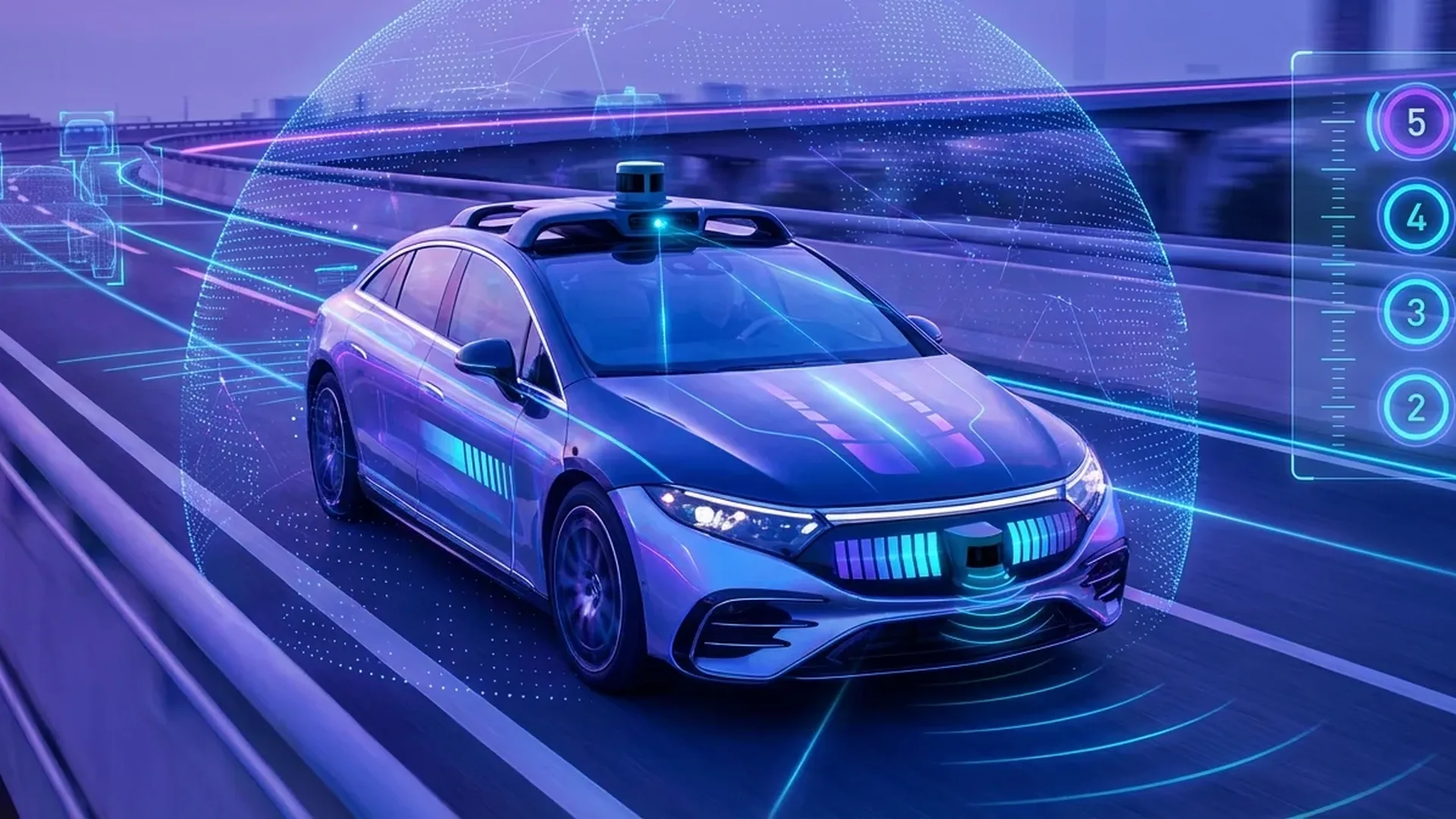
The autonomy levels were defined by SAE International and adopted by the U.S. Department of Transportation. It's a 0-5 scale describing how much control the driver has versus the system. According to Synopsys's automotive guide (Feb 2025), each level works as follows:
📖 Read more: Electric Taxis in Athens: The Change Has Begun
Source: SAE International (J3016), Synopsys Automotive — Feb 2025
🚗 Level 2: Where Most Cars Are Today
Level 2 is what the industry calls ADAS (Advanced Driver Assistance Systems). The car can simultaneously control steering and acceleration/braking — but the driver must monitor at ALL times and be ready to take over.
According to Synopsys, Level 2 systems include:
- Tesla Autopilot — the world's best-known L2 system
- Tesla FSD (Full Self-Driving) Supervised — despite the name, it remains L2 as it requires constant supervision
- Cadillac Super Cruise (GM) — L2 with hands-free highway driving
- Hyundai/Kia Highway Driving Assist 2
- BMW Driving Assistant Professional
- Mercedes-Benz Driver Assistance (L2 mode)
The critical point: at Level 2, legal liability stays with the driver. If there's a crash with L2 engaged, the driver is at fault — not the manufacturer.
⚡ Tesla FSD: The Big Controversy
Tesla's “Full Self-Driving” is perhaps the most controversial ADAS system in the world. Despite the name, it is not “fully autonomous” — Tesla's own website labels it “Supervised.” According to electrek.co:
- December 2025: A California judge ruled Tesla engaged in “deceptive marketing” over FSD. Tesla must fix its advertising within 60 days or lose its sales licence
- January 2026: Tesla stopped selling FSD as a standalone purchase
- July 2025: $16.5B deal with Samsung for HW6 chips — but still no solution for earlier HW3 hardware
- January 2026: Former Waymo CEO John Krafcik called FSD a “bad case of myopia” over its vision-only approach (no LiDAR)
Independent testing (Sep 2024) found that FSD v12.5 required driver intervention every 13 miles — a long way from “full self-driving.”
"Tesla must stop lying or it can't sell cars" — California court ruling in an FSD false advertising case.
📖 Read more: Tesla FSD vs Waymo: Which System Wins?
— electrek.co, December 2025🔓 Level 3: The Big Transition
The leap from Level 2 to Level 3 is enormous from a legal and technical perspective — even though the driver won't notice a huge difference day-to-day. The key: at L3, legal liability shifts to the manufacturer while the system is active.
According to Synopsys, the Audi A8L was the first production car designed as Level 3 (Traffic Jam Pilot), though in the US it was classified as L2 due to regulatory issues. In Germany, it was approved with full L3 capabilities.
Today, the most notable Level 3 systems are:
- Mercedes-Benz DRIVE PILOT — approved in Germany, Nevada, and California. Operates on highways up to 60 km/h (traffic jam conditions)
- Honda SENSING Elite — Level 3 in Japan (Honda Legend, limited production)
- BMW iX/i7 (upcoming) — BMW is developing an L3 system for highway use
Goldman Sachs estimates that by 2030, up to 10% of new global car sales could be Level 3 vehicles.
🤖 Level 4: Robotaxis Are Already Here
Level 4 means the car can drive completely on its own within a predefined area (geofencing) without any human intervention. If something goes wrong, it stops safely by itself — no driver needed.
The dominant player in Level 4 is Waymo (Alphabet/Google). According to TechCrunch:
- February 2026: Waymo raised $16B to expand internationally to London and Tokyo
- February 2026: Driverless testing launched in Nashville
- January 2026: Public robotaxi service opened in Miami
- January 2026: Rides to/from SFO airport (San Francisco)
- January 2026: New York governor cleared the path for robotaxis statewide (except Manhattan)
- December 2025: Robotaxi ride volumes “skyrocketed” according to an investor letter
Waymo uses a multi-sensor approach: LiDAR + cameras + radar. This differs fundamentally from Tesla's vision-only strategy and is considered safer — though significantly more expensive.
However, it's not all smooth sailing. Austin data (Feb 2026) showed robotaxis crashed at 4x the rate of human drivers. The NTSB (National Transportation Safety Board) is investigating Waymo over school bus violations.
📖 Read more: EV 2030: What Experts Predict for the Future
Where Robotaxis Operate Today (Feb 2026)
- Waymo: Phoenix, San Francisco (+ SFO), Los Angeles, Austin, Miami, Nashville (testing)
- Cruise (GM): Operations suspended after an accident (Oct 2023), future uncertain
- Baidu Apollo: China (Beijing, Shanghai, Shenzhen, Wuhan)
- Pony.ai: China + US testing
🌌 Level 5: The Ultimate Goal — Still Far Away
At Level 5, the car wouldn't need a steering wheel, pedals, or human attention. It could go anywhere, in any conditions — snow, rain, rural roads, foreign cities. The passenger simply says “take me there” and falls asleep.
According to Synopsys: no Level 5 vehicle is available to the public today. Prototypes are being tested in a few locations worldwide, but full autonomy remains a challenge — both technologically and legally.
The main obstacles:
- Edge cases: Unpredictable situations (animals, unusual weather, dirt roads)
- Cybersecurity: Every “connected” car is a potential hacking target
- Legislation: Who's liable in a crash? The company, the owner, or the software developer?
- Cost: Sensor systems (LiDAR, radar, cameras) remain expensive
🇪🇺 What Does This Mean for Europe?
In the EU, the autonomous driving reality is more restrained. The majority of new cars sold today come with Level 1 or 2 systems (adaptive cruise, lane keep assist). Mercedes DRIVE PILOT (L3) hasn't been fully approved across the EU yet, though European legislation (UN Regulation 157) permits L3 on highways at up to 60 km/h.
As for robotaxis (L4)? Europe doesn't yet have a regulatory framework. Athens, Berlin, and Paris aren't on any company's roadmap — but the momentum (Waymo: London, Tokyo) suggests Europe will follow soon.
📊 Summary: Where We Stand in 2026
- Level 2: The norm — Tesla Autopilot/FSD, Super Cruise, Highway Driving Assist. Hands on the wheel.
- Level 3: Mercedes DRIVE PILOT in Germany/California. Limited operation (highway, < 60 km/h).
- Level 4: Waymo robotaxis in 6+ US cities, Baidu in China. Geofenced, no driver.
- Level 5: None available to the public. Estimated: 2030+ at the earliest.
Autonomous driving isn't “one thing” — it's a 6-level scale with enormous differences between each step. Saying a car “drives itself” without specifying the level is misleading — something even a California court recognised recently.