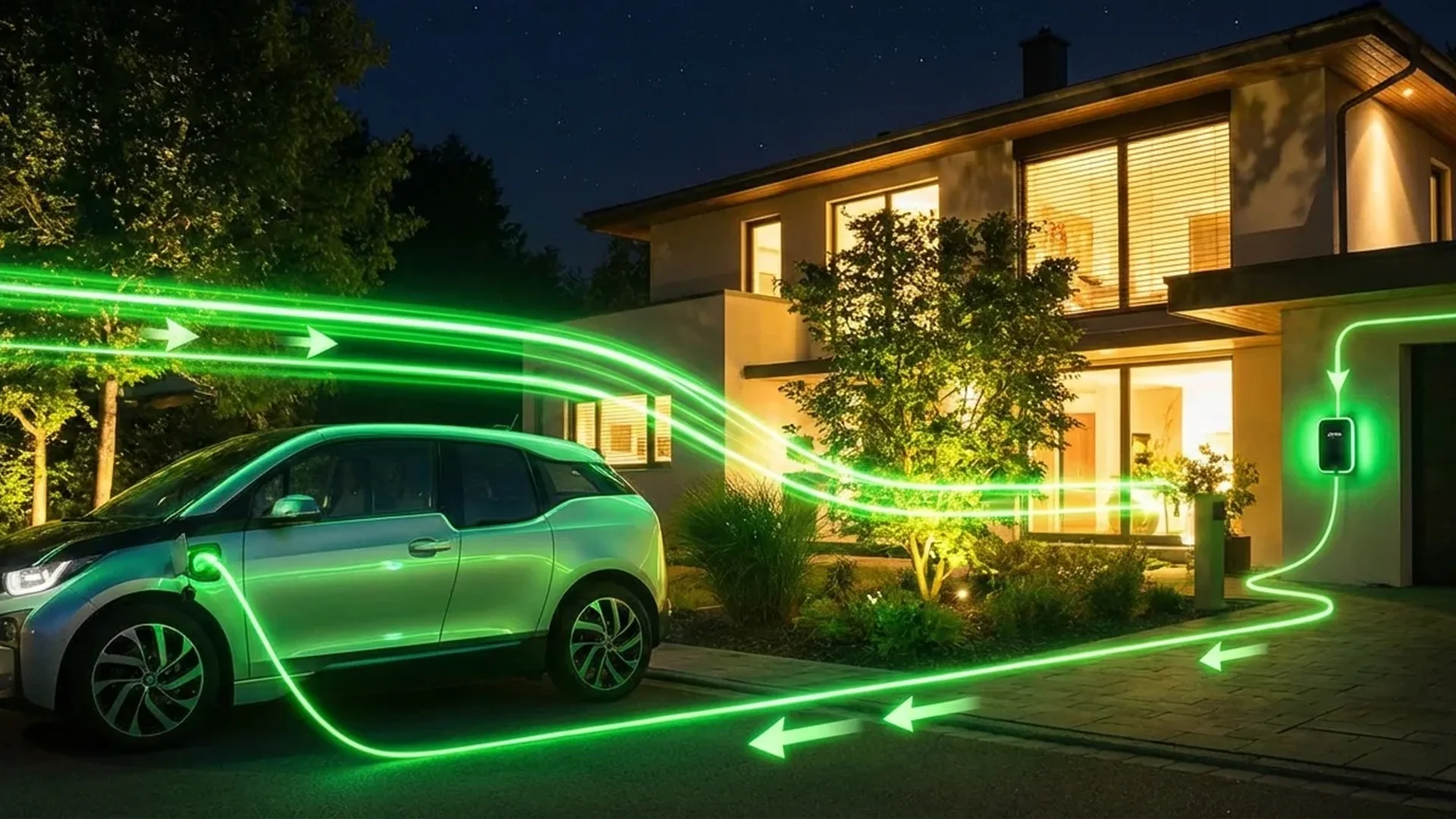
Imagine your electric car not just as transportation, but as a massive portable battery capable of powering your entire home during a blackout. Bidirectional charging turns this idea into reality — and in 2026, it's going mainstream.
📖 Read more: Lucid Air: 800+ km Range Explained
What V2H, V2L & V2G Mean
V2H
Vehicle-to-Home
Your EV powers household appliances during a blackout or reduces your electricity bill by using cheap off-peak energy stored in the battery.
V2L
Vehicle-to-Load
A built-in 120/240V outlet on the car. Charge your laptop, power tools, or go camping with electricity — no external equipment needed.
V2G
Your EV sells energy back to the grid during peak hours. The owner earns money and the grid is stabilized — a win-win.
How It Works in Practice
In conventional charging, electricity flows one way: from the grid (AC) → through a converter → to the battery (DC). With bidirectional charging, the flow reverses: the battery can export energy back out through a built-in or external inverter.
Example
A typical EV with a 77 kWh battery can power an average US household (about 30 kWh/day) for 2-3 days during a complete blackout — without fully draining the battery.
For V2H you need a specialized bidirectional charger installed at home (e.g., Ford Charge Station Pro, Wallbox Quasar 2, dcbel). This acts as a “bridge” between the car and your electrical panel, automatically managing energy flow.
📖 Read more: One Pedal Driving: How It Works in EVs
Compatible Models (2026)
| Model | V2L | V2H | V2G |
|---|---|---|---|
| Ford F-150 Lightning | ✅ | ✅ | ✅ |
| Hyundai IONIQ 5 | ✅ | ✅ | ✅ |
| Kia EV6 / EV9 | ✅ | ✅ | Pilot |
| Nissan LEAF / Ariya | ✅ | ✅ | ✅ |
| VW ID.4 / ID.5 | — | Soon | ✅ |
| BMW iX / i4 / i5 | — | Soon | ✅ |
| Porsche Taycan | — | Pilot | ✅ |
ChargeScape, a joint venture by BMW, Ford, Honda, and Nissan, is working on a unified V2G protocol across all models (electrek.co, Oct. 2024).
Real-World Examples
Ford + Sunrun: First US V2G Home
In September 2025, Sunrun and BGE (Maryland) launched the first residential V2G “power plant” in the US using Ford F-150 Lightning trucks. The trucks export energy to the grid 5-9 PM on weekdays, earning owners up to $1,000/season.
Massachusetts: Free V2X Chargers
In February 2026, MassCEC announced a program providing free bidirectional chargers to 5 school districts, 4 municipalities, and 30 households. Target: 1+ MW of power during peak demand — enough for ~300 homes.
Netherlands: The First “Bidirectional City”
Hyundai and We Drive Solar deployed a fleet of 25 IONIQ 5s with V2G in Utrecht, creating the world's first “bidirectional city”. The cars power homes and businesses during peak hours.
Winemaker + Nissan LEAF = Profit
A winemaker with a $6,000/year electricity bill installed solar + V2G with a Nissan LEAF. He stores energy during the day and feeds it back at night. Result: savings + extra profit from selling surplus power.
Why Bidirectional Charging Is a Game-Changer
Several factors make bidirectional charging increasingly attractive for EV owners:
- Blackout protection — A V2H system acts as an automatic backup generator during power outages, especially valuable in rural or island communities
- Peak shaving — Charge your EV on cheap off-peak electricity, then power your home during expensive peak hours to cut your bill
- Solar synergy — Rooftop solar panels charge your EV for free during the day; V2H uses that stored energy at night
- Grid revenue — V2G lets you sell energy back to utilities during peak demand, earning up to $1,000/season in pilot programs
- Regulation momentum — California is already legislating mandatory bidirectional charging for future EVs, with the EU expected to follow by 2028
Equipment Cost & Payback
Combined with rooftop solar, payback can drop to 2-3 years. Massachusetts already provides free equipment to residents, and many states are expected to follow with similar incentive programs.
The Future Is Bidirectional
Bidirectional charging transforms every EV into an energy hub. With Ford, Hyundai, Nissan, BMW, and Porsche already supporting V2G, and government programs distributing free equipment, this technology is no longer “futuristic” — it's here. As Massachusetts Secretary Rebecca Tepper put it: “Virtual power plants are the future of our electrical grid.”