What Is the BYD Blade Battery?
The Blade Battery is a lithium iron phosphate (LFP / LiFePO₄) battery designed and manufactured by FinDreams Battery, a subsidiary of BYD Company. It was officially launched in March 2020 and first used in the BYD Han EV in July of that year.
The name “Blade” comes from the cell form factor: they are extremely long and thin prismatic cells that resemble blades. Each cell measures 96 centimetres long, just 1.35 centimetres wide, and 11.8 centimetres tall. The cells are arranged in rows inside the battery pack like blades, eliminating the need for intermediate modules.
LFP Chemistry: Inherent Safety
LiFePO₄ (LFP) chemistry differs fundamentally from the NMC (nickel-manganese-cobalt) and NCA (nickel-cobalt-aluminium) chemistries used by most competitors. The key difference lies in thermal stability: LFP cells won't catch fire or explode even when mechanically damaged.
This is because the phosphorus-oxygen bond in LFP's olivine crystal structure is exceptionally strong. Unlike layered oxides (NMC/NCA), the LFP structure does not release oxygen when overheated — and without oxygen, there is no combustion. This inherent chemical safety allows BYD to design battery packs without the heavy and expensive safety systems that ternary batteries require.
Why LFP Doesn't Catch Fire
The P-O bond in LiFePO₄'s olivine crystal structure remains stable up to 600°C. By contrast, NMC cells begin decomposing at 210°C, releasing oxygen that fuels thermal runaway. This ~400°C difference explains why LFP is considered the safest lithium chemistry.
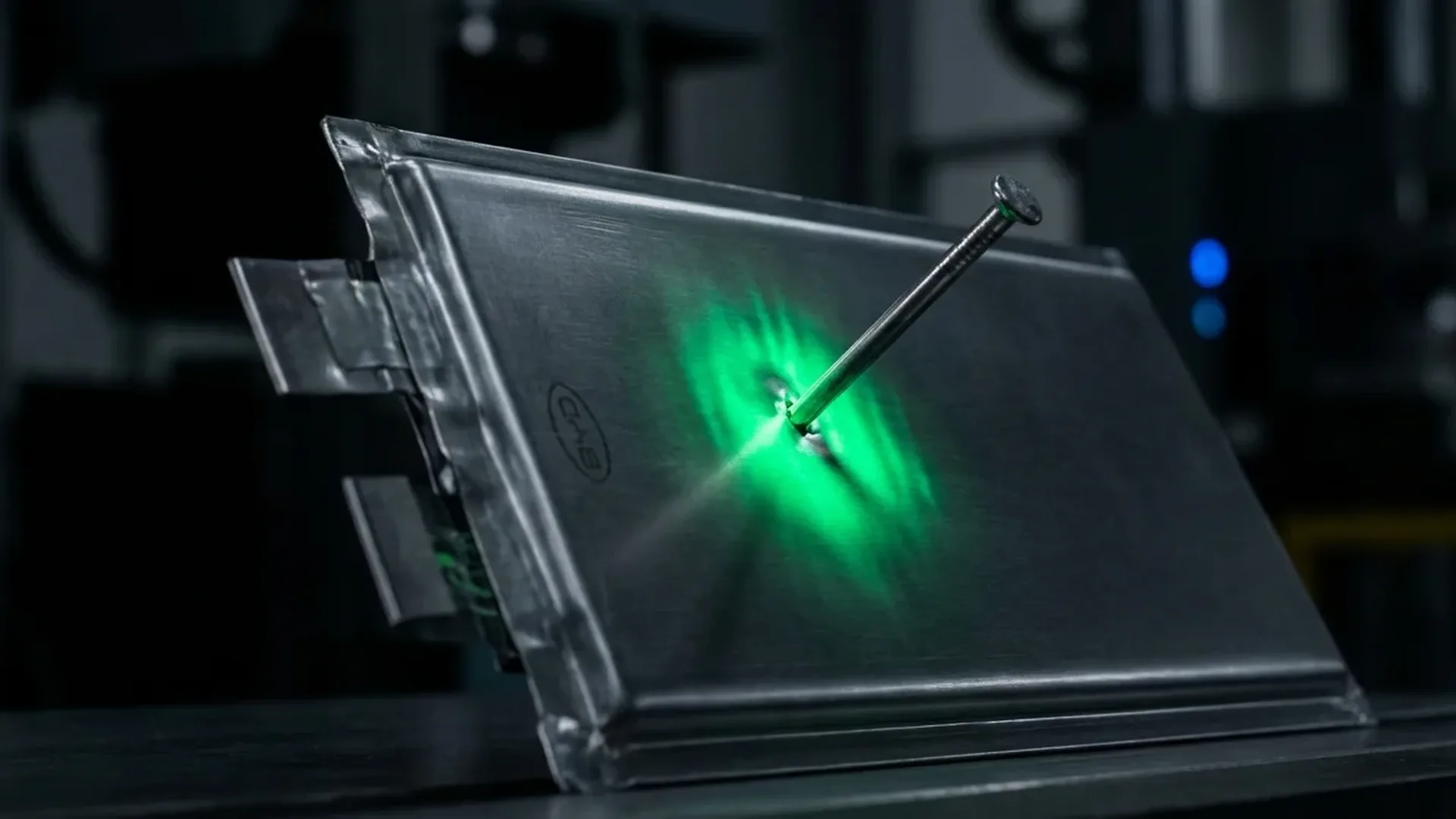
Nail Penetration Test: The Test That Made History
In March 2020, BYD released a video that went viral: three battery cells — a ternary (NMC), a standard LFP, and a Blade — were pierced by a steel nail. The results were dramatic:
The ternary cell caught fire immediately, with surface temperatures exceeding 500°C. The standard LFP didn't burn but generated significant heat — above 200°C. The Blade Battery produced no smoke or fire, and its surface temperature stayed between 30-60°C — cool enough to touch by hand.
But the nail test was just the beginning. BYD subjected the Blade Battery to a series of extreme tests:
- Crushing and bending — no fire or explosion
- Furnace heating to 300°C — no issues
- 260% overcharging — remained stable with no thermal runaway
- Short-circuiting — controlled reaction with no danger
"EVs equipped with the Blade Battery would be far less susceptible to catching fire — even when they are severely damaged."
— BYD, official statement 2020Cell-to-Pack: The Packaging Innovation
The Blade Battery's secret weapon isn't just chemistry — it's the packaging architecture. Unlike conventional batteries that follow a cell → module → pack structure, the Blade Battery uses a Cell-to-Pack (CTP) design: the long cells are placed directly into the pack, eliminating intermediate modules entirely.
This increases space utilisation by over 50% compared to conventional prismatic LFP cells. The large, thin cells also serve as structural elements of the pack, adding rigidity. This design dramatically reduces weight, complexity, and cost.
With the newer e-Platform 3.0 (2021), BYD went even further with Cell-to-Body (CTB) technology: Blade cells are integrated directly into the vehicle chassis, replacing part of the floor. This increases torsional rigidity by 20% while further reducing weight.
LFP Blade vs NMC: Feature Comparison
While NMC batteries excel in energy density, the Blade Battery makes up for this through its more efficient CTP design. At pack level, the range gap narrows considerably, while on cost, longevity, and safety, the Blade wins on every metric.
Which BYD Models Use the Blade Battery
Since April 2021, every pure electric BYD vehicle is exclusively fitted with the Blade Battery. This includes an impressive lineup:
Ocean Series
- • BYD Dolphin — Compact hatchback
- • BYD Seal — Sedan, Model 3 rival
- • BYD Sealion 7 — Coupé SUV
- • BYD Seagull — Ultra-affordable small EV
Dynasty & Premium
- • BYD Han EV — Flagship sedan
- • BYD Tang EV — Full-size 7-seat SUV
- • BYD Atto 3 — Compact SUV (Yuan Plus)
- • Denza D9 EV — Premium MPV
BYD doesn't keep the Blade Battery exclusively for its own models. The Toyota bZ3 — a Toyota-BYD joint venture for the Chinese market — also uses Blade cells. There were even reports that Tesla explored using Blade Battery in some models.
The Evolution: Flash Charging Battery and Super e-Platform
In March 2025, BYD unveiled the next generation of Blade cells branded as the Flash Charging Battery, part of the new Super e-Platform. The new cells support:
In practice, the new Flash Charging Battery can add 400 kilometres of range in just 5 minutes — a charging rate comparable to filling up with petrol. The first models on the new platform are the BYD Han L EV and BYD Tang L EV, capable of 0-100 km/h in just 2.7 seconds.
BYD plans to deploy over 4,000 megawatt-class stations across China, with the first 500 already operational. Each station includes integrated energy storage systems to avoid straining the power grid.
Cost, Sustainability, and Vertical Integration
One of the Blade Battery's biggest advantages is cost. According to analysis by Everbright Securities, the Blade pack costs approximately 420 yuan (€55) per kWh — significantly less than the 570 yuan for a generic CTP LFP pack or 650 yuan for an LFP pack with modules.
This cost advantage stems from BYD's vertical integration. Over 70% of a BYD vehicle's components are manufactured in-house — batteries, electric motors, electronic controls, even the manufacturing tools themselves. A teardown analysis by UBS revealed that the BYD Seal uses 75% internally manufactured components, versus just 46% for the made-in-China Tesla Model 3.
LFP chemistry also offers a sustainability advantage. It contains no cobalt — a rare metal linked to problematic mining conditions in the Congo — and iron is one of the most abundant elements on Earth. Combined with 3,000+ cycle longevity, the Blade Battery is one of the most sustainable energy storage solutions available.
What This Means for Europe
BYD is expanding aggressively across Europe, with models like the Atto 3, Dolphin, Seal, and Sealion 7 already available in many countries. The company is building a factory in Szeged, Hungary — its first European passenger vehicle plant — while another is under construction in Manisa, Turkey, with annual capacity for 150,000 vehicles.
For European consumers, the Blade Battery means access to EVs with an exceptional price-to-value-to-safety ratio. The BYD Dolphin, for example, starts below €30,000 in Europe, while its battery promises years of reliable service with no fire risk or premature degradation. With a 3,000+ cycle life, a BYD with Blade Battery can theoretically cover over 1,000,000 kilometres before the battery drops to 80% of its original capacity.
Key Takeaways
- The Blade Battery uses LFP chemistry — inherently safer than NMC/NCA
- It passed nail penetration testing without fire (30-60°C vs 500°C+ for NMC)
- CTP/CTB design cuts costs by 35%+ compared to module-based packs
- Over 3,000 cycle life — up to 1 million km potential
- The new Flash Charging Battery adds 400 km in 5 minutes
- Cobalt-free — more sustainable and ethical supply chain