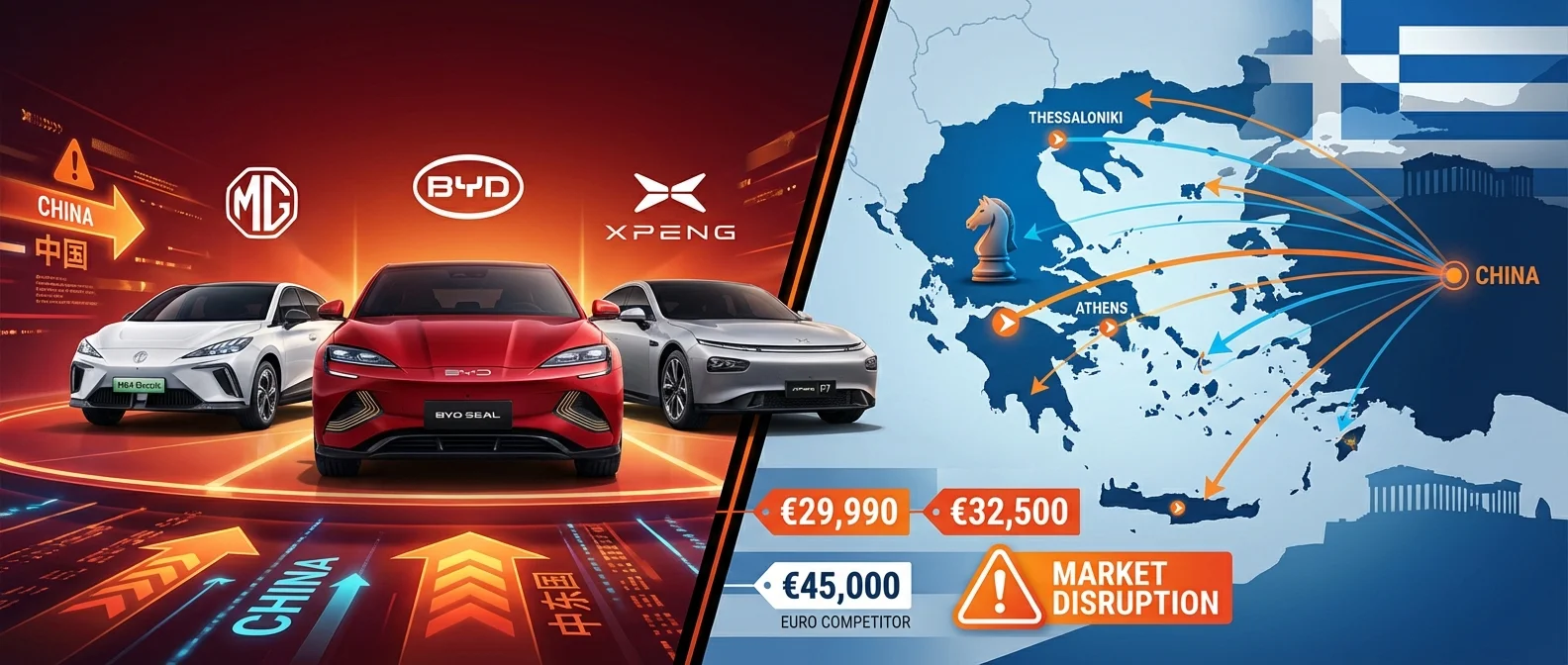
Greece is in the crosshairs of the largest Chinese automakers — and this is no coincidence. With zero domestic car production since 1992, an aging vehicle fleet, generous government subsidies, and growing demand for affordable electric mobility, the country represents an ideal entry point for Chinese EVs into Southeastern Europe.
Why Greece Is a Strategic Target
The Greek car market presents a unique combination of characteristics that make it extremely attractive for Chinese EV manufacturers:
Zero Domestic Production
According to Wikipedia, Greece has had no large-scale car production line since 1992. All assembly plants (Opel Kadett, Alfa Romeo, Datsun/Nissan, Mazda) in Volos and Athens have closed. This means 100% dependence on imports — an ideal landscape for new players.
Aging Vehicle Fleet
Greece has one of the oldest vehicle fleets in the EU, with an average car age of over 16 years. Millions of vehicles need replacement, and affordable Chinese EVs can fill this gap.
Price Sensitivity
After a decade of economic crisis, Greek consumers are particularly price-sensitive. Chinese EVs cost on average 20% less (~€10,000) than their European counterparts — a massive advantage.
Generous Subsidies
The «Kinoumai Ilektrika 3» (Go Electric 3) program offers subsidies up to €8,400 (€3,000 base + bonuses). Combined with road tax exemptions (Law 4710/2020), a Chinese EV priced at €25,000 can drop below €17,000.
The Greek EV Market in Numbers
According to Wikipedia data (Plug-in electric vehicles in Greece), the Greek EV market is growing rapidly but starting from a very low base:
Why the low numbers are an opportunity: An 11.8% share means a huge remaining 88.2% of consumers still buying gasoline/diesel. Chinese manufacturers see this gap as an untapped market — especially in the sub-€30,000 category where there aren't many European alternatives.
The Entry Strategy: Who & How
Chinese companies are not entering Greece randomly. Each one follows a different strategy:
BYD — The «Leading Player»
Strategy: Direct entry with own dealerships and premium positioning. With 4.27 million global sales in 2024, BYD surpassed Tesla in Europe in April 2025.
Advantage: Vertical integration (proprietary Blade batteries) and a factory in Hungary (2026) that reduces logistics costs and avoids tariffs (17.4%).
Key models: BYD Atto 3, Seal U, Dolphin — priced €25,000-€42,000.
MG (SAIC) — The «Pioneer»
Strategy: Leveraging its British heritage (est. 1924) for European brand recognition. MG is already present in Greece with a dealership network.
Challenge: SAIC faces the highest EU tariff: 37.6%. However, MG sold 840,000 vehicles globally in 2023, 88% outside China.
Key models: MG4 Electric, MG ZS EV — prices from €22,000.
Chery — The «Strategist»
Strategy: Multi-brand approach with three distinct brands (Omoda, Jaecoo, Exlantix) for different audiences. China's largest exporter for 23 consecutive years, with 1.14 million exports in 2024.
Advantage: A $1 billion factory in Turkey and a factory in Barcelona — an ideal geographic location for the Mediterranean.
Key models: Omoda 5 EV, Jaecoo 7 — prices from €24,000.
Geographic Strategy: The Mediterranean «Gateway»
Greece's geographic location serves as a strategic advantage for Chinese manufacturers:
Port of Piraeus
Controlled by COSCO (China), it serves as the main gateway for Chinese products into Europe. Cars arrive directly without intermediaries.
Proximity to Factories
BYD Hungary, Chery Barcelona/Turkey — Greece is within close range, reducing shipping costs and delivery times.
Test Market
Greece serves as a «pilot market» for Cyprus, the Balkans, and the Southeastern Mediterranean. Success here means expansion to 50+ million consumers.
The European «Walls»: Tariffs & How They Bypass Them
The EU imposed additional tariffs on Chinese EVs to offset state subsidies. But Chinese manufacturers are responding strategically:
Important: When a BYD is manufactured in Hungary, it loses its «Chinese» classification for tariff purposes. This means the selling price in Greece will drop even further after 2026.
Why Europe Can't Compete in Greece
The European auto industry focuses on premium models (VW ID.4 from €42,000, BMW iX1 from €50,000). In the sub-€30,000 category — where the average Greek consumer is looking — alternatives are scarce:
The critical gap lies below €30,000 — precisely where Chinese brands have the advantage due to lower production costs, proprietary batteries, and state incentives in China.
The Dealership Network: Key to Conquest
Having a physical dealership is critical in the Greek market — Greek consumers want a physical point of sale and service:
Already Present
- MG: Network in Athens, Thessaloniki, major cities
- BYD: Dealership through official importer
- GWM (Great Wall): Presence through local partner
Expected (2025-2026)
- Chery (Omoda/Jaecoo): Seeking local importers
- XPeng: Focus on premium EV segment
- Leapmotor (via Stellantis): Leveraging Peugeot/Citroën network
Charging Infrastructure: Challenge & Opportunity
Greece has approximately 1,700 public charging stations (June 2022), with a ratio of just 1 charger per 250 km of road. Athens had only 62 public chargers in August 2022 — the 6th worst ratio among European capitals.
Why this helps the Chinese: Some manufacturers, like BYD and NIO, offer their own charging solutions — from portable chargers to battery swap stations. NIO is already developing a swap station network across Europe. This means they can «bring» the infrastructure along with the cars.
Additionally, Athens is planning a Zero Emission Zone by 2025, a measure that will dramatically increase demand for electric cars in the city center — exactly where small, affordable Chinese EVs (BYD Dolphin, MG4) are an ideal fit.
What It Means for the Greek Consumer
Positives
- More choices: New models at prices Europeans don't offer
- Price competition: Pressure on BMW, VW, Stellantis to lower prices
- Technology: Top-tier infotainment, OTA updates, ADAS systems
- Accessibility: EVs become a «normal» purchase, not luxury
Concerns
- After-sales: The service network is still sparse
- Spare parts: Wait times may be longer
- Resale value: Uncertainty — Chinese brands have no track record in Greece
- Data privacy: Questions about driving data management
Forecast: Greece from 2027 to 2030
2026
BYD Hungary factory launches. Chinese EV prices drop 10-15% due to zero tariffs. Chery officially enters Greece.
2027-2028
Chinese brands capture 15-20% EV market share. Europeans respond with their own budget models. Competition benefits the consumer.
2030+
Ahead of the EU's new ICE ban (2035), Greece becomes fully dependent on EV imports. Chinese manufacturers established with 5+ brands.
Conclusion
Greece is not simply «just another target» — it is the ideal gateway into Southeastern Europe. Zero domestic production (since 1992), 100% import dependence, an aging fleet, generous subsidies (€8,400), and price sensitivity create the perfect environment for Chinese EVs. Piraeus (COSCO) provides logistics, factories in Hungary/Barcelona/Turkey reduce tariffs, and the EU 2035 ban guarantees long-term demand. For the Greek consumer, this means more choices at lower prices — as long as they carefully check the service network and warranty before buying.
Related Articles
Chinese Electric Cars in Greece 2026
BYD, MG, Chery: The models, prices and how they compare
Electric Car Subsidy 2026
How to get up to €8,400 for an EV purchase
EU 2035: Gasoline & Diesel Ban
What the ICE ban means for Greek drivers