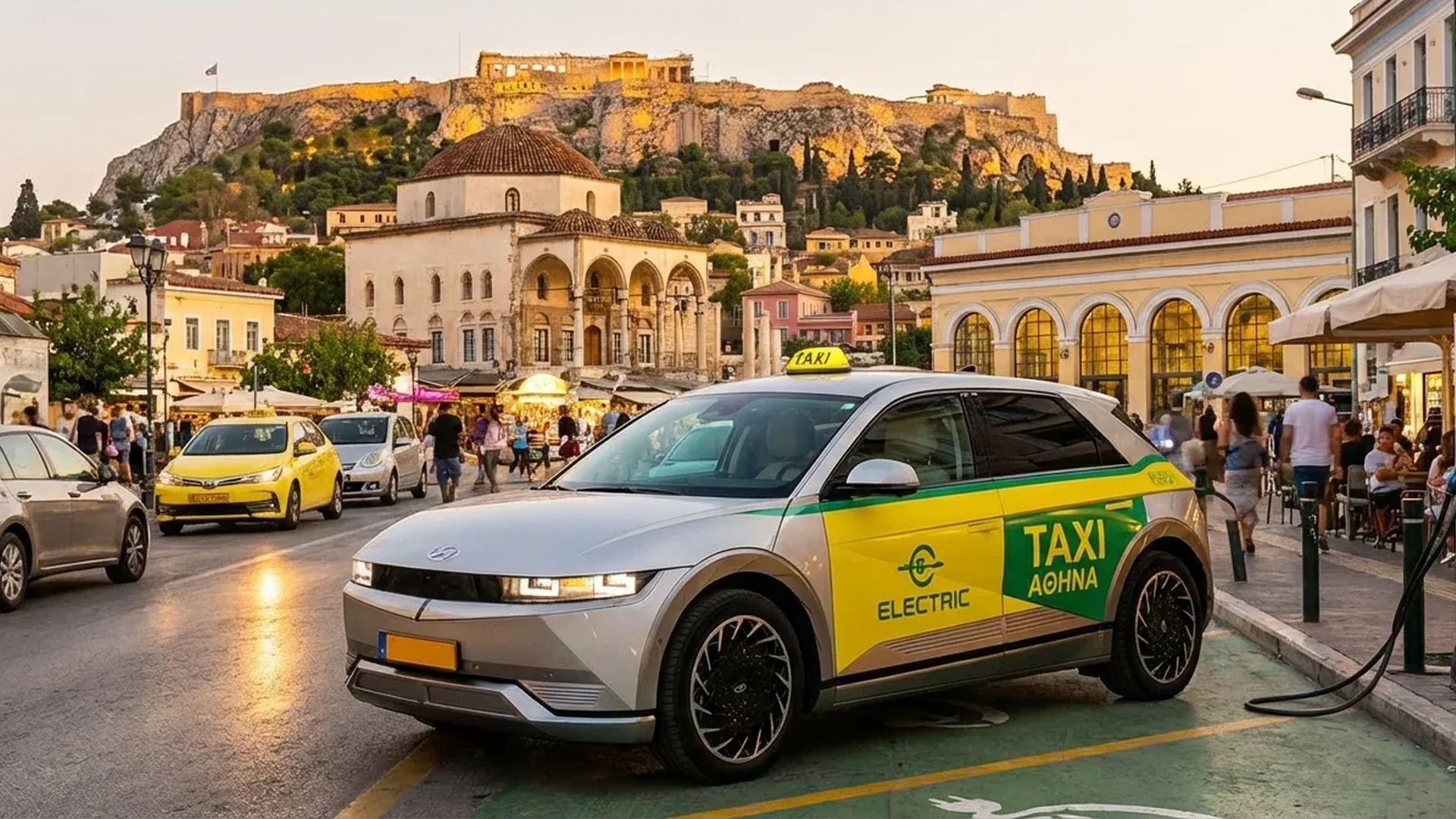
When you step into an Athens taxi, the first sensations are usually the rumble of a diesel engine and a faint smell of fuel. Now imagine something entirely different: silent acceleration, zero emissions, a smooth ride. This isn't a future scenario — it's a change already unfolding on the streets of the Greek capital.
Why Electric Taxis Are Inevitable
Athens, with a metropolitan population exceeding 3.6 million, faces chronic air-pollution and traffic-congestion issues. Taxis covering an average of 200–300 km daily across the urban network are a significant source of CO₂ and particulate emissions. The shift to EVs isn't merely an environmental aspiration — it's a business imperative.
According to the latest data, Greece's EV market is growing impressively, with BEV and PHEV sales rising by 36% in 2024. The electric-vehicle market share in Greece has reached 12.4%, demonstrating that Greek society is steadily — if gradually — embracing electromobility.
Government Support: Subsidies Specifically for Taxis
Prime Minister Kyriakos Mitsotakis announced a comprehensive electromobility plan in June 2020 with a budget of €100 million for the first 18-month phase, estimated to cover roughly 14,000 new electric vehicles. The most interesting element concerns the enhanced subsidies for professional vehicles.
While private cars receive a 15% subsidy up to €5,500, taxis enjoy preferential treatment:
- ▸ 25% subsidy up to €8,000 for purchasing an electric taxi
- ▸ €2,500 scrappage bonus when retiring an old vehicle
- ▸ Total benefit with ecological bonus and tax exemptions approaches €10,000
- ▸ Charging expenses are exempt from taxable income
These are the most generous subsidies the Greek government has ever offered professional drivers, clearly signalling the commitment to a green transition of the taxi fleet.
Models Currently Used as Taxis
Which EVs can handle the demands of a taxi operating 10–12 hours a day on Athens' streets? Range, boot space and battery durability are the key criteria.
| Model | Range | Fast Charge | Price from |
|---|---|---|---|
| Tesla Model 3 | 317–423 mi | 15→80% in 25 min | ~$42,000 |
| BYD Seal | 323–354 mi | 10→80% in 26 min | ~$38,000 |
| Hyundai Ioniq 6 | 323–382 mi | 10→80% in 18 min | ~$46,000 |
| MG4 Extended | 270–323 mi | 10→80% in 35 min | ~$30,000 |
* Prices are list prices before subsidies. Real-world range varies with conditions.
The Tesla Model 3 has emerged as a popular choice among early electric taxi drivers, mainly due to access to the Supercharger network. However, Chinese models such as the BYD Seal offer competitive purchase costs, while the Hyundai Ioniq 6 impresses with its exceptionally fast 800 V charging speed.
Running Costs: Diesel vs Electric
The most persuasive reason to switch isn't environmental — it's financial. A taxi covering roughly 60,000 km per year shows a dramatic difference in fuel/energy costs.
Annual Running Cost (60,000 km / 37,000 mi)
Diesel taxi: Consumption ~7 L/100 km × €1.55/L = ~€6,500 fuel + servicing ~€1,200 = ~€7,700
Electric taxi: Consumption ~16 kWh/100 km × €0.25/kWh = ~€2,400 energy + servicing ~€400 = ~€2,800
Savings: ~€4,900 per year ≈ €408/month
These savings mean the purchase-price gap between a diesel and an electric taxi is recouped in 2–3 years — and taxis typically last 8–10 years. Factor in the tax exemption on charging expenses and the electric taxi becomes a clearly more profitable investment.
Charging Infrastructure in Athens
Athens is rapidly expanding its charging network. DC fast-charging stations already exist at strategic locations: near Athens International Airport, along the Attiki Odos motorway, in the city centre and across the southern suburbs. Taxi drivers can take advantage of waiting times at ranks to charge, turning “dead” time into refuelling time.
Greece is also complying with the EU's AFIR regulation (Alternative Fuels Infrastructure Regulation), which requires charging stations every 60 km along major motorways. At the current rate of investment, access to fast charging is expected to double by the end of 2027.
What Other Cities Are Doing Globally
Athens isn't alone in this transition. Many major cities have already taken significant steps toward electrifying their taxi fleets:
- ▸ Bogotá, Colombia: The first Latin American city with a fully electric taxi fleet — 45 BYD e6 vehicles since 2013
- ▸ Singapore: 100 BYD electric taxis, the largest such fleet in Southeast Asia (2017)
- ▸ Montevideo, Uruguay: 225 BEV taxis comprising 7.5% of the fleet (May 2025), with $4,000–$5,000 replacement subsidies
- ▸ London: The iconic black LEVC TX cabs are plug-in hybrids with 60+ miles of electric range
- ▸ Shenzhen, China: The world's first city with a 100% electric taxi fleet — over 21,000 vehicles
The trajectory of these cities shows that taxi electrification isn't an experiment — it's a proven, scalable solution.
Challenges for Athenian Taxi Drivers
Despite the clear advantages, the transition isn't without obstacles. Many taxi drivers raise concerns that need to be addressed:
Upfront cost: Despite the subsidies, the purchase price of an EV remains higher than an equivalent diesel. For drivers operating on thin margins, the initial investment can feel daunting.
Range in hot weather: Athens sees temperatures above 35 °C in summer. Running air conditioning at full blast reduces real-world range by 15–25%, something drivers need to plan around.
Charging time: Even with DC fast charging, a 10→80% session takes 20–35 minutes. Over a 12-hour shift, 1–2 charging stops may be needed, representing lost income.
Lack of specialised workshops: EVs need significantly less maintenance, but when repairs are required, certified technicians in Greece remain limited.
The Passenger Experience
For passengers, the difference is immediately noticeable. The first thing most people comment on is the silence. Without diesel-engine vibration, the ride feels noticeably more comfortable. The smooth, gear-free acceleration provides a premium feel traditionally associated with luxury vehicles.
It's no coincidence that ride-hailing apps in cities with electric taxis report higher satisfaction ratings. The cleaner cabin atmosphere (no fuel odour), combined with reduced noise pollution, meaningfully upgrades the travel experience.
The Journey So Far: From 35 to Thousands
Greece's EV market started slowly. In 2015, just 35 new BEV registrations were recorded — practically zero presence. There followed 47 (2017), 88 (2018), 190 (2019), and 292 in the first nine months of 2020. If those numbers seem small, consider where we are today: tens of thousands of EVs are on Greek roads, and the growth rate remains in double digits.
In the taxi sector, the shift is still in its early stages but accelerating. Each new round of licence approvals brings a higher percentage of electric vehicles, as drivers begin to see the financial benefits first-hand.
What the Next Few Years Hold
The trend is irreversible. The EU has set a zero-emissions target for new vehicles from 2035, meaning every new taxi licensed after that date must be electric. However, the real shift will come much sooner, driven by economics:
Battery prices continue to fall — from €150/kWh in 2022 to roughly €115/kWh by late 2024, according to BloombergNEF. This means cheaper EVs every year. Meanwhile, diesel prices remain volatile due to geopolitical developments.
The forecast is that by 2030, over 30–40% of new taxi licences in Attica will be for electric vehicles, while by 2035 electrification will be near-universal.
Conclusion
Electric taxis in Athens are no longer a question of “if” but “how fast.” With generous subsidies reaching €10,000, annual savings of nearly €5,000 on running costs, and EU legislation steadily pushing toward electrification, the transition is a matter of time. Drivers who embrace this change early don't just gain financially — they become pioneers of a cleaner, quieter and more modern Athens.
Tags: electric taxis · Athens · EV subsidies · charging costs · electromobility 2026