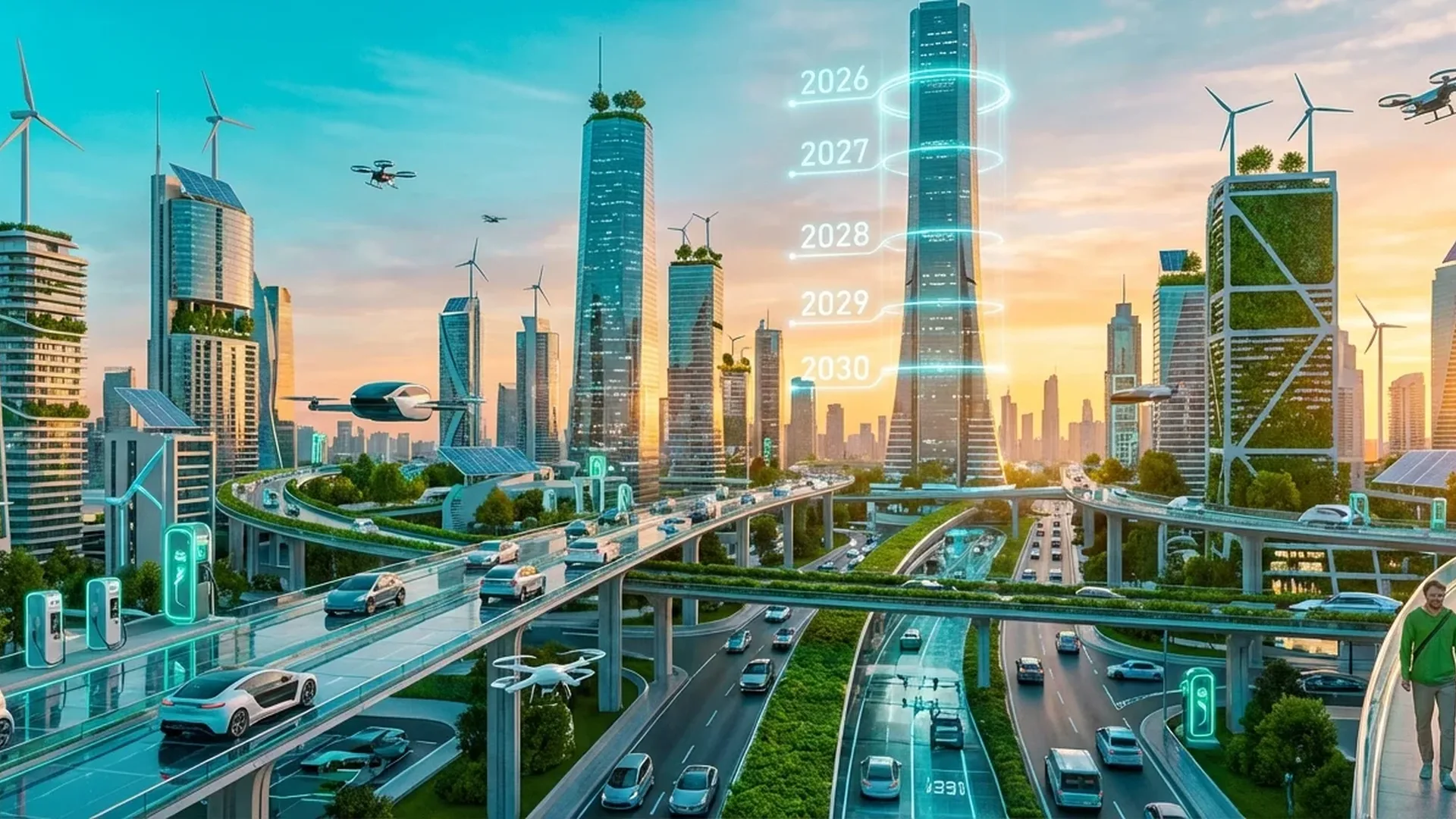
In 2024, global electric vehicle sales surpassed 17 million, capturing over 20% market share. In 2025, they're expected to exceed 20 million. But what happens by 2030? Experts from the IEA, BloombergNEF, and the world's largest automakers are painting a future where solid-state batteries, 600+ mile range, autonomous driving, and prices under $22,000 will no longer be fantasy.
The Market in Numbers: Where We Stand Today
According to the IEA (International Energy Agency), just the additional 3.5 million EVs sold in 2024 compared to 2023 is more than the total number of EVs sold worldwide in 2020. China accounts for nearly 60% of global registrations, with a domestic market share exceeding 35%. In Q1 2025, sales were up 35% year-on-year.
Prediction #1: 50-65% Market Share by 2030
IEA Net Zero Scenario
65%
EV sales share by 2030. Requires 23% average annual growth — current trends (35% Q1 2025) already exceed this.
Manufacturer Targets
42-58%
If all corporate targets materialize: VW 80% Europe, Hyundai 2M/year, Kia 1.6M, Nissan 100% Europe.
Over 20 manufacturers, together representing more than 90% of global car sales, have set electrification targets for 2030. Volkswagen is targeting 80% BEV in Europe, Hyundai 2 million EVs annually, Kia 1.6 million, Nissan 100% BEV sales in Europe. Even Toyota, until recently cautious, accelerated to 20% EV by 2026.
Prediction #2: Solid-State Batteries in Mass Production
Solid-state batteries promise double the energy density, faster charging, greater safety, and less weight compared to current lithium-ion batteries. Their commercialization is expected in the second half of the decade.
Toyota
2027-2028
600+ mile range, 10-minute 0-80% charge. Partnership with Idemitsu.
Samsung SDI
2027
Pilot production of solid-state for premium EVs. Target: 900 Wh/L.
QuantumScape
2026-2027
Lithium-metal solid-state, reliability testing with VW/PowerCo.
Prediction #3: Price Parity or Cheaper Than Gas Cars
The cost of battery cells — the biggest factor in EV pricing — has dropped by 90%+ since 2010. According to BloombergNEF, it's expected to reach $50-60/kWh by 2030, making EVs cheaper to buy even without subsidies.
Battery Cell Price Over Time
2010
$1,100
2015
$381
2020
$137
2024
~$90
2030
$50-60
$/kWh — Source: BloombergNEF
New battery chemistries are helping: LFP (lithium iron phosphate) batteries captured over 40% of the market in 2023, using no cobalt or nickel. Sodium-ion batteries — the first viable lithium-free alternative — could cost 20% less than lithium-ion, ideal for affordable urban EVs.
Prediction #4: 17 Million Public Chargers
Today (2023)
3.9 million
China: 70% of global stock. Europe: 725,000 (+35% in 1 year)
Target 2030 (NZE)
17 million
Requires ~23% annual growth — achievable at current momentum
Battery manufacturing capacity is growing rapidly: in 2023 it reached 2.5 TWh, and according to the IEA, could exceed 9 TWh by 2030 — enough to cover over 90% of Net Zero Scenario needs. Investments in 2022-2023 alone exceeded $275 billion in EVs and $195 billion in batteries.
Prediction #5: Level 3-4 Autonomous Driving Goes Mainstream
EVs are the platform upon which autonomous driving is being built. By 2030, we expect:
Level 3: Eyes Off
Already legal in Germany, Japan, Nevada. Mercedes EQS (DRIVE PILOT), BMW iX. By 2030, expected on highways in many countries — the driver doesn't need to watch the road at low speeds.
Level 4: Robotaxis
Waymo already operates in San Francisco, Phoenix, LA. Tesla Cybercab designed without a steering wheel. Chinese companies (Baidu Apollo, WeRide) in pilot operation. By 2030: commercial operation in 10+ cities worldwide.
Prediction #6: Declining Oil Demand & CO₂ Impact
The EV fleet already displaces 0.9 million barrels of oil per day (2023). Under the IEA's NZE Scenario, this must reach 8.2 million barrels/day by 2030 — practically equivalent to Saudi Arabia's entire current production.
Regulatory Targets for 2030
UK
80%
ZEV sales by 2030
Canada
60%
ZEV by 2030, 100% by 2035
EU
-45%
CO₂ heavy vehicles vs 2019
Europe 2030: A Realistic Outlook
Europe is positioning itself as a leader in the EV transition:
EV Share: Projected to reach 40-50% of new car sales by 2030, driven by EU mandates and cheaper models from multiple brands
Charging Network: AFIR (Alternative Fuels Infrastructure Regulation) requires fast chargers every 60 km on main road networks by 2025-2030
Renewable Energy: Southern Europe's solar surplus is ideal for EV charging. Solar+EV integration can effectively zero out charging costs
Affordability: Access to affordable Chinese EVs (BYD, MG, Leapmotor) under $25,000/£20,000 will democratize electric driving
The Biggest Risks
The transition isn't guaranteed. There are real challenges:
- Geopolitical Tariffs: The EU imposed tariffs up to 45% on Chinese EVs — risk of price increases
- Raw Materials: Lithium, cobalt, and nickel price volatility remains a challenge, though LFP and sodium-ion reduce dependency
- Charging Infrastructure: In rural and remote areas, development is lagging
- Power Grid: EV electricity demand will increase dramatically — smart grids are essential
- Manufacturing Overcapacity: If demand doesn't meet targets, massive battery factory investments could be wasted
Conclusion
Based on the data, 2030 will look radically different on the roads. Predictions point to 50-65% EV share in new sales, solid-state batteries in mass production, prices at parity with gas cars, autonomous taxis in dozens of cities, and charging networks 4x denser. The transition isn't just possible — it's already underway.