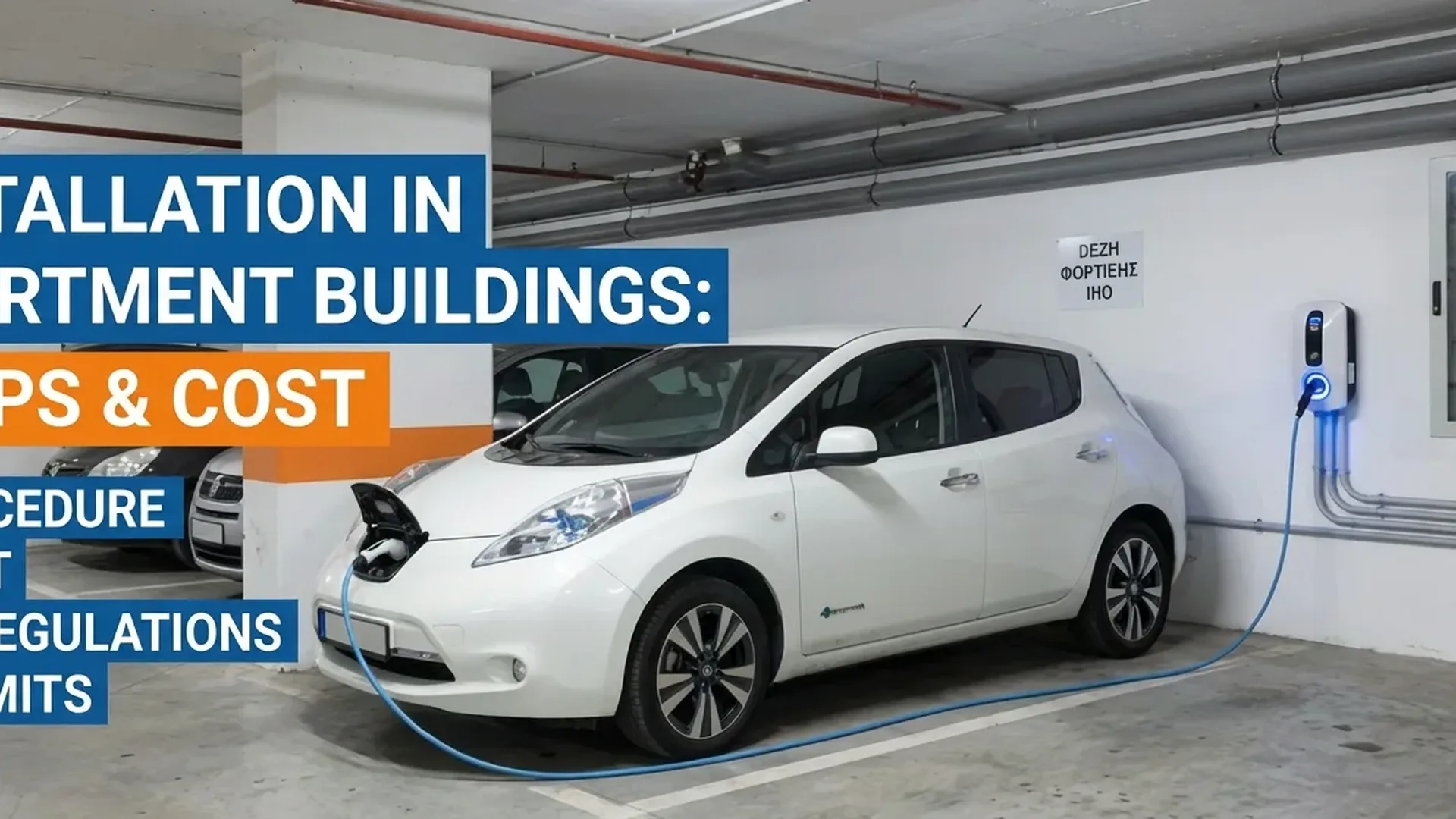
Charging an electric vehicle in an apartment building is one of the most common questions from prospective EV owners in Greece. Law 4710/2020 on electromobility — passed in July 2020 following the announcement of the plan by Prime Minister Kyriakos Mitsotakis — establishes a clear right to install a charger without requiring a unanimous decision from the general assembly. Here is a detailed look at what the law says, the process involved, and how much it costs.
📖 Read more: Solar Panels & EV: Free Home Charging
What Law 4710/2020 Says About Charging in Apartment Buildings
Law 4710/2020 “Promotion of Electromobility” is the main framework law for electromobility in Greece. It was passed in July 2020, following the prime ministerial plan announcement on June 5, 2020, when Kyriakos Mitsotakis stated that "every new building must have EV charging infrastructure" (electrive.com, 2020).
📖 Read more: EV Road Tax 2026: What's Changing in Greece
Key right: Every apartment building owner or tenant has the right to install a charging point at their parking space, without requiring unanimous consent from the co-owners' general assembly.
This regulation marks a significant breakthrough, as previously the installation of electrical infrastructure in common areas required unanimity — a practically insurmountable obstacle. The law aligns with EU Directive 2018/844 (EPBD) which encourages member states to promote e-mobility infrastructure in buildings.
Requirements by Building Type
Installation Process — Step by Step
Notify the Building Manager
Submit a written notification to your building manager about your intention to install a charging point. No approval is needed — only notification. It is recommended to send an extrajudicial letter or an email with proof of receipt.
Electrical Engineer Assessment
A licensed electrician must check the building's available electrical capacity, the condition of the panel, and design the power supply line. If the existing supply is insufficient, a power upgrade from HEDNO (DEDDIE) may be required.
Charger Installation
The electrician installs the wallbox charger at your parking space. The connection is made to your individual meter, so that common charges are not affected. The installation includes grounding, a residual current device (RCD Type B), and a properly sized conductor cable.
Electronic Registration & Subsidy
Register the installation electronically and apply through the "Go Electric 3" (Kinoumei Ilektrika 3) program for a €400 subsidy for the home charger. The application is submitted via the platform kinoumeilektrika3.gov.gr.
Cost of Installing a Charger in an Apartment Building
The total cost depends on the charger type, the distance from the electrical panel, and any upgrades required. Here is an indicative breakdown:
📖 Read more: First EV: 10 Things You Need to Know
Home Charger Types
Schuko Socket (Mode 2)
- Power: 2.3 kW (10A)
- Charge 0-100%: 20-30 hours
- Cost: ~€0 (existing socket)
- ⚠️ Not recommended — overheating risk
Wallbox 7.4 kW (Mode 3)
RECOMMENDED- Power: 7.4 kW (single-phase, 32A)
- Charge 0-100%: 6-8 hours
- Cost: €400-€800
- ✅ Ideal for overnight charging
Wallbox 11 kW (Mode 3)
- Power: 11 kW (three-phase, 16A/phase)
- Charge 0-100%: 3-5 hours
- Cost: €600-€1.200
- Requires three-phase supply
Common Problems & Solutions
Co-owner objections: Despite the legal protection, some residents may object. Remember that you do not need their consent under Law 4710/2020. If necessary, you can invoke the law through a lawyer.
Problem: Insufficient electrical supply
Solution: Apply for a power supply upgrade from HEDNO. Alternatively, install a “smart” charger with dynamic load balancing that automatically adjusts the charging current.
Problem: Long distance from panel to parking
Solution: Use a separate meter/sub-meter near your space. In some cases, a shared backbone cable for multiple charging points significantly reduces overall cost.
Problem: No privately owned parking space
Solution: If you use a shared space, installing a charger requires a general assembly decision. Alternatively, use public charging stations — over 1,700 across Greece (2022).
Problem: Tenant — not owner
Solution: Tenants have the right to install a charger, but they need written consent from the property owner. The cost is borne by the applicant, unless there is a different agreement.
Home Charging Cost vs Public Stations
Tip: Take advantage of the PPC night tariff (02:00-08:00) for home charging. Most wallbox chargers have scheduling features. With the night tariff, 100 km costs just €1.50-€2.00 — up to 90% cheaper than petrol!
Subsidies & Incentives 2026
The Greek government provides generous incentives for electromobility through the "Go Electric 3" (Kinoumei Ilektrika 3) program (kinoumeilektrika3.gov.gr). The incentives started in 2020 with €100 million over 18 months, targeting 25% of the cost of ~14,000 electric vehicles (Wikipedia).
📖 Read more: Ionity vs Tesla Supercharger 2026: Which Network Wins?
Charger Subsidy
For purchase & installation of a home wallbox charger — "Go Electric 3″ program
Vehicle Subsidy
Base subsidy + bonuses (scrappage €1,500, young drivers €500, disabled €1,000, large families €2,000) — up to €8,400
Tax Incentives
Zero road tax, free parking in regulated zones, income tax deduction for charging expenses
New vs Older Buildings — What Changes
New Buildings (after 2020)
- ✅ Mandatory pre-cabling at every parking space
- ✅ Provision for a dedicated EV electrical panel
- ✅ Adequate electrical supply from the start
- ✅ Installation cost: €400-€800 (wallbox only)
- ✅ Compliance with EU Directive EPBD 2018/844
Older Buildings (before 2020)
- ⚠️ No pre-installed infrastructure — new line required
- ⚠️ Possible need for HEDNO power supply upgrade
- ⚠️ Longer cable runs (higher cost)
- ⚠️ Installation cost: €800-€2,700 (wallbox + labor)
- ✅ Installation right guaranteed by Law 4710/2020
Safety Rules & Standards
Mandatory
- Licensed electrician installer
- RCD Type B (30mA residual current device)
- Grounding per ELOT HD 384 standard
- Properly sized conductor (≥6mm²)
- Charger with CE/IEC 61851 certification
Prohibited
- Long-term charging from a standard Schuko socket
- Using an extension cord or power strip
- Connecting to the common building meter
- Installation without a circuit breaker
- DIY installation without a licensed electrician
Conclusion
Law 4710/2020 eliminated the biggest obstacle to EV charging in apartment buildings. At a cost of €400-€2,700 (before subsidy), installing a home wallbox is one of the best investments for an EV owner — overnight home charging costs up to 90% less than petrol and 60-70% less than public DC fast charging. With the "Go Electric 3″ subsidies (€400 for the charger + up to €8,400 for the vehicle), the transition to electromobility has never been more affordable.
Related Articles
PPC Charging Stations 2026
The public charging station network in Greece
EV Subsidy 2026
Complete guide to "Go Electric 3″
Electricity vs Petrol: Cost
Cost-per-kilometer comparison: EV vs ICE
EV Road Tax 2026
Zero road tax, free parking & tax benefits