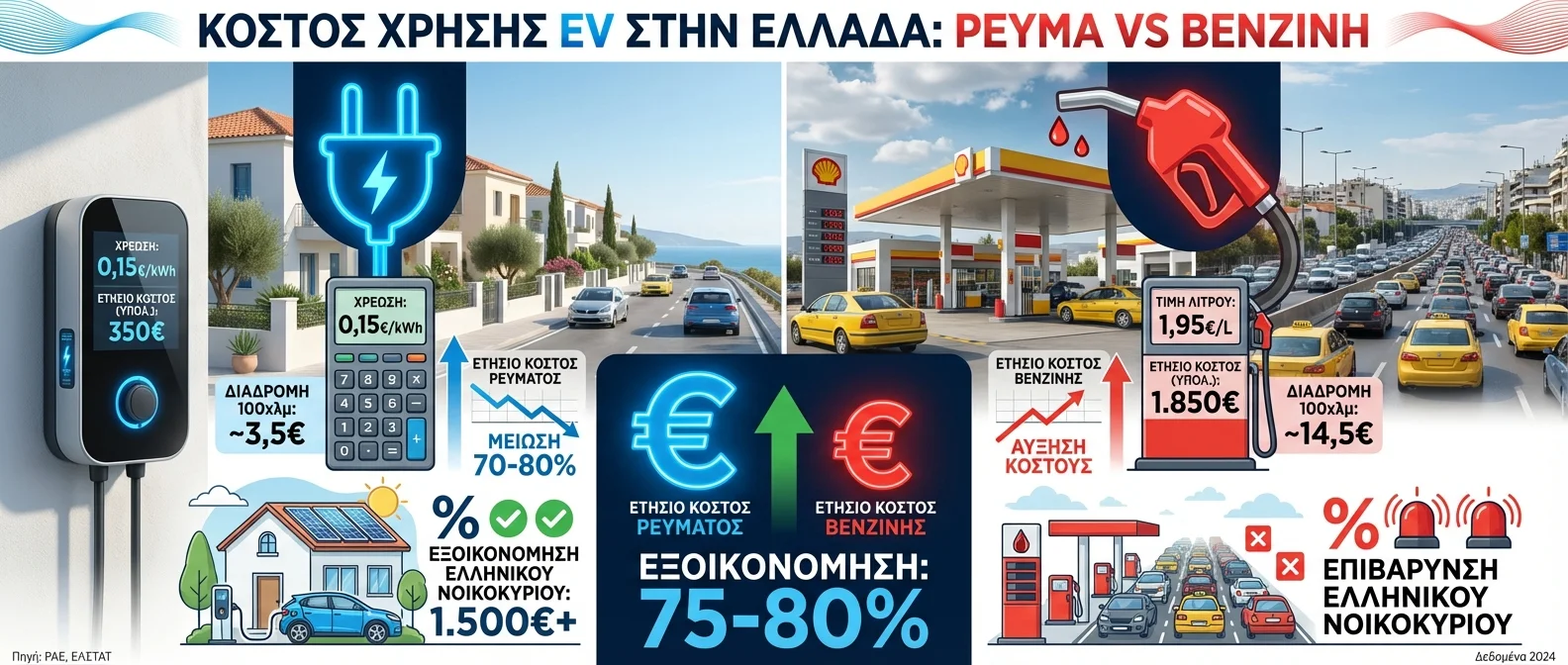
Gasoline in Greece costs €1.72 per liter. Home electricity costs €0.24 per kWh. Those numbers tell a story — but not the complete one. Real EV ownership costs in Greece go far beyond fuel versus electricity. We're talking service intervals, road taxes, insurance premiums, and the total cost of ownership (TCO) that determines whether going electric actually saves money over a decade of driving.
Energy Costs: Electricity vs Gasoline
The math starts simple. Drive 100 kilometers in Greece — how much does the energy cost? According to official data from RAE (Regulatory Authority for Energy) and the Fuel Price Observatory, the numbers are stark.
Residential electricity in Greece costs €0.24/kWh (June 2025 data, RAE/PPC source), while 95-octane gasoline runs €1.72/liter (February 2026, fuelprices.gr). Greece's electricity prices sit at 108.15% of the European average. Gasoline? 148% of the global average. Both are expensive, but one hurts way more than the other.
| Parameter | Electric (BEV) | Gasoline |
|---|---|---|
| Consumption per 100km | 15-18 kWh | 6.5-8.5 liters |
| Energy cost/100km (home charging) | €3.60 - €4.32 | €11.18 - €14.62 |
| Cost per 100km (public charger) | €5.25 - €9.00 | — |
| Annual cost (15,000 km) | €540 - €648 | €1,677 - €2,193 |
| Annual savings | €1,030 - €1,545 | |
How we calculate: A typical EV (Tesla Model 3, VW ID.3) consumes 15-18 kWh/100km. At €0.24/kWh home electricity, that's €3.60-€4.32/100km. A gasoline C-segment car (VW Golf, Toyota Corolla) burns 6.5-8.5 liters/100km. At €1.72/liter, that's €11.18-€14.62/100km. The savings hit 60-70%.
Charging Costs by Location
Charging costs aren't fixed — they depend on where and when you plug in. Home charging remains the cheapest option, especially with time-of-use rates that drop electricity prices during off-peak hours.
Home Charging
- ⚡ Day rate: ~€0.24/kWh
- 🌙 Night rate: ~€0.14-0.18/kWh
- 💰 Cost/100km: €2.10-€4.32
- 📊 Perfect for daily use
- 🔌 Wallbox 7-11kW: €500-€1,500
Public AC (22kW)
- ⚡ Price: €0.35-€0.50/kWh
- ⏱️ Time: 3-6 hours (full)
- 💰 Cost/100km: €5.25-€9.00
- 📍 Shopping centers, parking
- 📊 Still cheaper than gasoline
DC Fast Charging
- ⚡ Price: €0.55-€0.79/kWh
- ⏱️ Time: 20-45 minutes (80%)
- 💰 Cost/100km: €8.25-€14.22
- 📍 Highways, national roads
- ⚠️ Comparable to gasoline costs
Critical point: DC fast charging approaches or exceeds gasoline costs at expensive chargers. Real EV savings come primarily from home charging, which represents 80-90% of total charging for the average EV owner.
Service & Maintenance: The Big Difference
Consumer Reports and BEUC (European Consumer Organisation) data shows EV owners save approximately 50% on maintenance and repair costs. The explanation is mechanical: an electric motor has dramatically fewer moving parts than an internal combustion engine.
| Maintenance Task | Gasoline | Electric |
|---|---|---|
| Oil changes | €80-€150 / 15,000km | Not required |
| Filters (oil, air, fuel) | €50-€120 / annually | Cabin filter only |
| Brake pads | €150-€300 / 30-50,000km | €150-€300 / 80-120,000km * |
| Clutch / transmission | €500-€1,500 (if it breaks) | Doesn't exist |
| Exhaust / catalytic converter | €200-€1,200 | Doesn't exist |
| Timing belt | €300-€600 / 80-120,000km | Doesn't exist |
| Annual service cost | €400-€800 | €100-€250 |
* Brake pads in EVs last 2-3 times longer thanks to regenerative braking — the motor slows the car instead of mechanical brakes.
Road Tax & Government Fees
Greek legislation (Law 4710/2020) provides complete exemption from road tax for pure electric vehicles (BEVs). This creates significant financial advantage, especially compared to high-displacement gasoline cars.
| Category | Gasoline | Electric (BEV) |
|---|---|---|
| Annual road tax | €120-€1,240+ | €0 |
| Registration fee | Based on displacement & emissions | €0 |
| Purchase subsidy | €0 | Up to €8,400 |
| Circulation fee | Standard | Reduced/Exempt |
Example: A 1.4L gasoline car pays ~€240 annual road tax. A 1.8L pays ~€630. Over 10 years, the EV owner saves €2,400-€6,300+ from road tax alone.
Insurance Costs
EV insurance in Greece presents a mixed picture. EVs are considered safer due to lower center of gravity and advanced driver assistance systems. However, higher purchase values and battery replacement costs can increase premiums.
Gasoline C-segment
Comprehensive: €600-€900/year
Basic coverage: €250-€400/year
Electric (equivalent)
Comprehensive: €700-€1,100/year
Basic coverage: €280-€450/year
Overall, EV premiums can be 10-20% higher for comprehensive coverage, but the gap narrows as insurance companies gather more EV data. The 8-year/160,000 km battery warranty significantly reduces risk.
Total Cost of Ownership (TCO) — 10 Years
Consumer Reports and BEUC (European Consumer Organisation) analyses show that in the EU, total cost of ownership (TCO) for recent electric vehicles is lower than equivalent gasoline cars, thanks to lower fuel and maintenance costs.
| Cost Category (10 years / 150,000km) | Gasoline | Electric (BEV) |
|---|---|---|
| Purchase price | €25,000 | €35,000 |
| Government subsidy | €0 | -€8,400 |
| Real purchase cost | €25,000 | €26,600 |
| Fuel/Electricity (150,000km) | €17,200 | €5,400 |
| Service & Maintenance (10 years) | €6,000 | €2,000 |
| Road tax (10 years) | €3,000 | €0 |
| Basic insurance (10 years) | €3,200 | €3,600 |
| TOTAL TCO | €54,400 | €37,600 |
| EV Savings | €16,800 over 10 years | |
Why EVs Are More Efficient
According to the US Department of Energy (DOE), electric motors convert over 77% of electrical energy into motion, while gasoline engines manage just 12-30% (average ~15%). This fundamental difference in energy efficiency explains why EVs need much less energy per kilometer.
Electric Motor
77%+ efficiency → motion
+ Energy recovery during braking (regenerative braking) increases efficiency further
Gasoline Engine
~15% efficiency → motion
~85% lost as heat, friction, noise. Engine needs cooling, lubrication, exhaust
When Does the Investment Pay Off?
Critical question: how many kilometers do you need to drive for the savings to cover the purchase price difference?
Break-Even Calculation
With €8,400 subsidy, real price difference drops to ~€1,600
Annual savings: ~€1,000 (fuel) + €400 (service) + €300 (road tax) = €1,700/year
Result: EV pays for itself within the first year with Greek subsidies!
* Without subsidies, payback takes 5-6 years at 15,000km/year
Greece's Energy Mix
Common question: "if electricity comes from fossil fuels, is an EV really 'cleaner'?" Greece is improving rapidly in this area. According to 2022 data:
Greece targets 82% renewable electricity by 2030, up from the original 66% goal. With 9.6 GW of installed solar capacity by late 2024 (doubled in just 2 years), the country already exceeds 100% renewable generation at peak times. This means the "environmental value" of an EV in Greece improves continuously.
Real-World Usage Scenarios
| Scenario | Gasoline Cost/month | EV Cost/month | Savings |
|---|---|---|---|
| 🏙️ City driving (800km/month) | €96 | €29 | €67/month |
| 🛣️ Mixed driving (1,250km/month) | €150 | €45 | €105/month |
| 🚗 Long distances (2,000km/month) | €240 | €72 | €168/month |
| 💼 Professional use (3,000km/month) | €360 | €108 | €252/month |
Calculation: Gasoline 7L/100km × €1.72. EV 16kWh/100km × €0.24 (home charging).
Battery Cost & Longevity
The battery is the most expensive single component in an EV, but recent data is encouraging. Studies show only 2.5% of EV batteries have been replaced to date. Typical battery warranty covers 8 years or 160,000 km, guaranteeing minimum 70% capacity.
Battery costs
Average pack cost: $115/kWh (2024)
LFP batteries: as low as $56/kWh
Trend: steady price decline — from €605/kWh (2010) to €100 (2019)
Battery longevity
Real lifespan: 15-20 years in the car
Only 2.5% replacements to date
After: second life in energy storage
The Bottom Line
In Greece 2026, an electric car saves €16,000-€17,000 over 10 years compared to an equivalent gasoline car. Savings come from: 60-70% lower energy costs, 50% lower service costs, complete road tax exemption, and purchase subsidies up to €8,400. With home charging, every 100 kilometers costs just €3.60-€4.32 instead of €11-€15 with gasoline. The only requirement: access to home charging, which maximizes the financial benefit.
Related Articles
Electric Car Subsidies 2026
Electric CarsEV Road Tax 2026
Electric CarsEV Insurance in Greece